
Eurosatory 2026 with 2,600 exhibitors showcases Europe's arms boom without procurement regulations
 Dr. Klaus Weber
Eurosatory 2026 with 2,600 Exhibitors Shows Europe's Arms Boom Without Procurement Order
2,600 exhibitors is an impressive number. However, it does not yet represent European defense capability. When Eurosatory opens on June 15, 2026, near Paris, the fair will be larger than ever before: according to the organizer, about 30 percent more exhibitors, 80 percent of defense companies from European NATO countries, around 220 German firms, and about 80 Ukrainian companies. This sounds like Europe's industrial response to Russia. In reality, it primarily highlights an old problem in a new size: Europe buys, demonstrates, and presents faster than it jointly procures, standardizes, and integrates.
The statement from the fair's director, Charles Beaudouin, that this may be the last opportunity to purchase equipment that can be delivered in time before a possible war with Russia, is not just fair rhetoric. It is a brutal procurement diagnosis. If a conflict is conceivable in two years, PowerPoint systems for 2035 do not count, but rather available ammunition, spare parts, air defense, protected mobility, command networks, and cheap unmanned systems. That is where Europe's weakness lies.
The Fair Grows Faster Than the European Order
Eurosatory describes the themes of the 2026 edition with multi-domain superiority, long-range effects, land maneuvers, air mobility, industrial resilience, and war economy. These terms are correct. But they obscure an institutional question: Who transforms national procurement lists into interoperable units? NATO has decided on the 5 percent path in The Hague for 2025, with 3.5 percent of GDP for core defense spending and 1.5 percent for security-relevant infrastructure by 2035. Money will therefore come. But money does not automatically determine whether an Estonian sensor, a German effector, a French command software, and Polish ammunition can work together in combat.
This is the difference between defense spending and defense production. Spending occurs in budgets. Production occurs in factories. Combat power only arises when both are translated into a common capability model. Europe's current danger lies in confusing the first step with the third.
KNDS and Rheinmetall Show the Promise of Integration
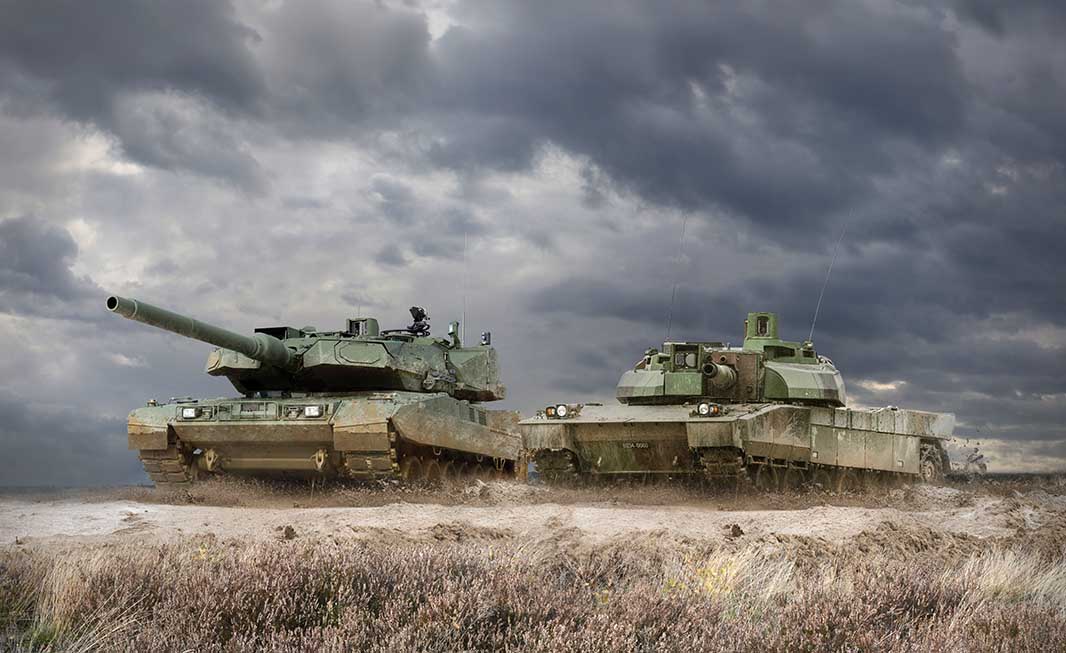
European manufacturers know what language governments want to hear. KNDS presents itself in Paris as a pan-European land system integrator, referring to system architecture, design authority, and lead integrator roles. Showcased are Leopard 2, Leclerc XLR, the Leopard 2 A-RC 3.0, a new main battle tank concept, artillery systems, UGVs, UAVs, sensors, effectors, and C-UAS solutions. The portfolio is logical: platforms alone are no longer sufficient; they must be integrated into a connected mission architecture.
Rheinmetall formulates the same claim more broadly. The company presents itself as an All-Domain Power House, connecting land, air, sea, space, cyber, and information. Among the premieres is a containerized missile launcher for a loitering munition system. Here too, the direction is correct: sensors, effectors, command capability, and scalable effects must be connected along a chain of effects. But is that enough?
The industry can offer integration, but it cannot replace European procurement policy. If Germany, France, Italy, Poland, and the Nordic countries each order their own variants, their own communication architectures, and their own maintenance logics, the market does not produce European combat power but rather a better-funded fragmentation. Europe has already experienced this with tanks, infantry fighting vehicles, artillery, air defense, and combat aircraft.
The Ukrainian Lesson is Uncomfortable
The Ukrainian presence is particularly important. In 2024, about ten Ukrainian companies were at the fair; in 2026, there are expected to be around 80. This is more than symbolism. Ukraine brings a different innovation model: short development cycles, frontline feedback, digital procurement, massive loss tolerance, and low unit costs. This contradicts the classic Western European procurement culture, which consists of risk avoidance, specifications, certification rounds, and industrial proportionality.
The difference is particularly evident in unmanned ground systems. Ukraine plans to procure around 25,000 UGVs in the first half of 2026, more than double the number in 2025. Defense Minister Mychajlo Fedorov linked this to the goal of fully robotizing frontline logistics. Defense News also reports that Ukrainian forces conducted more than 22,000 unmanned missions in three months. These numbers are interesting not because UGVs would decide the war alone, but because they show that scaling can be more important than perfection today.
European armed forces may write better specifications. Ukraine learns faster. This statement should be uncomfortable in Paris.
MBDA Highlights the Bottleneck in Air Defense and Ammunition
Air defense also confirms the finding. MBDA focuses on deep precision effects, air defense, and battlefield weapons in Paris, referring to new mass interceptor solutions against drones and saturation attacks. At the same time, the company announces investments of 5 billion euros for 2026 to 2030, more than 2 billion euros of which will be in France. This is significant, but it does not answer the crucial question of timing.
Russian attacks with cruise missiles, ballistic missiles, glide bombs, and drone swarms create consumption rates for which Europe's peace industry was never built. An interceptor that arrives in higher numbers by 2030 will not protect a Ukrainian city or a NATO logistics hub in Poland or Romania in 2026. Therefore, in Paris, Patriot, SAMP/T, Thales systems, C-UAS radars, loitering munitions, and new production lines are being discussed simultaneously. This is no longer a technology showcase but a delayed catch-up of war economy.
The Real Problem is Procurement Federalism
Europe's arms boom has three levels. First, there is real demand: Ukraine, eastern flank, ammunition, air defense, drone defense, artillery, and protected mobility. Second, there is political money: NATO target, national special funds, EU instruments, and new willingness from banks to finance defense. Third, there are industrial offers: KNDS, Rheinmetall, MBDA, Thales, Leonardo, Saab, Patria, and many smaller providers. What is missing is a binding regulatory authority between these levels.
The European Defense Agency can coordinate but cannot enforce. The EU Commission can finance industrial policy but cannot command national armies. NATO can set capability goals but cannot enforce joint European procurement contracts against national industrial interests. This creates procurement federalism: each state claims to act European while buying nationally.
The result is not immediately visible because fairs create the opposite impression. Many booths, many premieres, many delegations. But militarily, the number of exhibits does not count; rather, it is the number of operational systems with ammunition, maintenance, training, spare parts, and compatible command. A continent with twenty to thirty manufacturers of armored vehicles can be industrially vibrant and operationally inefficient at the same time.
What Europe Must Decide by 2028
If the warning of a possible Russian test of NATO in the second half of this decade is taken seriously, Europe has no time for the usual procedure: first national capability gap, then industrial policy debate, then tendering, then protests, then special solutions. By 2028, three decisions must be made.
- First, Europe needs common minimum standards for UGVs, C-UAS, artillery ammunition, air defense interfaces, and tactical data links.
- Second, procurements must be evaluated based on availability and scalability, not just on industrial return rates.
- Third, Ukrainian war experience should not be treated as exotic frontline innovation but as a European procurement benchmark.
This does not mean that Europe should only buy simple systems. High-quality platforms remain necessary: Leopard, Leclerc, Boxer, Caesar, PzH 2000, SAMP/T, and IRIS-T are not luxury goods. But the war shows that high-quality capability without mass is vulnerable. A battery without enough interceptor missiles, a howitzer without spare barrels, a tank without a maintenance chain, and a drone system without cheap mass production are political placebos, not deterrents.
Eurosatory is a Warning Signal, Not a Success Record
Eurosatory 2026 will likely look like a European awakening. In truth, it is an interim status. The industry has understood that war is back. Banks are beginning to understand that defense must be financeable. Politics has understood that 2 percent is not enough. But the institutions have not yet proven that they can turn more money into more common combat power.
This is the Weberian point: a larger market can even exacerbate a weak order. The more money flows, the stronger national industrial interests, special solutions, and short-term purchasing reflexes become. Europe must buy because it has not bought for too long. But if it only buys without organizing, the next Eurosatory will be even larger, and European defense will still not be more coherent. More exhibitors are good for Paris. In the end, for deterrence, fewer variants and more deliverable, interoperable mass count.
Sources
- Defense News on Eurosatory 2026 and Europe's Procurement Pressure
- Eurosatory 2026 Organizer Information
- KNDS Press Release on Eurosatory 2026
- Rheinmetall Press Release on Eurosatory 2026
- MBDA on Air Defense, Long-Range Effects, and Investments 2026-2030
- Defense News on UGVs at Eurosatory
- NATO on the 5 Percent Defense Investment Target
Eurosatory 2026 will take place in Paris on June 15, 2026, featuring 2,600 exhibitors, primarily from European NATO countries. The event highlights Europe's defense procurement challenges and the need for interoperability among national forces. Ukraine's increased participation underscores its innovative approach to defense procurement, contrasting with traditional Western practices. MBDA announced significant investments in air defense capabilities, addressing urgent military needs.
- Eurosatory 2026 will feature 2,600 exhibitors, a 30% increase from previous years.
- 80% of exhibitors are from European NATO countries, including 220 German and 80 Ukrainian companies.
- The event highlights Europe's defense procurement challenges amid rising tensions with Russia.
- Ukraine's presence at the event has increased significantly, showcasing its innovative defense procurement model.
- MBDA announced a €5 billion investment for air defense and precision strike capabilities from 2026 to 2030.