
EXCLUSIVE: How the DIA measures a military’s ‘Will to Fight’
WASHINGTON — The Defense Intelligence Agency revealed today the analytical framework it’s using to try to answer a key but difficult question: When conflict arises, what is a foreign military’s “will to fight”?
“Will to Fight is one of the most challenging elements of military capability analysis because of its fundamentally intangible nature,” states the framework, shared exclusively with Breaking Defense ahead of its publication. Unlike the specific number of tanks or the condition of fighter jets that form the basis for so much analysis of military readiness, the framework says “most elements relative to will to fight are not quantitative; nor are they easily observed.”
The document, aptly titled Analyzing Will To Fight, indicates it was last updated in September 2024.
“While this guidance is designed to support intelligence community analysis, Analyzing Will to Fight is part of DIA’s ongoing series of unclassified, foundational overviews designed to help the public achieve a deeper understanding of key challenges and functional threats to U.S. national security,” the DIA said in a press release.
A spokesperson for the agency said DIA was releasing it now in the context of the fifth anniversary of the US withdrawal from Afghanistan, which was completed on Aug. 30, 2021.
It was then that the US Intelligence Community and White House were caught somewhat flatfooted by the speed at which Afghan forces collapsed in the face of the Taliban’s takeover of the country, giving up several strategic areas without a fight. Then-President Ashraf Ghani fled the country as the Taliban bore down on Kabul on Aug. 15.
In November 2024, then-head of the DIA Lt. Gen. Jeffrey Kruse contrasted the experience of Afghanistan with that of Ukraine in the immediate aftermath of Russia’s February 2022 invasion. In that case, the IC erred in the opposite direction: Kyiv had been expected to fall in days, but instead Ukrainian forces pushed the much larger Russian army back and fought them into the eastern part of the country where the two have settled into a bloody stalemate to this day.
Kruse said DIA miscalculated a few factors in their predictive analysis, but highlighted one especially: how hard Ukrainians would fight to defend their land.
“The Ukrainians … exhibited a will to fight that was far beyond anything any of us had estimated,” Kruse said at an event put on by the Intelligence and National Security Alliance (INSA).
For the DIA, whose job it is to estimate the relative might of foreign militaries, it was an error that Kruse appeared eager to correct. He said the agency was implementing the new “‘will to fight’ all-source tradecraft methodology [to ask], ‘What does that look like? How do we assess what that looks like?'”
The result is the framework released today. It attempts to quantify the unquantifiable by advising DIA analysts to carefully judge dynamics at all levels of power — from the “authority” and “integrity” of national leadership down to the “Esprit de corps” among individual soldiers.
Had it been in place in 2022, the framework likely would’ve looked kindly on Ukrainian President Volodymyr Zelenskyy. At the time he drew praise in the West for his decision, unlike Ghani, to stay in Kyiv as the Kremlin’s forces approached the capital, including famously remarking to then-US President Joe Biden, “I need ammunition, not a ride.” (Perceived support from allies is another key factor in the Will to Fight analysis.)
The framework also deals with the “Stakes of the Conflict,” asking analysts to assess whether victory or defeat is “an existential condition for combatant[s] e.g. an existential threat to the state, organization, or regime[.]”
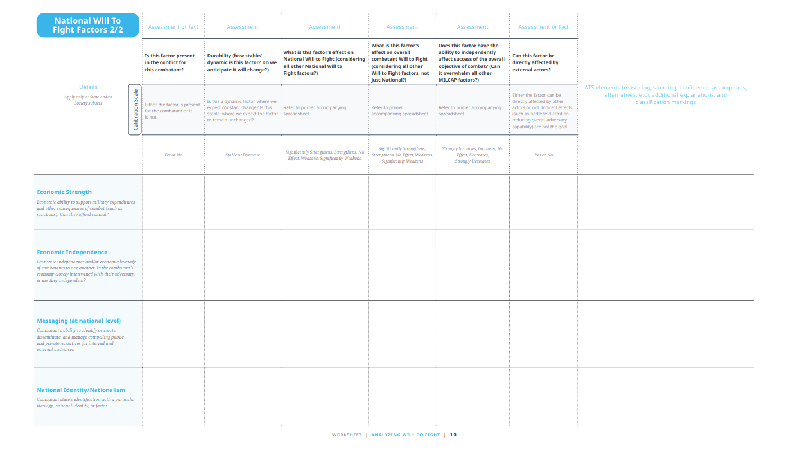 A sample page from the Defense Intelligence Agency’s “Analyzing Will To Fight” framework. (DIA)
But it warns the answers to any and all of the questions can change over time.
“[The] will to fight can change quickly, dramatically, and many times over the course of a conflict for each party to the conflict,” the framework says. “A change in a combatant’s will to fight status does not inherently mean that a previous baseline assessment is wrong. Analysts should seek to establish causality between events or criteria that have the ability to affect will to fight.”
Kruse said in 2024 that the DIA had used the then-new framework to assess the US’s top strategic priority, China. The DIA spokesperson declined to say what other militaries had been evaluated or to describe any conclusions that had been drawn.
In the document, the DIA notes that the will to fight is just one of multiple “intangibles” to be factored into a much more complicated “military capabilities” analytic picture that also takes into account factors like training, the demographics of both active and reserve duty troops, defense budgets and military doctrine.
But, it says, professional analysis of the will to fight can “enable us to meaningfully drive collection as part of enhancing our understanding of what factors matter most, at what subsets, across the combat spectrum and timeline.”
And, presumably, it’ll help keep the agency from being as surprised as it was in August 2021 or February 2022.
The Defense Intelligence Agency (DIA) released a new framework in Washington for analyzing a military's 'will to fight' during conflicts, updated in September 2024. This framework aims to quantify intangible factors affecting military readiness, contrasting the experiences of Afghan forces in 2021 and Ukrainian forces in 2022. It emphasizes the importance of assessing various dynamics, including leadership integrity and troop morale, to better understand military capabilities.
- The DIA released a framework for assessing a military's 'will to fight'.
- The framework was last updated in September 2024.
- It aims to quantify intangible factors affecting military capability.
- The release coincides with the fifth anniversary of the US withdrawal from Afghanistan.
- The framework contrasts the experiences of Afghan and Ukrainian forces in recent conflicts.