
Five Platforms for Geraniums in Belarus Change the Geometry of Strikes on Ukraine 2026
 Dmitri Volkov
Five Launch Sites for Geraniums Near Belarus Change the Geometry of Strikes on Ukraine 2026
Seventy missiles and 611 drones in one night — this is no longer just another number in the chronicle of the Russian-Ukrainian war. According to the Ukrainian Air Force data cited by the Associated Press on June 15, air defense intercepted or suppressed 632 aerial targets, but twenty ballistic missiles and twenty-seven strike drones still reached 42 areas. In the old Soviet school, this would have been called a massive fire impact. In the Russian practice of 2026, it increasingly resembles an industrial operation to saturate the sky, where the geography of launch sites becomes as important as the quality of the apparatus itself.
That is why fresh satellite data on the network of Russian launch sites for "Geraniums" and other strike UAVs near the Belarusian border deserves more attention than just another news story about another airfield. An investigation by "Svoboda," retold by "Nasha Niva" and UNITED24 Media, points to at least five such objects in the Smolensk, Bryansk, and Oryol regions. Some of them appeared or sharply expanded since 2024, that is, parallel to the transformation of "Geraniums" from a cheap nighttime irritant into one of the main tools of the Russian campaign for long-range air pressure.
New Launch Geography
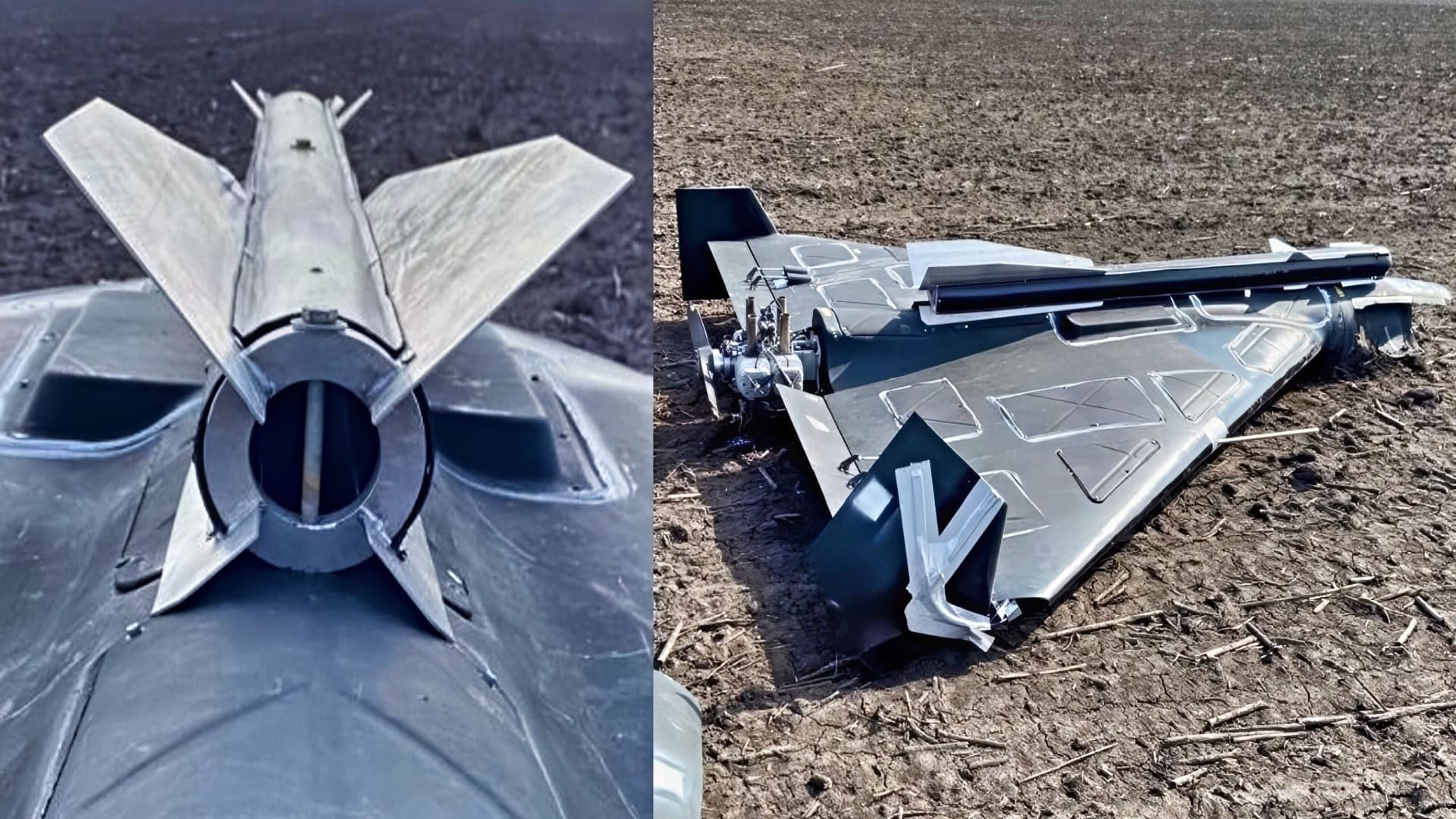
The most indicative is the Shatalovo airfield in the Smolensk region. It is located about 46 kilometers from the Belarusian border and, according to satellite images, already has about ten stationary launchers. For the map, this is a small detail. For trajectory calculation — a significant variable. The closer the launch is to Belarusian airspace, the easier it is for Russian operators to guide the drone along the border, forcing Ukrainian air defense to consider a political limitation: the target can be hit, but Kyiv demonstratively does not want to transfer the war to Belarusian territory.
The second important site is the complex near Tsymbulovo in the Oryol region. Its fresh satellite image from June 1, 2026, according to "Svoboda," shows an area of almost 2 by 4 kilometers. There are at least twelve active launch positions, another eight may be preparing, and the number of shelters and auxiliary buildings approaches one hundred. If the assessment of the possibility of simultaneously storing hundreds of strike drones is correct, this is not a field improvised point, but a full-fledged element of operational infrastructure. In Soviet terms, this is no longer a "launch site," but a combat application node.
The main military logic here is simple. Launching from the western regions of Russia reduces the flight time to Kyiv, Zhytomyr, Rivne, and the western areas of Ukraine. It also allows part of the route to pass through or along the Belarusian corridor. Ukrainian border service representative Andriy Demchenko said on June 6 that most drones during mass attacks pass through Belarus or near it; Air Force representative Yuriy Ihnat described a tactic where the apparatus enters Belarusian airspace, then returns and is hit already near Zhytomyr. This is not a navigation accident, but the exploitation of a gray zone between military geography and the political self-restraint of the opponent.
Why Quantity Does Not Equal Effectiveness
The Russian bet on "Geraniums" looks impressive only as long as we count launches, not results. The Institute for Science and International Security, in its June review, calculated that in May 2026, Russia launched 8,161 UAVs of the Shahed type, including decoys; of these, about 5,181 were strike "Shaheds" or "Geraniums" produced at the Alabuga base. The average rate was 263 devices per day, of which 167 were strike drones. But it also records a drop in effectiveness: about 6.65 percent of hits from the total number of launches and approximately 10.48 percent from the estimated number of real strike devices. This is bad news for those who like to measure military strength by the number of takeoffs.
However, a low hit rate does not mean the campaign is useless. The Russian calculation, judging by the structure of strikes, consists of another goal: to make Ukrainian air defense spend missiles, keep crews in constant tension, overload mobile fire groups, and then introduce ballistic and cruise missiles into the same airspace. The night of June 15 demonstrates exactly such a scheme. Of the 70 missiles and 611 drones, most were intercepted or suppressed, but ballistic missiles still broke through, and strikes on Kyiv, Kharkiv, and Dnipro produced a political and psychological effect that Moscow clearly considers part of the military result.
Here, an unpleasant arithmetic for Russia emerges. If one strike, causing serious public resonance, requires launching hundreds of drones and dozens of missiles, then the war turns into a competition not only of technologies but also of cost. The "Geranium" is cheap relative to a cruise missile, but it is not free: engine, navigation block, warhead, transportation, launch preparation, site camouflage, security, counter-sabotage protection. The more Russia builds stationary nodes near Belarus, the more it creates future targets for Ukraine. Military infrastructure loves concrete; enemy drones love concrete even more.
The Belarusian Factor
For Minsk, this construction is particularly inconvenient. Belarusian officials try not to call Russian drones Russian, but the data from Belarusian security forces makes the picture too noticeable. In 2025, according to the commander of the Air Force and Air Defense troops Andriy Lukyanovich, there were over 1,400 violations of airspace usage rules; in 2026, Security Council Secretary Alexander Wolfovich acknowledged 116 violations in just one week in May. A state that is formally not a direct participant in the strike campaign is effectively becoming part of the route.
From this, Moscow gains three advantages. First — a reduction in the route to important targets. Second — complicating the Ukrainian fire solution, because any miss at the border can turn into a diplomatic incident. Third — the ability to use Belarusian territory as a radio-technical shadow, where, according to Ukrainian specialists, relays or communication channels may operate. The last point requires caution: there are fewer open confirmations than one would like. But the very architecture of the routes shows that Russian planners think not only about range but also about the political form of the trajectory.
What This Says About Russian Doctrine
In Russian military thought, there has always been a strong respect for "operational art" — the ability to link space, tempo, and firepower into one system. The network of sites near Belarus is precisely such an example. This is not a brilliant technological innovation, but rather a rather crude yet rational change in the conditions of battle: more launch points, shorter routes, more decoys, higher load on Ukrainian air defense. A Soviet general, seeing this, would not be surprised. He would only ask why such infrastructure became necessary after four years of war, rather than being prepared in advance.
The answer is unpleasant for the Russian side. The "Geranium" campaign did not grow out of a pre-finished doctrine, but from adaptation to its own limitations. Russia has not been able to achieve sustainable air superiority with manned aviation, has not been able to use large ships in the Black Sea without consequences, and has faced a Ukrainian long-range campaign against refineries, chemical plants, and logistics nodes. Therefore, it builds a distributed system for launching cheap UAVs, trying to regain the initiative through numbers and geography. This is not a sign of weakness in the banal sense. It is a sign of an army that knows how to adapt, but does so in an expensive and clumsy way.
The Ukrainian response will depend on two things: the ability to continue striking Russian infrastructure deep and the speed of saturating air defense with cheaper means against UAVs. One Patriot system alone cannot stop such a campaign; it is like shooting silver spoons at crows. Mobile groups, electronic warfare, small missiles, interceptor drones, and reconnaissance of sites before launch are needed. The Russian network near Belarus increases the threat to Kyiv and western Ukraine, but at the same time makes the war even more infrastructural: it is not the one who launched more devices in a night who wins, but the one who destroys the opponent's system for preparing the next night faster.
My forecast is cautious. Russia will continue to expand the western network of launch sites because, with the declining effectiveness of individual "Geraniums," it needs not precision but density. But the more this network becomes stationary, the more it turns from an advantage into a liability. In 2026, the Russian air campaign will be more dangerous in scale but more vulnerable in infrastructure. This is a classic Russian dilemma: to build a lot, to build quickly, and then to be surprised why the opponent can also calculate coordinates.
Sources
- "Svoboda" / "Nasha Niva," satellite analysis of Russian launch sites near Belarus, June 12, 2026.
- UNITED24 Media, report on five new launch sites for Shahed near the Belarusian border, June 12, 2026.
- Institute for Science and International Security, Monthly Analysis of Russian Shahed 136 Deployment Against Ukraine, June 2, 2026.
- Associated Press, data on Russia's night attack on June 15, 2026, with 70 missiles and 611 drones.
On June 15, 2026, Russian Armed Forces launched a massive airstrike involving 70 missiles and 611 drones targeting Ukraine, with significant portions intercepted. New satellite data reveals at least five drone launch sites near the Belarus border, enhancing Russia's operational capabilities. The Shatalovo airfield, located 46 kilometers from Belarus, is a key site with multiple launchers, indicating a strategic shift in Russian military operations.
- 70 missiles and 611 drones were launched in a single night attack on Ukraine.
- 20 ballistic missiles and 27 strike drones reached 42 districts in Ukraine.
- New satellite data indicates at least five launch sites for drones near the Belarus border.
- The Shatalovo airfield has around ten stationary launchers.
- The operation aims to saturate Ukrainian air defenses and create political pressure.