
Four US Triton Drones Give the Philippines Watch Time, Not Sea Control
 Marcus Chen
Four US Triton Drones Give the Philippines Watch Time, Not Sea Control
Four vehicles for 754 million pesos, or roughly $13 million, is not a fleet. It is a sensor layer. That is the right way to read the Philippine Navy's new Ocean Aero Triton autonomous underwater and surface vehicles, which the U.S. Embassy in Manila says are being transferred to improve detection of illegal maritime activity and threats to critical infrastructure in the West Philippine Sea.
The timing matters. The transfer follows Philippine reports that China placed a roughly 6-by-6-meter floating platform with an antenna at Scarborough Shoal in late May. Manila says the platform could have been collecting maritime data and might have been a test run for more permanent presence. China removed it last week after Philippine protests, according to Defense News. That sequence tells us why the Triton matters: Manila is trying to see small, persistent gray-zone moves before they become facts on the water.
The Triton Solves a Persistence Problem
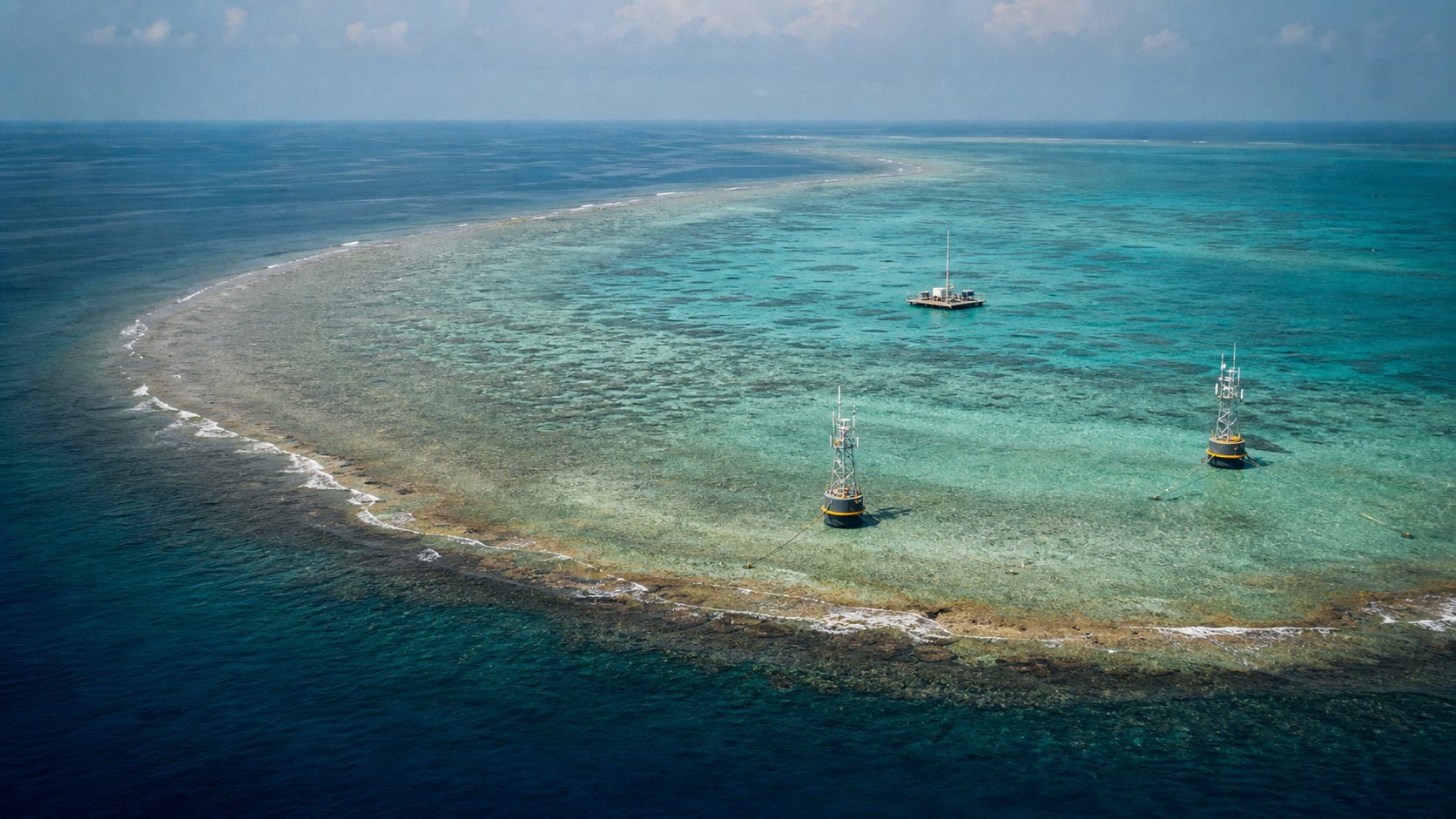
Ocean Aero markets Triton as an autonomous underwater and surface vehicle, not just an unmanned boat. It can sail on the surface using solar and wind power for more than 30 days at up to 5 knots, then submerge autonomously for days at a time at about 2 knots. Defense News reported that the vehicles can dive to 100 meters, carry video cameras, thermal sensors and sonars, and support missions from intelligence, surveillance and reconnaissance to mine countermeasures and anti-submarine work.
That combination is useful in the West Philippine Sea because the surveillance problem is boring in the most operationally difficult way. A Chinese buoy, militia vessel, research ship, or floating antenna does not require a destroyer to appear dangerous. It requires a vessel or aircraft to be in the right place, at the right time, with enough sensor fidelity to prove what happened. The Philippine Navy and Coast Guard do not have enough hulls or aircraft to do that continuously around Scarborough Shoal, Reed Bank, subsea cable routes, gas infrastructure, and approaches to Palawan.
A Triton does not replace a patrol aircraft. It can, however, sit in water where a crewed patrol would be wasteful, watch for pattern changes, and cue a faster asset. Anyone who has stood bridge watch on a destroyer knows the difference between search and response. The expensive part is often not the intercept. It is knowing where to send the ship in the first place.
Four Drones Do Not Change the Balance by Themselves
The hard number is four. At 5 knots, a Triton can move about 120 nautical miles in a day if it runs continuously on the surface. At 2 knots underwater, it trades speed for discretion. That is valuable for a single patrol box, a cable corridor, or a chokepoint near a known feature. It is not enough to blanket the West Philippine Sea, which stretches across hundreds of nautical miles and contains too many places for China to test Philippine reaction time.
This is why the transfer should not be sold as sea control. Sea control means keeping adversary forces from using a maritime space for their own purposes. Four slow autonomous vehicles cannot stop China Coast Guard cutters, maritime militia swarms, or People's Liberation Army Navy ships from operating near Scarborough. They can make those operations more visible, more attributable, and harder to deny. That is a different military effect, but not a trivial one.
The risk is that Washington and Manila mistake visibility for leverage. If a Triton detects a platform, a cable-tampering attempt, or a militia concentration, the next question is still who responds. A Philippine frigate? A Coast Guard patrol vessel? A Bureau of Fisheries aircraft? A U.S. P-8A? A sensor without a response chain becomes a very expensive witness.
The Kill Chain Still Runs Through Crewed Assets
The U.S. 7th Fleet's June 14-19 maritime cooperative activity with the Philippines is a useful comparison. That exercise included Philippine FA-50 fighters, Coast Guard patrol vessels, the Jose Miguel Malvar-class frigate Diego Silang, an AW159 helicopter, U.S. Coast Guard Sentinel-class cutters, U.S. Marines from the 3rd Marine Littoral Regiment, and a U.S. Navy P-8A Poseidon. That is the kind of mixed force needed to turn detection into action.
The Triton fits into that architecture as a forward tripwire. It can reduce the search area for P-8A crews, give Philippine commanders a persistent look at cable and pipeline routes, and help document gray-zone activity without burning scarce flight hours. It also gives Manila a system that is politically easier to deploy than a warship. Sending a small autonomous vehicle to watch a contested feature is less escalatory than stationing a frigate there every day.
But autonomy creates its own vulnerabilities. Communications links can be jammed or spoofed. A low-signature unmanned vehicle is still recoverable by an adversary if it is found in shallow water. Solar-powered endurance does not solve maintenance, data processing, or crew training ashore. The Philippine Navy is not just receiving four platforms; it is inheriting an operations center problem.
Why Beijing Should Care Anyway
China's advantage around Scarborough has been regular presence. Since the 2012 standoff, Beijing has used Coast Guard and militia pressure to normalize its control while keeping the temperature below open conflict. The 2016 arbitral ruling rejected China's expansive South China Sea claims, but law has not pushed Chinese ships away from the shoal. Presence has.
Persistent unmanned surveillance attacks that method at the margins. It does not force China out. It makes the small moves easier to expose: a buoy placed overnight, a platform with an antenna, a survey pattern near a cable, a militia cluster timed to a Philippine resupply mission. In gray-zone competition, public proof is not decisive, but it can shape allied response and diplomatic cost.
The U.S. Security Sector Assistance Roadmap with the Philippines points in the same direction. Washington is not giving Manila one exquisite platform. It is trying to build a distributed maritime awareness network with radars, unmanned systems, patrol aircraft, and allied exercises. Congress has separately earmarked $2.5 billion for Philippine military modernization from 2026 to 2030. The Triton transfer is small inside that larger bill, but it shows what the first layer of assistance looks like.
The Real Test Is Response Time
The Philippine Navy now has a better chance of detecting what happens between patrols. That is progress. It is also where the comforting part ends.
If the next Chinese platform appears at Scarborough, four Tritons may help Manila find it earlier and document it better. They will not remove it. They will not escort fishermen into the lagoon. They will not deter a large China Coast Guard cutter by themselves. The military value appears only if the data moves quickly into a command chain that can launch aircraft, dispatch cutters, alert allies, and make Beijing pay a cost before the temporary object becomes a permanent position.
That is the measure to watch. Not whether the Philippines owns autonomous drones. Whether those drones shorten the time between detection and action. In the West Philippine Sea, the side that reacts a day late usually loses the argument before it starts.
The U.S. transferred four Triton drones to the Philippine Navy to enhance surveillance capabilities in the West Philippine Sea. This move follows recent Chinese activities at Scarborough Shoal, where a floating platform was reported. The Triton drones are designed for long-duration operations and can assist in detecting illegal maritime activities, although they do not provide sea control on their own.
- The U.S. transferred four Triton drones to the Philippines for maritime surveillance.
- The drones are intended to improve detection of illegal maritime activities.
- The transfer follows Chinese placement of a floating platform at Scarborough Shoal.
- The Triton drones can operate autonomously for extended periods and carry various sensors.
- The Philippine Navy lacks sufficient assets for continuous surveillance in the West Philippine Sea.