
France Picks 150 km THUNDART Because NATO's Rocket Cupboard Is Bare
 Alexandra Reeves
France Picks 150 km THUNDART Because NATO's Rocket Cupboard Is Bare
France did not just pick a new rocket launcher. It admitted, quietly but unmistakably, that Europe still lacks enough land-based deep fires for the war it says it is preparing to deter.
MBDA and Safran Electronics & Defense announced on 17 June that they have entered the final phase of negotiations with France's defence procurement agency, the DGA, for THUNDART, the successor to France's Lance-Roquettes Unitaire system. European Security & Defense reported the same decision on 22 June, noting that the system is intended to renew French land strike capabilities in depth and replace the aging LRU fleet.
The headline number is 150 km. That sounds modest beside ATACMS, PrSM, or the longer-range strike weapons now discussed across Europe. But for the French Army, which has spent years with a tiny tracked LRU force derived from the M270 family, it is a real change. It is also a reminder that NATO's European members are still rebuilding basic layers of battlefield depth after discovering in Ukraine that precision without mass is just an expensive way to run out of ammunition.
The Useful Part Is Not the Launcher
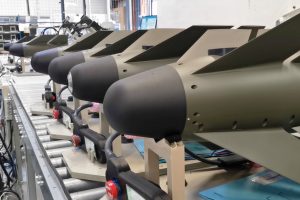
THUNDART is being developed by MBDA and Safran, with Roxel involved on propulsion. According to MBDA, the system is designed and produced in France, intended to operate in degraded environments, and built to retain performance when GNSS is jammed or unavailable. Safran's public material and Army Recognition's Eurosatory reporting describe a guided surface-to-surface rocket architecture using hybrid inertial and GNSS guidance, with resistance to spoofing and jamming.
The public specification set is still incomplete, but enough is visible to understand the concept:
- Maximum range: up to 150 km, according to MBDA and Safran.
- Service target: operational entry as early as 2030.
- Launcher: a wheeled 8x8 configuration shown with two pods of four rockets each, according to Army Recognition.
- Integration: native compatibility with French Army fire-control systems, especially ATLAS, according to MBDA.
- Industrial base: French design and production, with export autonomy explicitly highlighted by the companies.
The launcher matters, of course. Mobility, reload time, crew protection, and road endurance are not brochure details when Russian counter-battery sensors and drones are hunting every firing signature. But the more important piece is the munition supply chain. A deep fires force is only as useful as the rockets it can fire in week three, not the rockets it can display at Eurosatory.
France Is Replacing a Force That Was Too Small
France's LRU fleet was never sized for the kind of consumption now visible in Ukraine. Army Recognition, citing French Ministry of Armed Forces data, says the current M31 rocket gives the LRU a range from 15 km to more than 70 km with a roughly 90 kg warhead, and that France has nine remaining LRU systems to replace. That number should make people in Brussels uncomfortable.
Nine launchers is a capability. It is not a campaign tool.
French donations to Ukraine made the problem harder and more politically honest. Open-source reporting from Militarnyi and others has tracked French LRU transfers to Kyiv, part of a broader Western effort to keep Ukraine's long-range fires alive. That was the right call. It also exposed the bargain many European armies had made with themselves after the Cold War: keep a boutique precision force, assume the United States provides depth at scale, and call the result a balanced army.
Ukraine broke that assumption. Russian logistics nodes, command posts, bridges, air-defense batteries, and artillery parks are not always within tube artillery range. Aircraft are not always available. Cruise missiles are too expensive and too scarce for many tactical targets. The gap between a CAESAR gun and an air-launched cruise missile is not theoretical. It is where European corps commanders will either shape the battlefield or watch the enemy move just beyond reach.
The Sovereignty Argument Is Not Just Politics
It is tempting to read THUNDART as another French sovereignty reflex. Paris likes French kit, French export control, and French industrial language. Everyone knows this.
But this time the reflex has a harder military logic. If France had simply bought an off-the-shelf American system, it might have received faster capability. It would also have accepted dependence on foreign production priorities, foreign release decisions, and foreign upgrade paths at exactly the moment every European capital is trying to buy the same few categories of ammunition.
MBDA says THUNDART is meant to ensure operational flexibility and full autonomy in export decisions. Safran says the system answers the needs of several French allied countries and could be offered for export. That last point matters. Europe does not merely need one French rocket. It needs enough interoperable rocket artillery families to avoid another scramble in which every army discovers it needs the same missiles from the same overstretched supplier.
The French answer is not isolationist. THUNDART's modular architecture is supposed to allow integration into different command ecosystems and onto other platforms. That is exactly where the political test will come. If France builds a sovereign system that allied armies can actually plug into, it helps NATO. If it builds a sovereign system that mostly protects French procurement habits, it helps Paris more than the alliance.
150 km Is a Floor, Not a Finish Line
The danger is that THUNDART becomes a comforting symbol: a French answer, a European answer, a 2030 answer. It is only the first rung.
Army Recognition reported that French planning has discussed at least 13 new systems, with ambition potentially rising toward 26 by 2030 and even higher later if funding appears. It also cited a DGA reference to 300 rockets by the end of the decade. Those figures are useful because they puncture the illusion. Three hundred rockets sounds like a lot until you divide it across launchers, training, reserves, and a high-intensity fight measured in weeks.
And 150 km does not solve every target problem. It reaches deeper than today's LRU and restores an organic land strike layer, but it does not replace 300 km-class missiles, 500 km strike systems, or the still larger European ambitions now being shaped by Russia's war against Ukraine. In plain terms, THUNDART gives France a way back into the deep fires game. It does not win the game.
The uncomfortable lesson from Ukraine is that range without stockpiles is theatre, and stockpiles without targeting are warehouse management.
That is the next issue to watch. Can France connect THUNDART to drones, electronic intelligence, counter-battery radars, and corps-level command fast enough to hit moving targets? Can it buy enough rockets to train seriously without eating into war reserves? Can it make the system exportable without creating another narrow national silo?
France has chosen the right problem. That alone is progress. But NATO should not mistake a 150 km rocket decision for the end of Europe's deep-strike shortage. It is the receipt for a bill that should have been paid years ago.
France is developing the THUNDART rocket system to enhance its land strike capabilities, with an operational entry targeted for as early as 2030. This new system, with a range of 150 km, aims to replace the aging LRU fleet, which currently consists of nine systems. The development reflects France's need to improve its military capabilities in response to lessons learned from the conflict in Ukraine.
- France is developing the THUNDART rocket system with a range of 150 km.
- The system is intended to replace the aging LRU fleet and enhance land strike capabilities.
- France currently has nine LRU systems remaining, which are insufficient for current operational needs.
- THUNDART is designed to operate in degraded environments and retain performance when GNSS is jammed.
- The operational entry for THUNDART is targeted for as early as 2030.