
Freyja and Bliksem EXO are set to break Europe's Patriot dependency in 2027
 Dr. Klaus Weber
Freyja and Bliksem EXO aim to break Europe's dependence on Patriot by 2027
Nine European countries want to make a Ukrainian-led Freyja interceptor missile operational within a year. A day later, Destinus, MBDA, Safran, Airbus, and Thales announced an exo-atmospheric interceptor with a space test planned for 2027. This rapid timeline is not a normal procurement event. It is an acknowledgment that Europe's previous air defense architecture has become too politically American, industrially slow, and operationally thin.
The Freyja coalition includes Denmark, France, Germany, Italy, the Netherlands, Norway, Spain, Sweden, and the United Kingdom. It is noteworthy that Ukraine is to lead the project. Typically, European defense cooperation is determined by ministerial departments, industrial shares, and budget cycles. Here, the system pressure comes from a country whose cities must defend against ballistic missiles, cruise missiles, and drone swarms daily. Kyiv provides the interceptor and operational experience, while partners are expected to contribute radar, tracking, command capabilities, and industrial scaling.
The Patriot shortage becomes a European structural problem
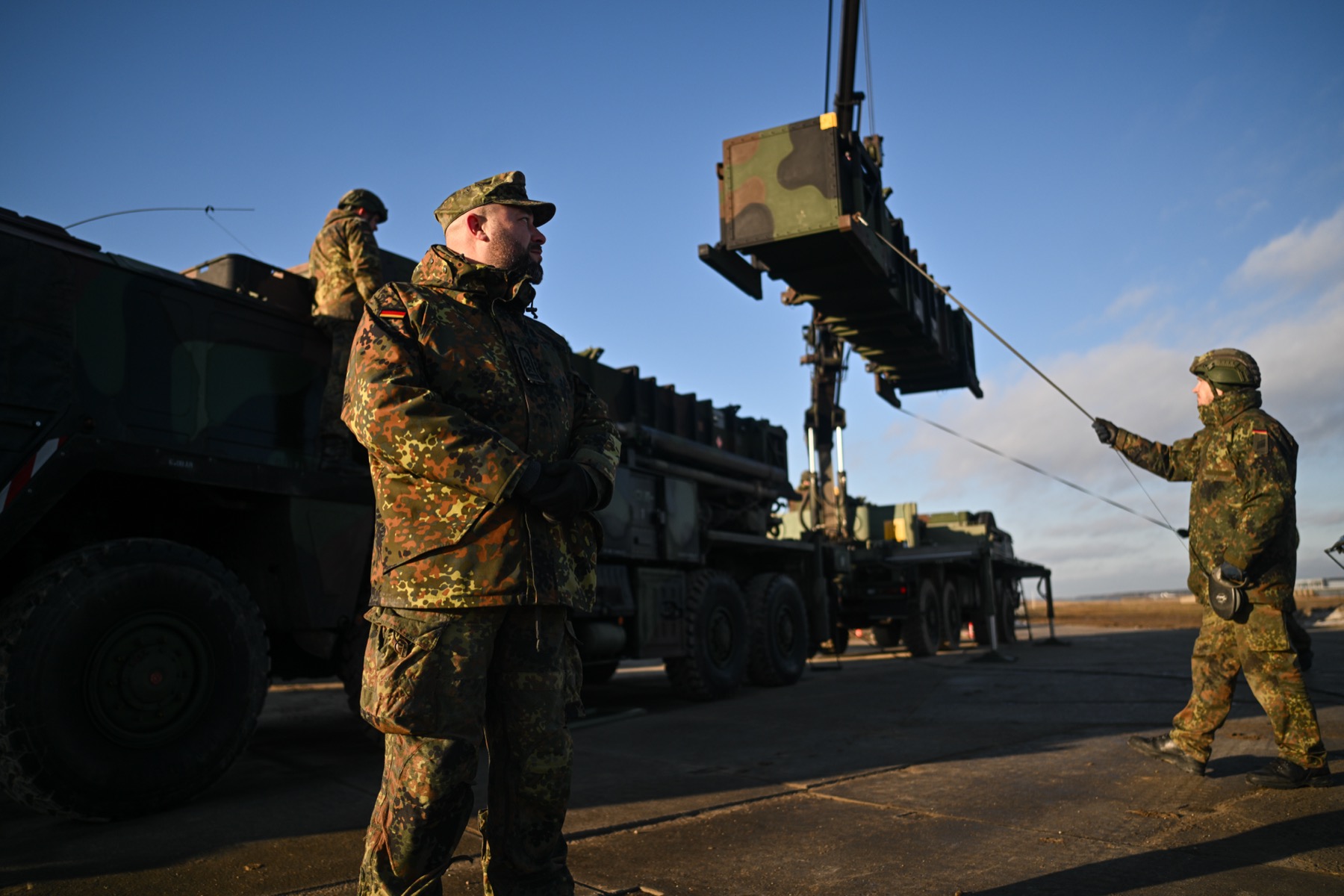
The immediate trigger is the global shortage of interceptor missiles. While the United States is increasing Patriot production, Europe is expanding SAMP/T, IRIS-T, and NASAMS, but demand is growing faster than production. The war against Ukraine, ongoing missile attacks from Russia, and regional escalation in the Middle East have overloaded the same market. A Patriot system does not just protect a Ukrainian urban area. It ties up American production lines, European budgets, political approval in Washington, and training capacities.
This is precisely where the institutional core of the problem lies. Europe has money but not enough critical industrial nodes. It can finance orders but can only set limited priorities. It can talk about strategic autonomy while remaining dependent on American or Israeli systems for the upper and middle layers of missile defense. Germany is purchasing Arrow 3 as an exo-atmospheric component for the European Sky Shield Initiative. NATO operates two Aegis Ashore sites with SM-3. Both close a capability gap, but they do so through external technology dependence.
Freyja is not a replacement for Patriot, but a political correction
Freyja is often described as an alternative to Patriot. This is only half correct operationally. Patriot is a proven system with radar, fire control, launchers, interceptors, NATO integration, and decades of operational logic. Freyja is primarily an accelerated development and coalition project. The comparison is therefore less technical than political. Freyja is meant to demonstrate that Europe and Ukraine do not have to remain permanently at the end of an American supply chain.
However, the partner formula is still risky. Joint operational requirements, technical working groups, governance mechanisms, and a roadmap sound sober. In European defense programs, these terms are often where time is lost. FCAS shows how quickly technical leadership, industrial shares, and national sovereignty claims can block a project. If Freyja is to deliver initial capabilities within a year, it must not be managed like a classic European large program. Ukraine will demand integration speed, while Western ministries will require certification, export control, and budget law.
But is that enough? A single interceptor is not an air defense architecture. Against ballistic missiles, early warning, sensor fusion, command posts, fire assignment, and stockpiling count. Europe has learned in recent years that an empty launcher is politically as embarrassing as having no launcher at all. The real question is therefore not whether Freyja can technically fly. It is whether Europe can simultaneously force sensor technology, production, ammunition depth, and command capabilities into the same timeframe.
Bliksem EXO addresses the missing upper layer
The parallelly announced Bliksem EXO consortium is strategically even more ambitious. Destinus, MBDA, Safran, Airbus, and Thales aim to develop a hit-to-kill interceptor that intercepts medium-range and intermediate-range missiles above the atmosphere. A test of the kill vehicle in space is planned for 2027. The division of labor is precisely defined. Destinus leads system integration and the kill vehicle, MBDA Germany handles the booster, launcher, and canister, Safran provides the seeker and guidance, Airbus manages command-and-control and battle management, and Thales supplies radar and sensor chain.
This division is more than industrial jargon. It marks the points where sovereignty actually emerges. Whoever controls the seeker understands the target. Whoever controls battle management decides on priorities. Whoever leads system integration determines what the system can ultimately do. Europe's previous mistakes rarely stemmed from a lack of money. They stemmed from organizing the division of labor based on political appeasement rather than technical accountability.
According to the involved companies, Bliksem EXO is also intended to address threats in the class of Russian Oreshnik systems with separating and maneuvering reentry vehicles. This is a high claim. Hit-to-kill above the atmosphere is not simply a larger version of air defense. It requires precise early warning, very fast data processing, exact target discrimination, and robust testing infrastructure. Europe cannot buy its way into this class through a declaration of intent. It must acquire it through test campaigns, failures, and series decisions.
Farnborough shows the shift from platforms to munitions
The context makes this week particularly revealing. Just before the Farnborough Airshow, Reuters reported that defense accounts for about half of the 1,600 exhibitors, while traditionally about 40 percent was common. The focus is shifting from the classic rivalry of Boeing versus Airbus to weapons, drones, AI systems, and mass production. Tom Enders, former Airbus CEO and now chairman of Helsing and KNDS, described the gap between the old defense industry and new defense companies as fundamental. Startups invest their own money, while classic procurement logics wait for state pre-financing.
This is uncomfortable for Europe. States are increasing their defense spending, but their procurement apparatuses were not built for wars with high ammunition consumption. They were optimized for peace dividends, interoperability rounds, and limited foreign deployments. Those who now want interceptor missiles in large numbers need not only budget lines but also production risk, stockpiling, and long-term purchase guarantees. This is precisely where European defense policy often fails. It loves programs, but it fears stockpiles.
The real test is governance
Freyja and Bliksem EXO are therefore not proof that Europe's missile defense problem is being solved. They are a test of whether Europe learns institutionally from the Patriot shock. This means clear leadership responsibility instead of endless consensus mechanics, series production before perfection claims, and NATO interoperability without complete American technology dependence.
For Germany, the lesson is particularly direct. Berlin cannot simultaneously buy Arrow 3, lament Patriot gaps, politically promote the European Sky Shield Initiative, and then only act as a cautious co-signer in European self-developments. If MBDA Germany takes on the booster and launcher for Bliksem EXO, it is not just an industrial contract. It is a test of whether the turning point from special funds to system responsibility is taking place.
The paradoxical finding is this: Europe's strongest step towards autonomy does not arise from Brussels but from Ukrainian pressure and industrial impatience. This can work if politics allows for speed. It can also fail if Freyja and Bliksem EXO turn back into European seminars with missile drawings. Europe now has more money. What is missing is the willingness to concentrate responsibility where capabilities are created.
Sources
- Defense News, July 14, 2026, report on the Freyja coalition and the nine European partner states.
- Defense News, July 15, 2026, report on the Bliksem EXO consortium from Destinus, MBDA, Safran, Airbus, and Thales.
- Reuters via Defense News, July 17, 2026, preview of the Farnborough Airshow and the shift towards weapons, drones, and AI systems.
Nine European nations are collaborating to develop the Freyja interceptor and Bliksem EXO system by 2027 to reduce reliance on U.S. Patriot systems. The Freyja Coalition, led by Ukraine, aims to enhance missile defense capabilities amid a global shortage of interceptors. The Bliksem EXO system will target medium-range and intermediate-range missiles, addressing strategic gaps in European defense.
- Nine European nations are collaborating on the Freyja interceptor project led by Ukraine.
- The Bliksem EXO system aims to intercept medium-range and intermediate-range missiles.
- There is a global shortage of interceptors, impacting European defense capabilities.
- The Freyja project is seen as a political correction to reliance on U.S. systems.
- Germany is purchasing Arrow 3 as part of the European Sky Shield Initiative.