
Freyja FP-7.X 2026 — Ukraine and Germany Build Europe's Patriot Alternative
 Dr. Klaus Weber
Freyja FP-7.X 2026 — Ukraine and Germany Build Europe's Patriot Alternative
Ukraine has completed its share of the Freyja program. Now, ten participating countries and their defense companies must prove that they can turn a Ukrainian missile into a functional defense system within a few months. This is where the strategic core of the message lies: It is not the missile body, but European integration that will determine whether Freyja becomes a Patriot alternative or just another European promise.
The Ukrainian Contribution Has Already Been Delivered
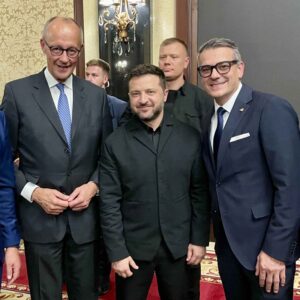
Fire Point, the main Ukrainian contractor and design authority, is developing the FP-7.X interceptor missile as well as launch and control components. President Volodymyr Zelensky stated on October 17 that Kyiv has fulfilled its part. France, Germany, the United Kingdom, Norway, Poland, and other partners must now provide the sensors, data links, and command and control capabilities. The political timeline is unusually tight: initial tests are expected to begin by the end of 2026, with deployment on the battlefield aimed for July 2027.
This is not an ordinary procurement project. According to Fire Point CEO Iryna Terekh, a development program that typically takes 20 to 30 years is to be completed in just a few years. This acceleration is made possible by the war, but it does not eliminate technical dependencies. On the contrary: the shorter the deadline, the more visible the bottlenecks in certification, software, interfaces, and series production become.
The Technical Architecture is European, but Not Yet a European Capability
Germany plays a central role through Hensoldt. The company supplies and integrates radars, including the TRML-4D with active electronically scanned array. Hensoldt claims that this system can detect and track approximately 1,500 aerial targets. Norway's Kongsberg is expected to contribute to command and control. Other designs include sensors from Saab, Thales, Weibel, or Leonardo. The connection to the Ukrainian air defense is to be established via NATO Link 16, the Asterix protocol, and a bidirectional data link.
This enumeration sounds like a division of labor, but initially, it is just a list of potential interfaces. A missile defense system does not work simply because each country has a good individual component. It only works when radar, fire control, seeker, data link, and missile cooperate under real interference and time conditions. The seeker is therefore the critical bottleneck. The integration of a German infrared seeker from Diehl is planned; even the involved manufacturers are entering new territory with this combination.
Freyja Emerges from a Concrete Patriot Crisis
The political pressure is real. According to Ukrainian sources, more than 100 ballistic missiles have been fired at Kyiv and the surrounding region in the past two weeks. In September, Russia deployed nearly 3,500 jet-powered Shahed drones nationwide. This creates a scarcity for two tasks: protection against drones and defense against ballistic missiles.
Patriot remains the most reliable capability for Ukraine against ballistic targets. However, a PAC-3 interceptor missile costs approximately $3.8 million and takes years to deliver. Additionally, the wars in the Middle East have strained American stocks. A European security strategy based on an American interceptor missile, which Europe cannot produce in sufficient numbers or reorder in the short term, is not strategic autonomy. It is a supply contract with conditions.
Freyja aims to change this structure. Fire Point sets a target for series production of at least 2,000 interceptor missiles per year at less than $1.2 million each. This would be significantly cheaper than PAC-3. The first FP-7.X is expected to operate with a fragmentation warhead and engage targets at approximately 20 to 25 kilometers in altitude; a later hit-to-kill variant is planned. These figures do not automatically make Freyja a replacement for Patriot. However, they show that Europe is attempting for the first time to combine cost, production volume, and operational experience in a joint system.
The Real Risk is European Decision Time
The crucial question is not whether Europe can mobilize money. The European Commission has called on member states at the end of October to utilize €21.3 billion from the SAFE program for defense readiness and support for Ukraine. The question is whether this money will be converted into integrated systems in time. A credit framework can finance factories, but it cannot replace unresolved divisions of labor and slow national approvals.
Freyja is therefore an unusually honest test for European defense integration. Ukraine brings operational urgency, its own missile, and a willingness for rapid iteration. The European partners contribute sensors, capital, and industrial depth. What is still missing is a common entity that enforces technical priorities against national industrial interests. If each partner first secures its own responsibility, integration will become the bottleneck.
Germany is under particular scrutiny in this regard. Berlin can provide a robust contribution with Hensoldt, but a German radar alone does not make a German or European missile defense. The federal government must accept that a Ukrainian-led program does not operate according to the model of classic German procurement. What matters is not who receives the largest work package, but who certifies the interfaces in weeks instead of years.
Europe's New Capability Begins with a Political Risk
The Freyja coalition shows what European defense autonomy could practically mean: not an abstract demand for a European product, but a Ukrainian design, German sensors, Norwegian command and control, and several national components in a near-operational development cycle. This is much more promising than another paper on strategic sovereignty.
But Freyja is still a work in progress in terms of integration. If a complete test is not possible by the end of the year, it will become clear that Europe's problem is not just a lack of technology, but a lack of decision-making speed. If the test succeeds, more than just a new interceptor missile will emerge: Europe will gain a model for how it can connect Ukrainian combat experience with its own industry. The contradiction remains. Europe wants to become independent of Patriot, but must first prove that it can act collectively with a Ukrainian system.
Sources
Ukraine and Germany are developing the Freyja FP-7.X air defense system as an alternative to the Patriot system, with the first tests expected by the end of 2026. The Ukrainian Armed Forces have completed their contributions, while Germany's Hensoldt is providing critical radar technology. The goal is to produce at least 2,000 interceptors annually at a lower cost than existing systems, amid increasing political pressure due to missile attacks on Ukraine.
- Ukraine has completed its part of the Freyja program.
- The first tests of the Freyja system are expected to begin by the end of 2026.
- Germany's Hensoldt is providing key radar technology for the system.
- The goal is to produce at least 2,000 interceptors per year at a lower cost than the PAC-3.
- Political pressure exists due to recent missile attacks on Ukraine.