
Galvion’s Polish helmet hub marks major first-year milestone
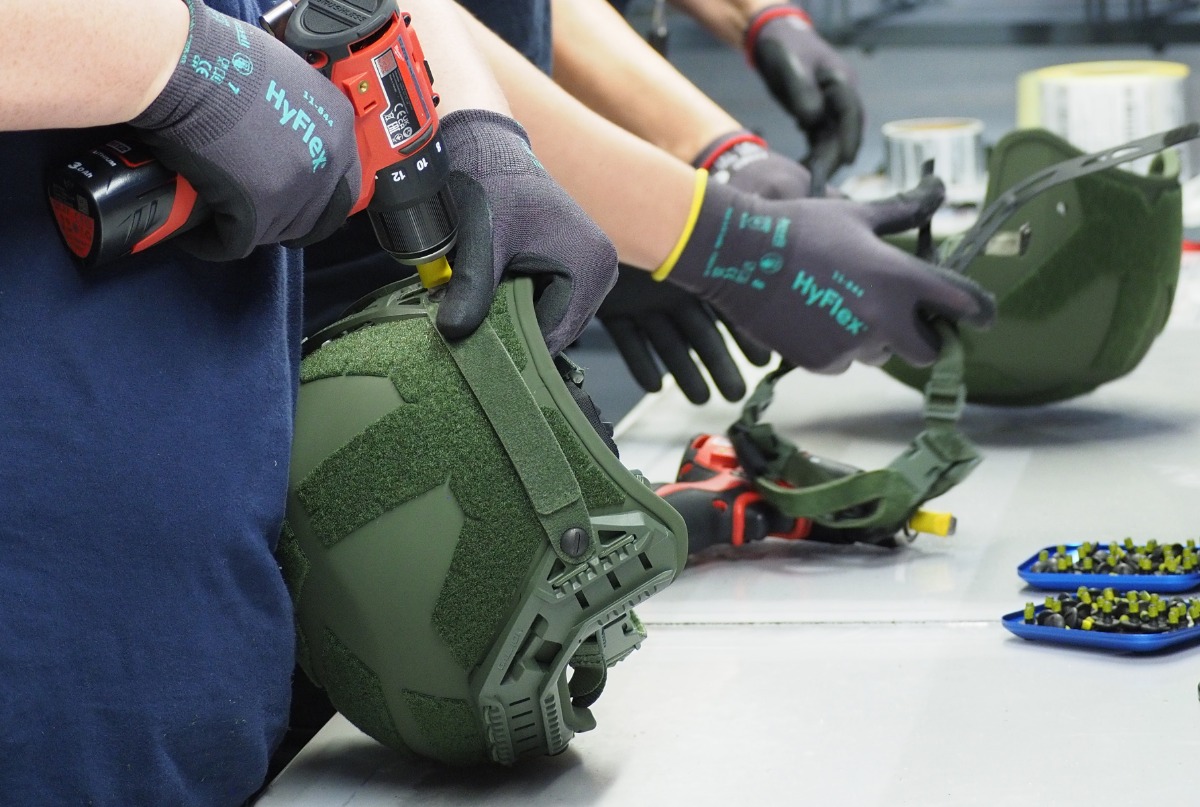
A helmet factory in northern Poland has spent its first year of operation shipping more than 90,000 ballistic helmets to NATO allies, and the company behind it says that pace confirms a bet made three years ago is finally paying off.
Galvion, a designer and manufacturer of soldier head protection, power systems, and integrated soldier equipment, announced that its European and NATO production hub in Gdansk, Poland has emerged as a significant center of excellence exactly 12 months after its formal opening. The company first announced plans for the facility in September 2023, completed construction in June 2024, and brought the site to full operational status in April 2025, before Canadian Ambassador to Poland Catherine Godin formally opened the facility at a ceremony held on June 23, 2025.
In the year since that opening, the Gdansk site has grown to employ more than 100 people and has shipped over 90,000 ballistic helmets to customers across 10 NATO and allied nations spanning Europe, Canada, and the Middle East, according to Galvion. The facility currently operates at an annual production capacity of 100,000 helmets on a single work shift, manufacturing multiple helmet platforms while also handling finishing and assembly work, along with support, maintenance, refurbishment, upgrade, and training operations for helmets already in service with allied militaries.
That growth builds on a relationship between Galvion and NATO that predates the Polish facility by several years. Galvion won a NATO Support and Procurement Agency framework contract in 2022 following rigorous trials led by Norwegian special operations forces and dismounted infantry units, with Norway subsequently selecting Galvion’s Caiman head system as the standard helmet issued to its elite units, a selection the company has pointed to as validation of the helmet’s survivability and operational performance under demanding trial conditions. Galvion said continued program awards from European nations tied to that NSPA framework agreement now put the company on track to have close to 2 million helmets in service across NATO and other European countries by the end of 2026, a milestone that would roughly quadruple the 500,000-plus units the company had delivered globally just a few years earlier.
Jonathan Blanshay, Founder and Executive Chairman at Galvion, framed the Gdansk facility’s first year as exceeding what the company originally set out to build.
“When we invested in Poland, our objective was never simply to build another manufacturing facility. We wanted to establish a long-term operational centre that could serve our European and NATO customers with local production, sustainment, modernization and technical support. One year later, the team has exceeded our expectations and demonstrated exactly what that model can achieve,” Blanshay said.
That emphasis on regional production and support reflects a broader shift in how NATO members increasingly want their equipment sourced. A supplier based entirely outside Europe faces longer shipping times, higher logistics costs, and greater exposure to supply chain disruption during a crisis, concerns that have grown more pointed since Russia’s full-scale invasion of Ukraine pushed European militaries to prioritize suppliers who can manufacture, maintain, and upgrade equipment without routing every shipment through North America first. Galvion’s Gdansk facility answers that concern directly, giving European customers a helmet finishing, assembly, and sustainment operation physically located inside the region their forces actually operate in, while Galvion’s existing facilities in Canada and the United States continue handling domestic and other global programs separately.
Galvion is not treating the ballistic helmet as a finished, unchanging product either. The company’s newest technology, called Cortex EVO and EVO HALO, integrates power, data, and digital capabilities directly into existing or new helmet platforms, effectively turning what was historically a purely protective piece of equipment into a foundation for a broader connected soldier system. That evolution matters strategically because it lets militaries modernize helmets already in their inventory rather than replacing entire fleets outright, a considerably cheaper and faster path to fielding networked soldier equipment than procuring brand-new systems from scratch. As those Cortex capabilities roll out across European military programs, Galvion says its Gdansk facility is positioned to support both new helmet production and the upgrade, refurbishment, and integration work needed to bring already-fielded helmets up to the newer digital standard.
Blanshay described that evolving role for the helmet as central to where Galvion sees its Polish operation heading over the coming years.
“Looking ahead, the opportunity is even greater. As soldiers become increasingly connected, the helmet is evolving into the platform that brings together protection, power, data and digital capability. Our vision is to help customers not only procure next-generation integrated systems but also upgrade equipment already in service. Gdańsk will play a central role in delivering that capability across Europe for many years to come,” Blanshay said.
Galvion has continued winning new contracts elsewhere even as the Gdansk facility scaled up, including a U.S. Marine Corps Integrated Helmet System contract built on the company’s Hellbender platform and follow-on Caiman helmet orders under Canada’s DICE program, giving the company a portfolio that spans North American military customers alongside its expanding European NSPA business. Privately owned, Galvion now operates accredited facilities in New Hampshire, Vermont, and Massachusetts in the United States, Montreal in Canada, Bristol in the United Kingdom, and Gdansk in Poland, employing more than 450 people across its global operations.
Content preview only. Full article available at source. View Full Article
Galvion's Gdansk facility in Poland has successfully shipped over 90,000 ballistic helmets to NATO allies in its first year of operation. The facility, which employs over 100 people, has an annual production capacity of 100,000 helmets and is positioned to support both new production and upgrades of existing helmets. Galvion aims to expand its service to nearly 2 million helmets across NATO and European countries by the end of 2026.
- Galvion's Gdansk facility shipped over 90,000 ballistic helmets in its first year.
- The facility has an annual production capacity of 100,000 helmets.
- Galvion won a NATO Support and Procurement Agency contract in 2022.
- The Gdansk site employs over 100 people.
- Galvion aims to have close to 2 million helmets in service by the end of 2026.