
General Dynamics shows Wolf XM30 at AUSA 2026
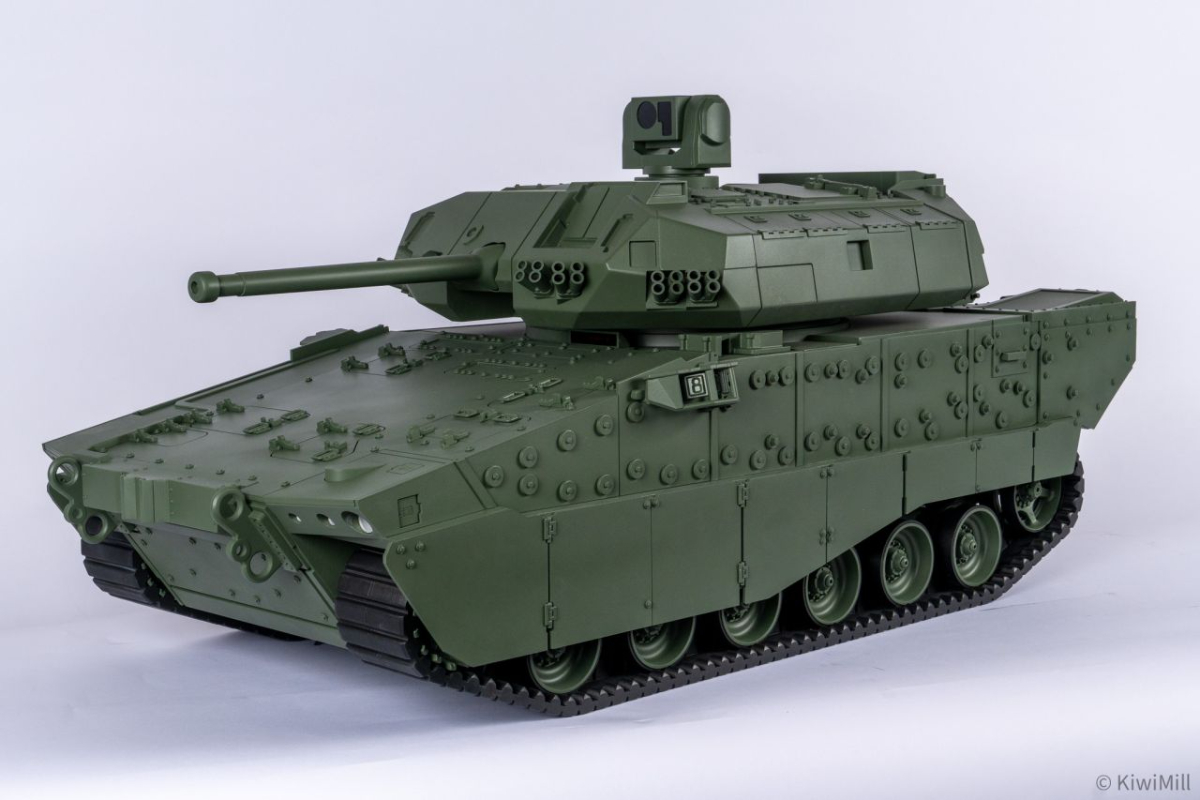
General Dynamics Land Systems has brought its Wolf XM30 infantry fighting vehicle to the Association of the U.S. Army’s annual meeting in Washington, but only as a one-eighth-scale model, leaving the full-size vehicle out of public view while it undergoes U.S. Army testing.
The company is offering the Wolf as a replacement for the M2 Bradley Fighting Vehicle in the U.S. Army’s XM30 Mechanized Infantry Combat Vehicle competition.
In a social media post on Oct. 12, General Dynamics said the vehicle was designed from the start around the U.S. Army’s Modular Open Systems Approach, which uses common hardware and software interfaces so new sensors, weapons and electronics can be added without redesigning the vehicle. The company also said the Wolf was “born digital,” meaning its digital engineering model is used in testing, production and maintenance as well as design. It did not release new specifications, photos of the full-size vehicle or any test results.
General Dynamics delivered its first Wolf prototype to the U.S. Army at Aberdeen Proving Ground, Maryland, on Aug. 21. The only public photo since then has shown the vehicle wrapped in a black tarp on a flatbed trailer. The company has said seven more prototypes will go to the 1st Armored Brigade Combat Team, 1st Cavalry Division, at Fort Hood, Texas, where soldiers will put them through field trials. The Wolf is based on the company’s Griffin III demonstrator, itself derived from the ASCOD 2 infantry fighting vehicle, and its team includes GM Defense, AeroVironment and General Dynamics Mission Systems.
The other finalist, American Rheinmetall, is not showing its Lynx XM30 at AUSA at all. The company said its prototypes have gone straight to the U.S. Army for soldier evaluation. American Rheinmetall delivered the first of eight Lynx prototypes days after General Dynamics’ delivery in August.
The U.S. Army’s requirements for the XM30 call for an uncrewed turret armed with the XM913 50 mm cannon, a hybrid-electric drivetrain and room for six dismounted infantry soldiers. The vehicle would carry infantry squads and cavalry scouts into combat and support them with fire once they dismount, the same job the Bradley has done since the early 1980s.
The U.S. Army picked General Dynamics and American Rheinmetall as finalists in June 2023, with the design and prototype phase valued at about $1.6 billion between them. The U.S. Army expects to choose a winner in 2027, and its budget plans call for buying 108 vehicles by fiscal 2031 ahead of larger production later.
Content preview only. Full article available at source. View Full Article
General Dynamics showcased a one-eighth-scale model of the Wolf XM30 infantry fighting vehicle at the AUSA 2026 in Washington. The full-size vehicle is currently undergoing testing by the U.S. Army. The Wolf XM30 is designed to replace the M2 Bradley Fighting Vehicle and will undergo field trials with the 1st Armored Brigade Combat Team in Texas. The U.S. Army plans to procure 108 units by fiscal 2031.
- General Dynamics presented a one-eighth-scale model of the Wolf XM30 at AUSA 2026.
- The Wolf XM30 is intended to replace the M2 Bradley Fighting Vehicle.
- The U.S. Army is testing the full-size version of the Wolf XM30.
- Eight prototypes of the Wolf will be delivered to the 1st Armored Brigade Combat Team for field trials.
- The U.S. Army plans to purchase 108 vehicles by fiscal 2031.