

At a time when the United States Navy is struggling through a shipbuilding crisis, when the Pentagon is convinced that China could invade Taiwan and trigger a regional war by as early as next year, the Americans have little ability to mass-produce and sustain a protracted naval war against the Chinese.
That might have been less of a concern a decade ago, as China was still building out its forces. Today, however, the People’s Liberation Army Navy (PLAN) is at a level and has a manufacturing base, unlike anything in the United States.
A Daunting Prospect for the US Military
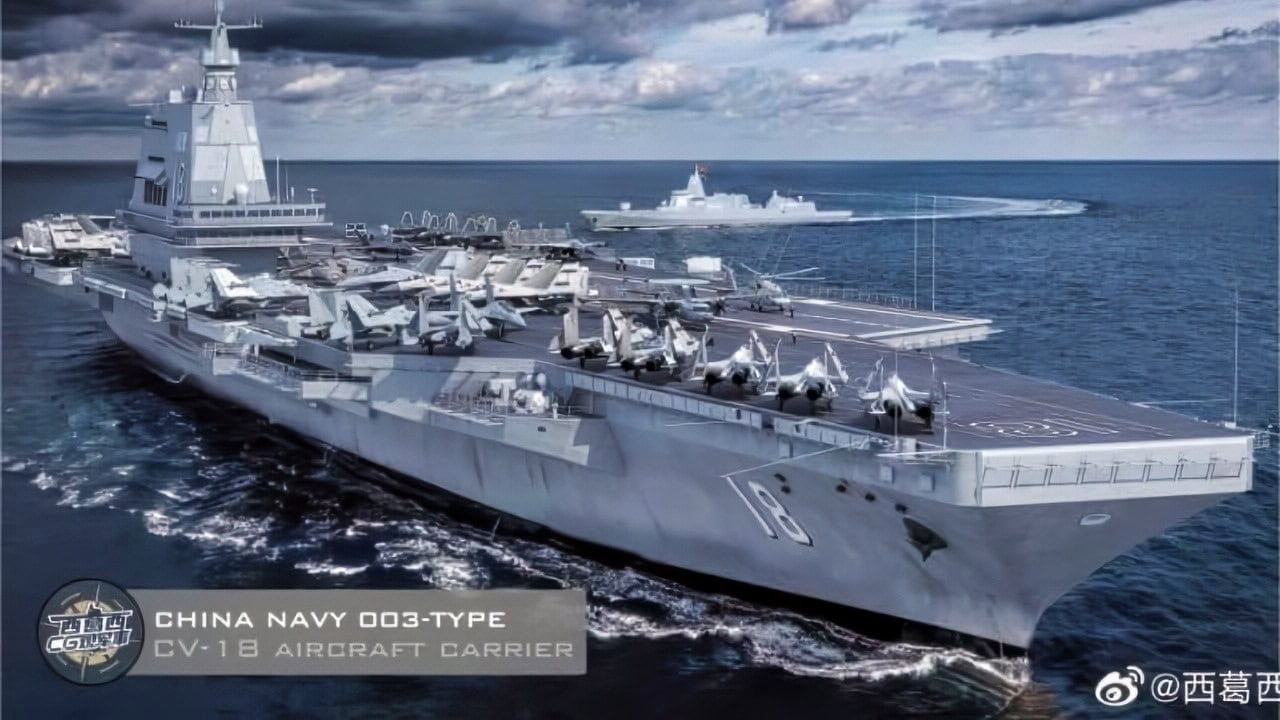
China Aircraft Carrier Type 003 Conventional Supercarrier. Image Credit: X Screenshot.
If a shooting war erupted between Beijing and Washington, D.C., over Taiwan or elsewhere in the First Island Chain, even if Americans could penetrate China’s comprehensive anti-access/area-denial (A2/AD) defenses, Chinese forces would have the endurance to sustain the fight.
They also have far more ships than do the Americans. Combined with “home-field advantage,” the US Navy will struggle against China in any conflict.
All one needs to do is look at how cautiously the US Navy has operated in the face of Iran’s A2/AD threats.
Amplify that threat to the US Navy by a factor of ten, because China’s military is larger and more advanced than Iran’s.
Still, Iran has given the Navy enough headaches to last a generation. China could easily break the US Navy’s back.
That’s not a knock against American sailors.
It’s a simple reality check: decades of American policymakers’ neglect of the defense industrial base’s critical infrastructure and naval shipyards.
China’s shipbuilding capacity is more than 200 times that of the United States.
It produces more than half of the world’s commercial ships by tonnage and dominates global maritime manufacturing. According to The War Zone, Chinese shipyards produce around 23.25 million gross tons.
Less than 100,000 gross tons is all that American shipyards can do. Chinese shipyards build 1,000 commercial ships annually, while American shipyards can complete only a fraction of large ocean-going merchant vessels.
Too Much Capacity in China
China is home to 14 of the world’s 20 largest shipyards.
Of course, those are for civilian ships.
But China’s shipyards continue churning out warships and submarines much faster than American yards.
Chinese shipyards also take less time to produce these ships than American yards.
That’s because China has incorporated stunningly efficient domestic production methods into its massive naval shipyards.
Meanwhile, the US remains mired in methods from the previous century and faces a significant shipyard workforce crisis.
It’s also important to understand China’s civilian shipbuilding capacity because of Beijing’s Military-Civil Fusion (MCF) program.
One might argue that all advanced nations do this to some level.
But China has taken the cake in using civilian means to achieve military ends.
China’s commercial shipyards and drydocks can be seamlessly switched to military production and use.
China has more than 50 drydocks that are large enough to accommodate a PLAN aircraft carrier.
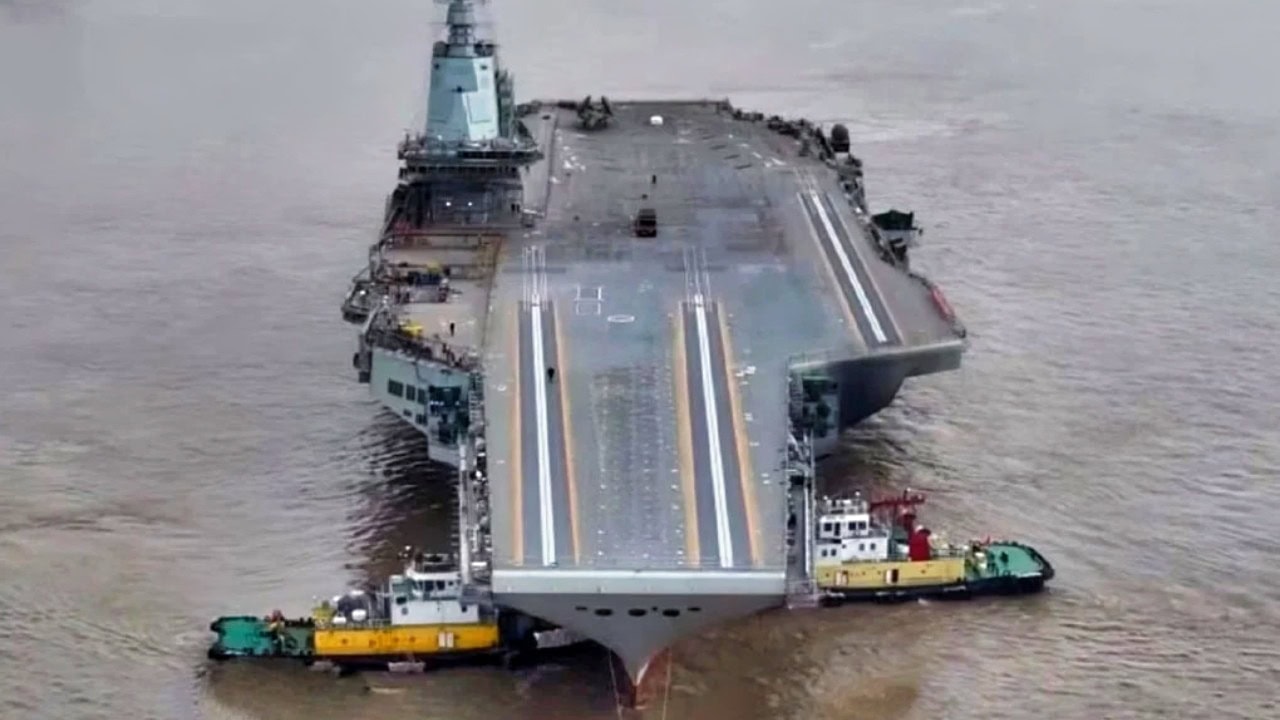
China Aircraft Carrier. Image Credit: Chinese State Media.
In fact, the PLAN has already become the world’s largest Navy by ship count, and it continues to outgrow the United States Navy.
Since 2012, the PLAN has received three active aircraft carriers from its shipyards. Each iteration is more advanced than the last.
A fourth carrier is under construction and will be deployed soon. Beijing plans to have nine carriers by 2035. The Americans technically have a fleet of 11 aircraft carriers.
However, the Nimitz-class carriers are aging, and the replacement Gerald R. Ford-class carriers have shown significant technical issues that still need to be worked out.
What’s more, the Americans can reliably field no more than four aircraft carriers at any given time (really, three, and that usually comes at a high cost).
China’s submarine production also outstrips America’s.
As with China’s carriers, each iteration of its submarines improves them.
And because China has more robust shipyard capability, it can churn out newer, more advanced submarines much faster than the Americans (or even US allies).
China Has Already Beaten America in the First Island Chain
The bottom line is that China has staying power because it’s spent decades building the resources and capacity to support advanced shipbuilding in both civilian and military sectors.
This has occurred at the same time that the Americans and their allies began mothballing ships and selling off their own shipbuilding capabilities (ironically, usually to China).
Today, China has honed its manufacturing capabilities and used them to build the world’s largest Navy.
Now, China is working diligently to ensure the world’s largest Navy becomes its most advanced and capable.
That will take time, of course.
Given how quickly the Chinese have advanced in general, though, it is only a matter of time before their Navy not only outnumbers (some say it already does, depending on how you do your count) the US Navy but outmatches it (at least in the First Island Chain).
About the Author: Brandon J. Weichert
Brandon J. Weichert is the Senior National Security Editor at 19FortyFive.com. He also manages The Weichert Brief on Substack. Weichert also hosts “National Security Talk” on Rumble. He is the author of four bestselling national security books, most recently A Disaster of Our Own Making: How the West Lost Ukraine (Encounter Books). Follow him via Twitter/X @WeTheBrandon.