
Germany tests 2026 Helsing HX-2 and Virtus for Lithuania — Europe's drone transition remains incomplete
 Dr. Klaus Weber
Germany tests 2026 Helsing HX-2 and Virtus for Lithuania — Europe's drone shift remains incomplete
On November 9, the Bundeswehr began the decisive firing campaign for two German one-way combat drones at the Wehrtechnischen Dienstbereich in Meppen. Helsing HX-2 and Stark OWE-V Virtus hit their intended targets and activated their warheads, the procurement authority reported. This is militarily relevant, but politically not yet a breakthrough. Germany has passed a functional test, but has not answered the question of whether an accelerated procurement process will lead to reliable combat capability in time.
The report from Defense News on November 20 and the Reuters coverage on November 22 mark an unusually swift step. The first systems are expected to be delivered as early as 2026; starting in 2027, the 45th Armored Brigade stationed in Lithuania is planned to be the first larger formation. The location is not chosen randomly. The brigade is intended to embody a German presence on NATO's eastern flank, which in case of emergency requires not only tanks and artillery but also mass-available precision effects.
A test with deliberately limited significance
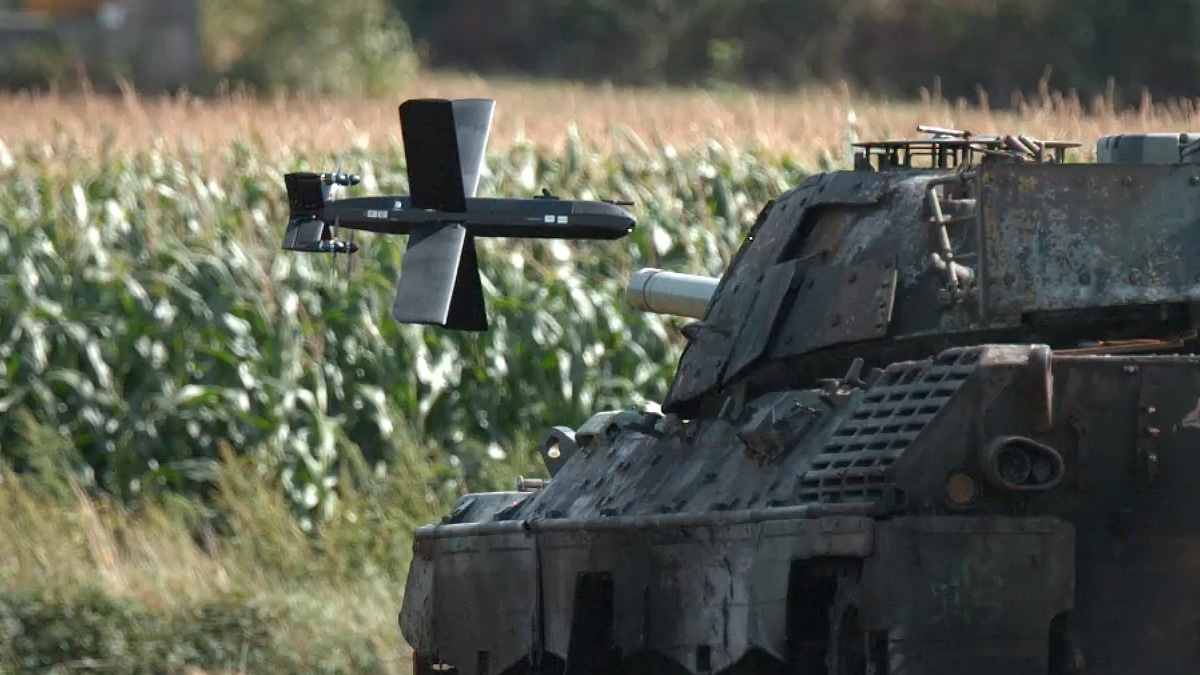
HX-2 and Virtus belong to the class of loitering munitions. They can remain over an operational area, search for targets, and attack upon human authorization. This combination of reconnaissance, decision-making, and effect distinguishes them from conventional artillery shells. However, the Meppen test primarily examined the final phase: approach, hit, and warhead effect. The Bundeswehr did not publish the number of systems fired, hit rates, ranges, or the exact warhead configuration.
This is not a trivial matter. The technical specification of a drone is only part of its military quality. Crucial are the data link, electronic warfare resilience, target tracking capability, availability of spare parts, and integration into the command network. A system may reliably hit a tank in the firing channel but still fail in real combat due to disrupted navigation, lack of reconnaissance, or insufficient operator training.
Germany's new procurement model
In February, the Bundestag approved contracts worth 268 million euros each for Helsing and Stark. Options could increase the value of each contract by up to one billion euros. This structure connects development, testing, qualification, and preparation for use more closely than previous German armament programs. Soldiers were involved in the tests early on; at the same time, termination clauses allow for withdrawal if the systems do not pass qualification.
This is the actual institutional value of the program. Germany is trying to break the classic sequence — years of development, delayed testing, and then even later introduction. Ukraine has shown that drone programs must iterate in months, not in a German budget cycle. But acceleration is not a substitute for prioritization. If the Bundeswehr also has to build the reconnaissance, communication, and logistics architecture alongside the drones, the bottleneck shifts from the missile to the system.
Why Lithuania is more than just a first customer
The decision for Lithuania gives the program a strategic function. The 45th Armored Brigade is intended to become Germany's most permanent military commitment on the eastern flank. Therefore, its drones must not only function on the training ground but also fit into NATO situational awareness, share targets with other units, and survive in a conflict under Russian electronic and kinetic threats.
Reuters reported on November 22 about Bundeswehr tests with an AI-supported target acquisition tool in Lithuania. This raises attention but should not be confused with autonomous weapon authorization. The political and legal responsibility remains with humans. For this reason, Berlin must precisely explain what tasks the software takes on: detection, prioritization, navigation, or merely supporting an operator. "AI" is not a proof of capability. Without verifiable rules for human control, the term becomes procurement rhetoric.
The European contradiction
Germany thus provides a correct response to the war in Ukraine, but not yet a European one. HX-2 and Virtus are national solutions, even though the operational environment is organized NATO-wide. If each state procures its own drones, data standards, and operating concepts, more mass may be created on the eastern flank, but not automatically more interoperability. PESCO and the European Defense Fund can only solve this problem if they prioritize interoperability and production volume over national symbolism.
Additionally, there is the industrial question. The contracts show that Germany is willing to integrate start-ups like Helsing and Stark into the Bundeswehr. This is a break with the previous dominance of large system houses. However, a contract for options is not yet serial production. Only regular deliveries, a reliable spare parts chain, and training for many operators turn a successful trial into a military capability.
Conclusion
The Meppen test is a step forward because it examines a concrete capability and is set to begin introduction as early as 2026. However, it is not proof of a completed turning point. Germany has shown that it can quickly deliver two types of drones to a target. Now it must demonstrate that these systems are permanently available in Lithuania, NATO-compatible, and politically controllable. Europe's problem has never been a lack of announcements. It has been the distance between contract, delivery, and combat capability. With HX-2 and Virtus, the real test begins only after the test.
Sources: Defense News, November 20, 2026; Reuters, November 22, 2026; information from the German procurement authority regarding the firing trials in Meppen.
The Bundeswehr commenced testing the Helsing HX-2 and Virtus drones on November 9, 2026, at the Meppen military facility. The tests confirmed the drones' ability to hit designated targets, with initial deliveries expected by 2026 for deployment with the 45th Panzer Brigade in Lithuania. This initiative aims to enhance Germany's military presence on NATO's eastern flank.
- Germany began testing the Helsing HX-2 and Virtus drones on November 9, 2026.
- The Bundeswehr successfully hit designated targets during the tests.
- The first systems are expected to be delivered by 2026, with the 45th Panzer Brigade stationed in Lithuania.
- The drones are designed for reconnaissance and precision strikes, differing from traditional artillery.
- Germany's procurement model aims to accelerate the development and deployment of military capabilities.