
Germany's 40 Percent Stake in KNDS 2026 Does Not Solve Europe's Tank Problem
 Dr. Klaus Weber
Germany's 40 Percent Stake in KNDS 2026 Does Not Solve Europe's Tank Problem
Germany plans to buy 40 percent of KNDS, France is to remain on an equal footing through Giat, and about 20 percent of the tank manufacturer is to go to institutional investors. This sounds like the long-sought answer to Europe's land warfare problem. In fact, it is initially an answer to an ownership problem. The difference is not academic. It determines whether additional Leopard successors, Caesar howitzers, and MGCS modules will emerge from European rearmament or just higher valuations for defense stocks.
The Franco-German decision of June 22 and the KNDS announcement of June 24 undoubtedly mark a political turning point. Berlin is no longer just entering as a customer but as a co-owner. Paris no longer presents the previous asymmetry between French state ownership and German family holdings as a structural law of nature. Both governments want parity in governance rights, long-term commitment, and security policy oversight. For a company created in 2015 from Nexter and Krauss-Maffei Wegmann, this is more than financial engineering.
Parity Is Not the Same as Production Capability
The sober numbers explain why the decision is politically so attractive. KNDS reported a revenue of 4.4 billion euros for 2025, an operating profit of 661 million euros, and a backlog of 33.1 billion euros. For 2026, the company aims for around 30 percent revenue growth. The European defense index STOXX Europe Targeted Defence has increased manifold over five years. Anyone in Berlin who does not seek access to the most important Franco-German land weapons company in this situation understands Zeitenwende only as a budget line.
But is that enough? The planned IPO is said by KNDS not to issue new shares. The existing owners will sell about 20 percent through private placements. The German entry is through KfW and is subject to the approval of the budget committee of the Bundestag. This is important: If no fresh equity flows into the company during the listing, the transaction does not automatically create a new factory, no additional tank hull, and no second turret production line. Liquidity for owners is not identical to industrial capacity.
The German State Stake Is a Vote of No Confidence in the Market
Germany is buying into KNDS because Berlin has now understood that strategic industries cannot be managed solely through orders. The special fund has proven how quickly billions are tied up; it has not proven that supply chains, skilled labor, and suppliers grow at the same pace. Whoever holds 40 percent of KNDS receives not only dividend rights. They gain rights to information, veto options, and political access to a company that is relevant for Leopard, Leclerc, Boxer, Caesar, PzH 2000, and future MGCS architectures.
This is institutionally plausible but politically uncomfortable. For years, Berlin preached competition, European market openness, and procurement neutrality. Now it is using a state vehicle to secure a key position in a nationally sensitive defense company. This is not hypocrisy but a late recognition of a reality: land weapon systems are not normal industrial goods. In ammunition, tanks, and artillery, ownership structure determines who is prioritized in a crisis.
France knew this earlier. That is why Giat remained state-controlled while Germany treated the KMW side as a private sector issue for a long time. The new parity corrects this imbalance. However, it also creates a classic Franco-German problem: when both states are equally strong, no one is clearly responsible. Parity can create trust. It can also institutionalize blockage.
MGCS Remains the Real Test
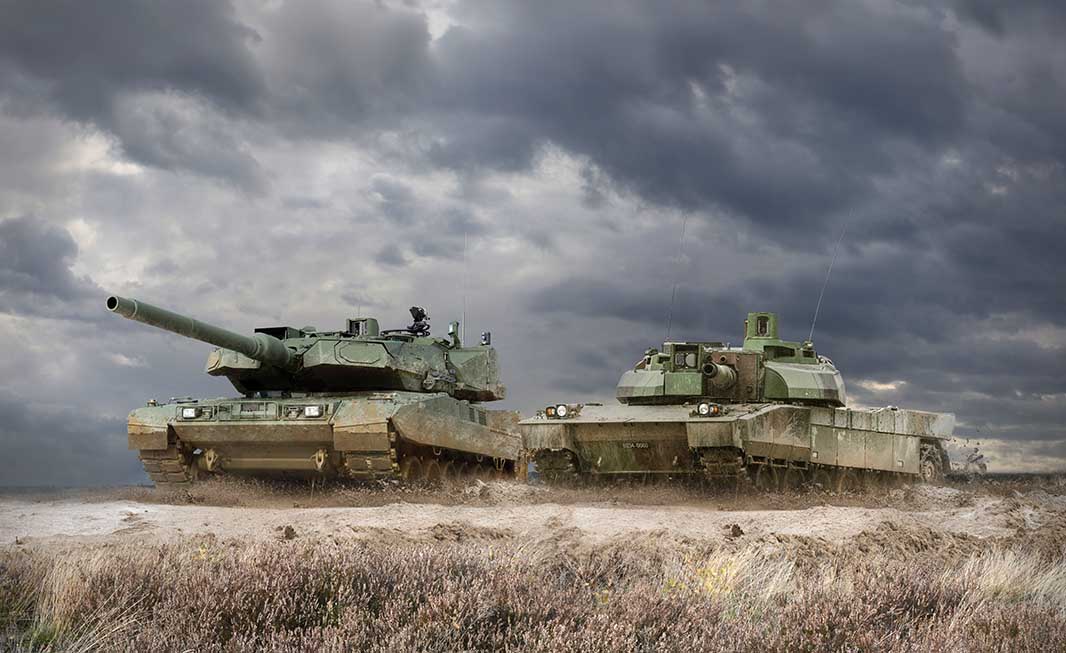
The most important point lies not in the IPO but in the Main Ground Combat System. France's Leclerc is nearing the end of its lifespan, while Germany's Leopard-2 family remains politically viable longer through modernization and new variants. KNDS has already shown a transition proposal in Paris: a French turret and French gun on a German Leopard-2 chassis. This is technically reasonable and politically elegant. However, it is also an admission that MGCS is not coming quickly enough.
Here is where it will be decided whether the new ownership framework is more than a placebo. MGCS needs clear system leadership, defined work packages, a binding export logic, and a realistic timeline. If Berlin and Paris transfer the 50-50 logic from the ownership structure into every technical decision, the familiar European pattern threatens: dual competence centers, political division of labor instead of industrial efficiency, and a program that looks sovereign on paper but arrives too late.
The temptation is great to now celebrate KNDS as a European counter-model to American dependency. However, Europe's problem is not that it lacks champions. Airbus, MBDA, Leonardo, Rheinmetall, and KNDS already exist. The problem is that champions operate in nationally segmented procurement markets. A Franco-German tank manufacturer can only become European if Poland, the Baltic states, Scandinavia, Italy, and other customers appear not just as buyers of finished products but are involved in standardization, maintenance, ammunition supply, and upgrade cycles.
The Capital Market Does Not Solve a Command Structure
The planned 10-year commitment of the French and German state vehicles, the approval requirements when certain ownership thresholds are not met, and double voting rights for longer-held shares show what it is really about. KNDS is to become more marketable but not truly left to the market. This is not a contradiction in the defense industry. It is the new normal of European defense policy: private valuation, state control, strategic rhetoric.
For investors, this is attractive. For armed forces, it is only relevant if it leads to shorter delivery times. The backlog of 33.1 billion euros is a sign of strength but also a warning. A full backlog means that demand is present. It says little about whether new orders will be processed quickly. The experience in Ukraine has destroyed Europe's most beautiful planning assumption: it is not the technical excellence of a system that decides first, but the ability to produce, maintain, and replace it in mass.
That is why Berlin should not sell the entry into KNDS as an industrial policy victory. It is more of a delayed insurance policy. Germany is buying political influence in a company whose capacities it urgently needs. France secures its sovereignty logic without bearing the financial burden alone. KNDS gains a more stable ownership base and better marketability. All of this makes sense. It is just not yet a tank brigade.
The real question is not whether KNDS will look more European in the future. The question is whether a Franco-German controlled company can produce faster, more standardized, and less nationally reflexively than the structures from which it emerged.
Europe's land forces need more than a strong symbol. They need ammunition lines, spare parts pools, training standards, and reliable series production. Germany's 40 percent entry can be a prerequisite for this, but it does not replace this work. This is precisely the paradox of the new KNDS order: without state control, strategic industry remains vulnerable; with too much state parity, it can become slow again. Therefore, Europe's tank problem does not begin at the factory gate. It begins in the governance model.
Germany is acquiring a 40% stake in KNDS by 2026, aiming to address ownership and governance issues in European defense alongside France. This strategic move is intended to enhance Germany's influence in military procurement and ensure parity in governance rights. KNDS reported significant revenue and growth projections, but the acquisition does not automatically translate to increased production capacity.
- Germany plans to acquire a 40% stake in KNDS by 2026.
- The acquisition aims to address ownership and governance issues in European defense.
- KNDS reported a revenue of 4.4 billion euros for 2025 and aims for 30% growth in 2026.
- The deal involves a political shift towards greater German influence in defense manufacturing.
- The acquisition does not guarantee immediate industrial capacity increases.