
Hazelnut over Kyiv in May 2026 — the third application changes the logic of Russian strikes
 Dmitri Volkov
Oreshnik over Kyiv in May 2026 — the third use changes the logic of Russian strikes
600 drones and 90 missiles in one night — this arithmetic alone would be sufficient for a military conclusion. But the main point of the strike on May 23-24 turned out not to be the number of "Shaheds" or the saturation of Ukrainian air defense with false and real targets, but the confirmed use of the "Oreshnik" by Russia, acknowledged by Kyiv and effectively recognized by Moscow. If Ukrainian data is correct, this is only the third combat launch of this system since February 2022. In Russian military culture, such rare launches are not wasted simply to destroy a warehouse or repair shop. They convey a political message, only the alphabet is ballistic.
What happened on the night of May 23-24
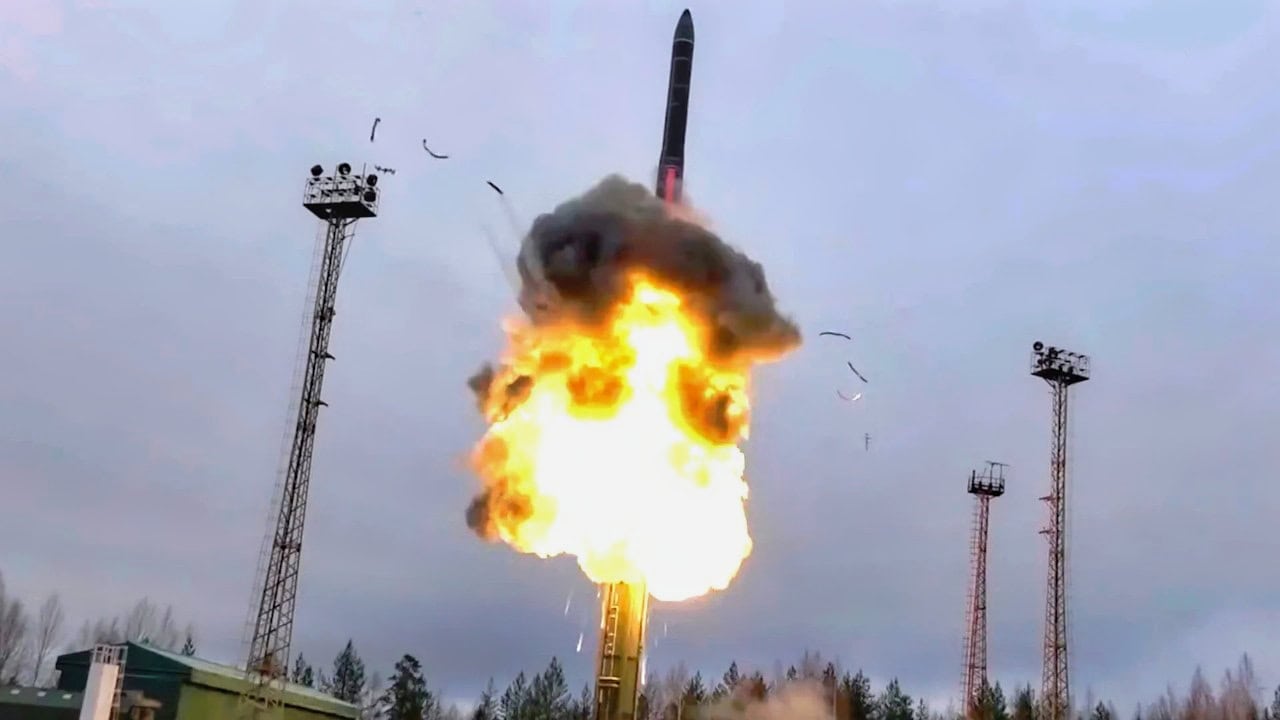
According to an Associated Press report on May 24, President Volodymyr Zelensky stated that Russia used the hypersonic ballistic missile "Oreshnik" during a massive strike on Kyiv and its surroundings. Ukrainian military reported 600 strike drones and 90 missiles from air, sea, and ground-based platforms. Reuters, echoed by several financial and news outlets, also noted that the strike was one of the heaviest for Kyiv throughout the war, and the "Oreshnik" was used in the capital area for the third time since the beginning of the full-scale invasion. The Russian version, published by TASS citing the Russian Ministry of Defense, formulates the target differently: command posts, airfields, and enterprises of Ukraine's military-industrial complex were hit by the "Oreshnik," "Iskander," "Kinzhal," "Tsirkon," and drones.
The difference between these descriptions is important not only for propaganda. Ukraine speaks primarily about the scale of the strike and civilian consequences. Russia emphasizes the range of means of destruction and the alleged military nature of the targets. Between these two frameworks lies the real military logic: the "Oreshnik" is not an economical means of destruction in conventional equipment if evaluated solely by the cost of the destroyed object. Its rationality emerges when the strike is viewed as part of a coercion campaign, where physical damage is combined with a demonstration of the ability to exert nuclear-associated, but formally non-nuclear pressure.
Why the "Oreshnik" is more important than the number of missiles
Technically, the "Oreshnik" is described in open sources as a Russian medium-range ballistic system, closely related to the RS-26 "Rubezh" line. Its military significance lies not in the attractive term "hypersonic," which journalists use too freely, but in the combination of three parameters: high speed in the terminal phase, possible separation of the warhead, and the political ambiguity of the carrier. Such a missile in conventional configuration does not do what the "Iskander" or a cruise missile cannot fundamentally do against a well-reconnoitered target. However, it sharply increases the cost of error for the adversary and its allies, as the trajectory and external profile resemble a more dangerous class of weapons.
The old Soviet school called this not "escalation for the sake of escalation," but management of fear. In the 1970s, the General Staff loved the term "demonstrative actions," implying steps that force the adversary to consider not only the damage inflicted but also the next possible level of violence. In May 2026, Moscow, judging by the sequence of events, is trying to bring this tool back to the center of the war. A few days before the strike, Russia conducted large-scale exercises of its nuclear forces, and the information background was already saturated with statements about "retribution" for Ukrainian long-range strikes on Russian territory. Against this backdrop, the launch of the "Oreshnik" appears not as a separate tactical episode, but as part of a vertical signal: drones pressure air defense, cruise and air-launched ballistic missiles inflict material damage, and the "Oreshnik" informs Washington and European capitals that Moscow is ready to play near the nuclear threshold without legally crossing it.
Combined strike as a new norm
The Institute for the Study of War noted in its assessment on May 24 that Russia is increasingly using mass waves of Shahed-type drones to overload Ukrainian air defense and facilitate subsequent missile hits. This observation seems prosaic, but it contains the operational essence. The Russian army in 2022 attempted to suppress the Ukrainian command and energy systems primarily with missiles. In 2024-2026, it is transitioning to a more industrial model: cheap drones create density, false targets consume air defense missiles, ballistic means seek temporary windows, and rare systems like the "Oreshnik" are used as the pinnacle of the psychological pyramid.
There is an unpleasant paradox for Moscow here. The more often Russia is forced to cover a strategic signal with thousands of relatively cheap drones, the more obvious the limitations of its missile stock and production cycle become. If the Russian defense industry had unlimited capacity for precision missiles, there would be no need to methodically saturate the sky with "moped" mass. However, from the Ukrainian perspective, this paradox offers little consolation: even a "cheap" drone that penetrates the air defense system can force a city to live in a state of continuous alert, and each wave depletes calculated resources, anti-aircraft missiles, mobile groups, and operator attention.
Military-political addressee of the strike
Formally, the strike was directed against Ukraine. In fact, there were more addressees. The first is Ukrainian society, to which Moscow is trying to prove that the capital is not protected even after four years of adaptation. The second is European governments discussing new aid packages and expanding the production of air defense systems. The third is Washington, where each Russian launch of a medium-range ballistic system will be viewed not only through the Ukrainian map but also through the architecture of strategic stability after the demise of the INF Treaty. The Soviet habit of speaking to America through Europe has not disappeared; it has simply shifted from East Germany and Poland to Ukraine on the map.
The Russian Ministry of Defense, claiming that all designated targets were hit, follows the familiar bureaucratic formula. It proves little. More important is the very list of declared means: "Oreshnik," "Iskander," "Kinzhal," "Tsirkon," drones. This is not just a list of weapons, but a showcase. Showcases, as anyone who lived in the late USSR knows, often display not the presence of abundance but the desire to portray it. But even a showcase can work if the buyer is nervous.
What this changes for Ukraine and NATO
For Ukraine, the main conclusion is not that a new "uninterceptable" Russian sword has appeared. There have been enough such swords in Russian rhetoric over the past twenty years. The conclusion is harsher: air defense must be calculated not for a single type of threat but for a package where the cost of interception systematically exceeds the cost of the attack. This requires not only Patriot and SAMP/T for ballistic targets but also a mass cheap layer against Shahed-type drones, resilient communication, spare radar positions, and industrial production of interceptors at a pace that Europe has only promised so far.
For NATO, the use of the "Oreshnik" in May 2026 serves as a reminder that Russian escalation has long ceased to be limited to the front in Donbas. Moscow is trying to combine a conventional war of attrition with a demonstration of means that are on the border of the strategic class. This does not mean the inevitability of a nuclear crisis. On the contrary, the Kremlin is still carefully staying below the formal threshold. But it is precisely such a zone below the threshold and above conventional war that is most dangerous for politicians accustomed to dividing events into "conventional" and "nuclear." Russian doctrinal practice has always favored intermediate states.
In the coming months, I would expect not frequent use of the "Oreshnik," but its periodic return at moments of diplomatic or military pressure: before major negotiations, after successful Ukrainian strikes on Russian infrastructure, or against the backdrop of decisions on new air defense and long-range systems supplies to Kyiv. Russia likely does not have enough stock of these missiles to turn them into a routine tool of the campaign. But it does not need many. For demonstrative weapons, what matters is not serial production but the memory of the launch. In this sense, the night of May 23-24 was not just a strike on Kyiv. It was Moscow's claim to return fear as a full-fledged element of operational art.
Sources: Associated Press, Reuters, TASS, Institute for the Study of War, Ukrainian Air Force and Ukrainian official statements from May 24-25, 2026.
On May 23-24, 2026, Russian Armed Forces conducted a massive strike on Kyiv, deploying 600 drones and 90 missiles, including the hypersonic Oreshnik missile. This marked the third use of the Oreshnik since the full-scale invasion began in February 2022. The attack is noted as one of the heaviest on Kyiv throughout the conflict, aiming to demonstrate Russia's military capabilities and send a political message to Ukraine and its allies.
- Russia launched a massive strike on Kyiv using 600 drones and 90 missiles.
- The Oreshnik missile was used for the third time since February 2022.
- The strike is one of the heaviest for Kyiv during the war.
- Ukrainian military reported significant damage and civilian impact.
- The operation is part of a broader strategy to demonstrate military capabilities.