
The PLA's 2026 New Training Includes Drones: Examining the Shortcomings of Mass Production of Unmanned Equipment from the Perspective of New Recruits
 Li Minghui
The PLA's 2026 New Training Incorporates Drones: Examining the Shortcomings After Mass Production of Unmanned Equipment from the Perspective of New Recruits
On May 25, an interesting detail from China Military Online reported that a certain army training base has fully integrated basic drone applications into the new recruit training system. New recruits do not first run five kilometers and make their beds before engaging with specialized equipment; instead, they practice roll angles, horizontal attitudes, and obstacle avoidance using simulation software in a dedicated drone training room. This change may seem small, but it points to a more pressing issue in the PLA's modernization: equipment is being acquired rapidly, but can personnel keep up?
Why New Recruit Training is Important
Three keywords in the report are worth unpacking: first, "fully integrated"; second, "at the beginning of a soldier's career"; and third, "solving the demand for specialized drone operators, which is high, and the training cycle, which is long." This indicates that drones are no longer just specialized subjects for reconnaissance teams, special operations units, or certain combined arms battalions, but are beginning to enter earlier stages of talent generation. In simple terms, the military has realized that supplementing drone courses after new recruits are assigned to units is already too slow.
The approach taken by this base is also very pragmatic: theoretical instruction, simulation experience, and practical flight training, followed by involving local technical teams for training support. There are no mysterious technologies here; rather, it is the most basic training engineering. The difficulty in training drone operators is not just whether they can take off, but whether they can stably complete tasks in strong winds, under cover, with electronic interference, low-altitude obstacles, and firepower coordination. The new training phase cannot solve all problems, but it can identify those with a good feel for the equipment early on and help ordinary infantry understand that unmanned equipment is not just "auxiliary toys."
Equipment Expansion Forces Training Reform
On the same day, another report from China Military Online mentioned that multiple military branches are pushing the boundaries of training outward: a certain brigade in the Tibet Military District quickly completed shooting preparations after mobile deployment of long-range rocket artillery; a certain unit of the Western Theater Air Force broke through the previously believed performance limit of 4800 meters for a certain type of radar equipment at an altitude of 5500 meters; the 71st Group Army's brigade used a long-range rocket artillery simulation training cloud platform to review operations, while the 83rd Group Army's brigade set up complex electromagnetic environments and extreme strike distances in a virtual sand table. These examples are scattered across different military branches, but the logic is consistent: once equipment enters the troops, training no longer follows the safety boundaries outlined in manuals, but instead seeks the limits of human-equipment integration.
The South China Morning Post on May 19 quoted a warning from PLA Daily that was more direct: new equipment, including unmanned and intelligent systems, is being rapidly deployed, but some units still have shortcomings in human-equipment integration, professional talent cultivation, and human-machine collaboration. I believe this warning is more significant than merely showcasing new models. The current issue in Chinese military industry is often not "can we produce a drone," but rather "can we ensure that hundreds or thousands of grassroots personnel can stably use unmanned systems." The former is an industrial project, while the latter is an organizational project, and the difficulty is not low.
Unmanned Equipment is Not Just a Single Platform Issue
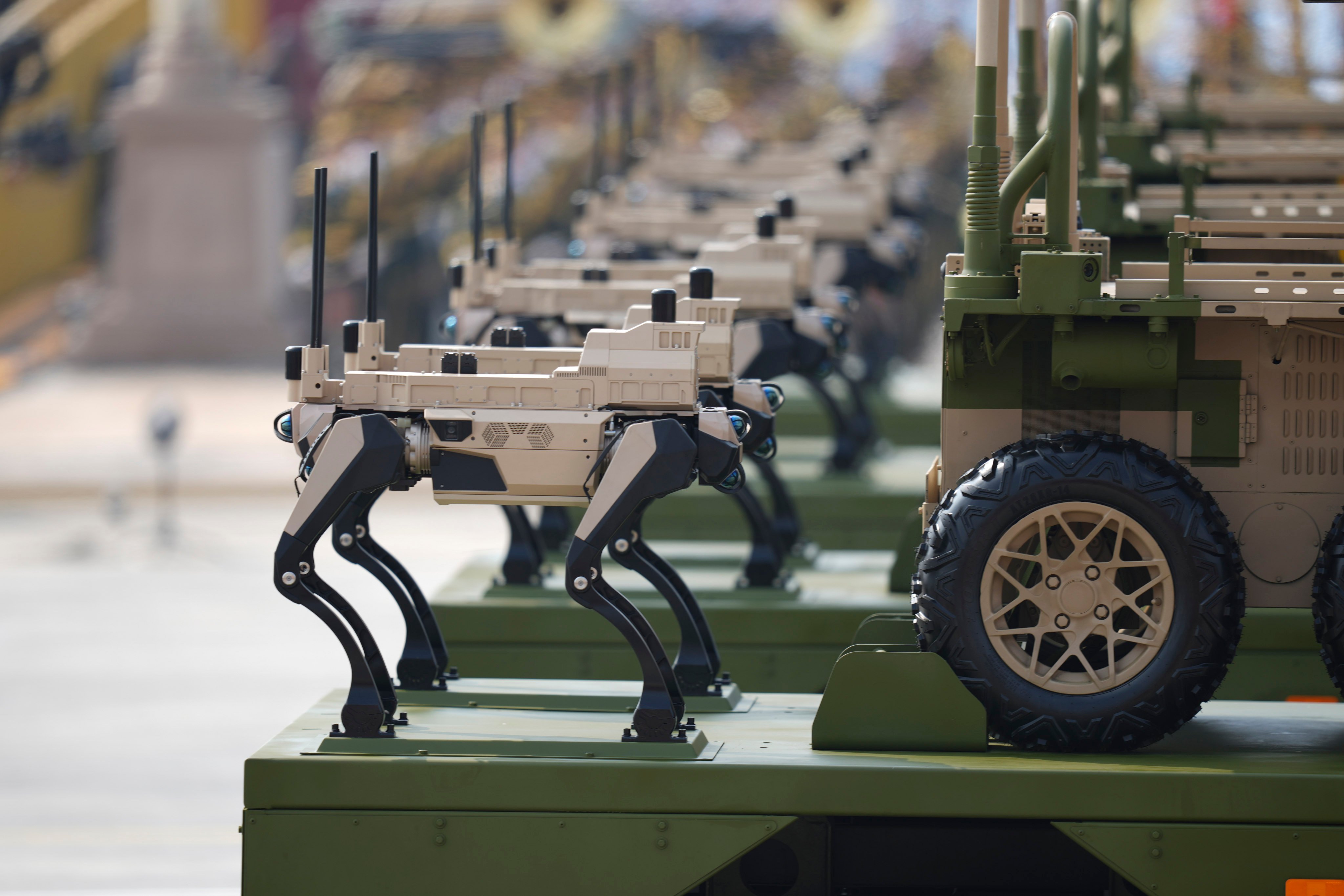
In recent months, the PLA has repeatedly showcased drones, robotic dogs, unmanned ground vehicles, and infantry collaboration in public footage. A CGTN urban warfare training video from April showed unmanned systems being used for reconnaissance, assault leading, and reducing personnel exposure risks. A report from the China Aerospace Studies Institute also mentioned that the PLA's unmanned equipment control model is evolving from multiple people controlling one platform to one person controlling one or even multiple platforms. The direction is clear: grassroots units in the future will need to manage not just guns, vehicles, and artillery, but also sensors, links, algorithms, and batteries.
- In terms of reconnaissance, drones can expand the field of vision for squad and platoon-level units from hundreds of meters to several kilometers.
- In terms of strike capability, drones, loitering munitions, and small unmanned vehicles can fill the firepower gaps of traditional infantry.
- In terms of support, robotic dogs and unmanned vehicles can transport ammunition, casualties, or sensor nodes.
- In terms of risk, link suppression, misidentification, and operator overload can directly negate the advantages of the equipment.
This is also why incorporating simulation software into new recruit training is not low-end. The real expense is not a small training drone, but rather enabling grassroots soldiers to develop a basic intuition about airspace, spectrum, terrain, and task chains. Without this intuition, so-called "intelligent equipment" will become another type of display item that requires maintenance by a few experts.
Shortcomings After Mass Production Are Harder to Address
From a supply chain perspective, the hardware foundation of China's unmanned equipment is not weak. Commercial drones, batteries, electro-optical pods, lidar, and small servo systems all have a large industrial support base, and military-civilian integration allows for rapid trial and error of many technologies. However, the training system does not have the same Moore's Law. A qualified drone operator, a squad leader who understands the electromagnetic environment, and a platoon leader who can integrate drone intelligence into the firepower chain all require time.
Therefore, when looking at these two official reports from May 25 together, the signal is not simply that "the PLA has added more drone courses," but rather that grassroots training is being reshaped by new types of combat forces. I am somewhat skeptical of an optimistic view: that as long as unmanned equipment is cheap and available in sufficient quantities, the troops will naturally develop combat capabilities. The battlefield in Ukraine has already proven that while cheap platforms are indeed important, what is more crucial is the speed of iteration, maintenance and supply, anti-jamming capabilities, and operator experience. Without these, numerical advantages will quickly be consumed by attrition rates.
What truly needs to be observed next is whether these newly trained soldiers can become the backbone of unmanned systems in combined arms battalions, army aviation brigades, and rocket artillery units in a few years. If the answer is no, then today's training reforms are merely remedial; if the answer is yes, the diffusion speed of the PLA's unmanned equipment may be faster than what external observers estimate based on equipment catalogs.
Sources
Main sources: China Military Online - PLA Daily "A Certain Army Training Base Focuses on Optimizing Training Models to Meet Troop Talent Needs," May 25, 2026; China Military Online - PLA Daily "Multiple Military Branches Persist in In-Depth Research and Training to Continuously Expand Training Boundaries," May 25, 2026; South China Morning Post "Can PLA training catch up with China’s rapid weapon development?" May 19, 2026; CGTN "Chinese army tests human-unmanned team tactics in urban warfare drill," April 19, 2026; China Aerospace Studies Institute "Taking Flight: China’s Military Unmanned Aerial Vehicle Industry," 2025.
The People's Liberation Army (PLA) has integrated drone training into its new recruit training system as of May 25, 2026, emphasizing the need for recruits to learn drone operation early in their training. This shift aims to address the growing demand for skilled drone operators and adapt military training to new technologies. The PLA is also exploring ways to enhance the integration of personnel and equipment in military operations.
- The PLA has integrated drone training into the new recruit training system.
- New recruits are trained on drones before traditional physical training.
- The training aims to address the demand for skilled drone operators.
- The PLA is pushing the boundaries of military training to adapt to new equipment.
- There are concerns about the integration of personnel and technology in military operations.