
Honeywell tests counter-drone system at CENTCOM event
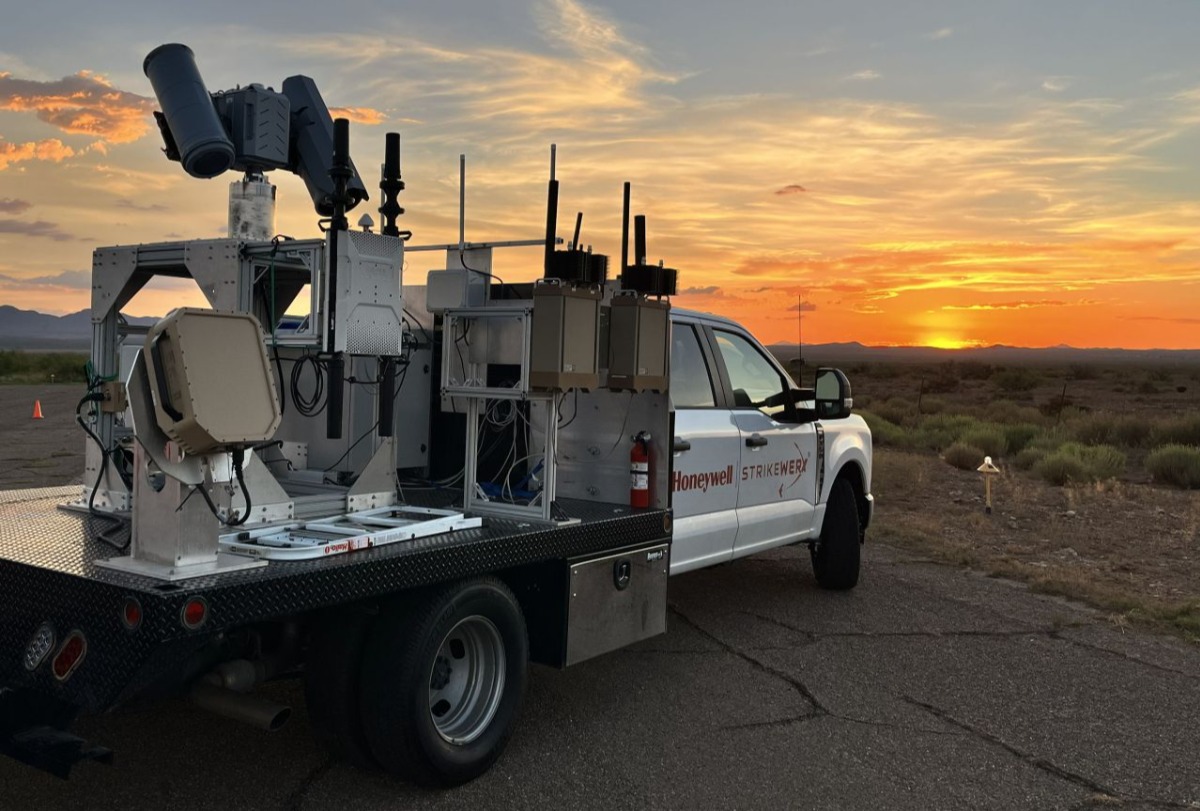
Honeywell Aerospace tested an integrated counter-drone system against simulated aerial threats during EXTiC 26-2, a technology experimentation event run by U.S. Central Command.
Honeywell served as lead systems integrator for the demonstration, pairing sensors and effectors with the company’s AI-driven counter-UAS software to detect, track and mitigate simulated drones while defending a simulated airfield.
“As a lead systems integrator, we combined best-in-class sensors and effectors with our AI-driven C-UAS software to detect, track, and mitigate simulated drone threats while defending an airfield,” said Shannon Bowman, senior customer marketing specialist for defense and space at Honeywell Aerospace.
“Our system proved effective across both static and on-the-move operations, highlighting an open, adaptable and layered approach to countering rapidly evolving UAS threats,” Bowman said.
EXTiC, short for Experimentation: Transforming in Contact, is a CENTCOM initiative run in coordination with the Defense Innovation Unit. The command uses the event to test, validate and integrate new and emerging technologies against operationally relevant scenarios for Joint Force participants. EagleNXT’s joint venture ThirdEye USA was separately selected in July to demonstrate its MeduzaX passive electro-optical counter-drone sensor at the same event.
The company’s counter-UAS product line includes the Stationary and Mobile UAS Reveal and Intercept system, known as SAMURAI, which combines customer-selected detectors and effectors under a Modular Open Systems Approach architecture. Honeywell has said SAMURAI can operate from a vehicle traveling up to 70 mph (113 km/h) or from a fixed position, and is designed to counter Group 1 through 3 drone swarms, including low-signature “dark” drones that are harder to detect.
Honeywell has demonstrated SAMURAI in earlier U.S. military testing, including a configuration operated from a ground vehicle and another that used sensors mounted on an aerostat flying above 1,000 feet (305 meters). The company has also worked with Odys Aviation since March 2026 to adapt an airborne version of SAMURAI for use aboard Odys’ long-range Laila unmanned aircraft, intended to protect infrastructure such as refineries and pipelines.
“One integrated system. Built to stay ahead of the drone threat,” Bowman said.
Content preview only. Full article available at source. View Full Article
Honeywell Aerospace tested an integrated counter-drone system against simulated aerial threats at the U.S. Central Command's EXTiC 26-2 event. The system, which combines sensors and AI-driven software, effectively detected and mitigated drone threats while defending a simulated airfield. This demonstration highlights the adaptability of the technology in both static and mobile operations.
- Honeywell Aerospace tested a counter-drone system at a CENTCOM event.
- The system uses AI-driven software to detect and mitigate drone threats.
- The event was part of EXTiC 26-2, a technology experimentation initiative by CENTCOM.
- Honeywell's SAMURAI system can operate from vehicles or fixed positions.
- The system is designed to counter Group 1 through 3 drone swarms.