
Colby's Burden-Sharing Tour Ends at the Naval Base China Renovated
 Marcus Chen
Colby's Burden-Sharing Tour Ends at the Naval Base China Renovated
Elbridge Colby, the Pentagon's under secretary of war for policy, wrapped his first official Southeast Asia trip on August 15 in Phnom Penh, sitting across from Cambodian Defense Minister Tea Seiha. On the table: reviving the Angkor Sentinel exercises, expanding training slots, and a renewed US interest in naval visits to Ream Naval Base. That last item is the part worth staring at. Ream is the facility Beijing renovated and the reason Washington kept Cambodia under an arms embargo through 2025. A trip that opened in Manila with the slogan "partners, not protectorates" closed with the US Navy asking for dock space at a pier China rebuilt.
The Manila Doctrine
Colby's August 10 speech at the Stratbase Institute was the doctrinal core of the tour. He told Manila's defense elite that "America is definitely not disengaging from Asia. We are not leaving; in fact, we are digging in to ensure a favorable balance of power where it matters most." The mechanism, he said, is "deterrence by denial along the First Island Chain" — the arc of islands from Japan through Taiwan and the Philippines to Borneo. Then came the part allies were actually listening for: Washington will not pay for all of it.
"When we ask our allies and partners to step up, to invest more in their own defense, and to take responsibility for their own sovereign security, we are not signaling abandonment. We are looking for partners, not protectorates. When our partners are strong, deterrence is strong."
Notably, Colby never named China in the Manila speech. The omission was deliberate. Weeks before Xi Jinping's September visit to Washington, the message was reassurance without confrontation — a posture he described as "strong, clear, but quiet" collaboration.
The Quiet Strategy and Its Price Tag
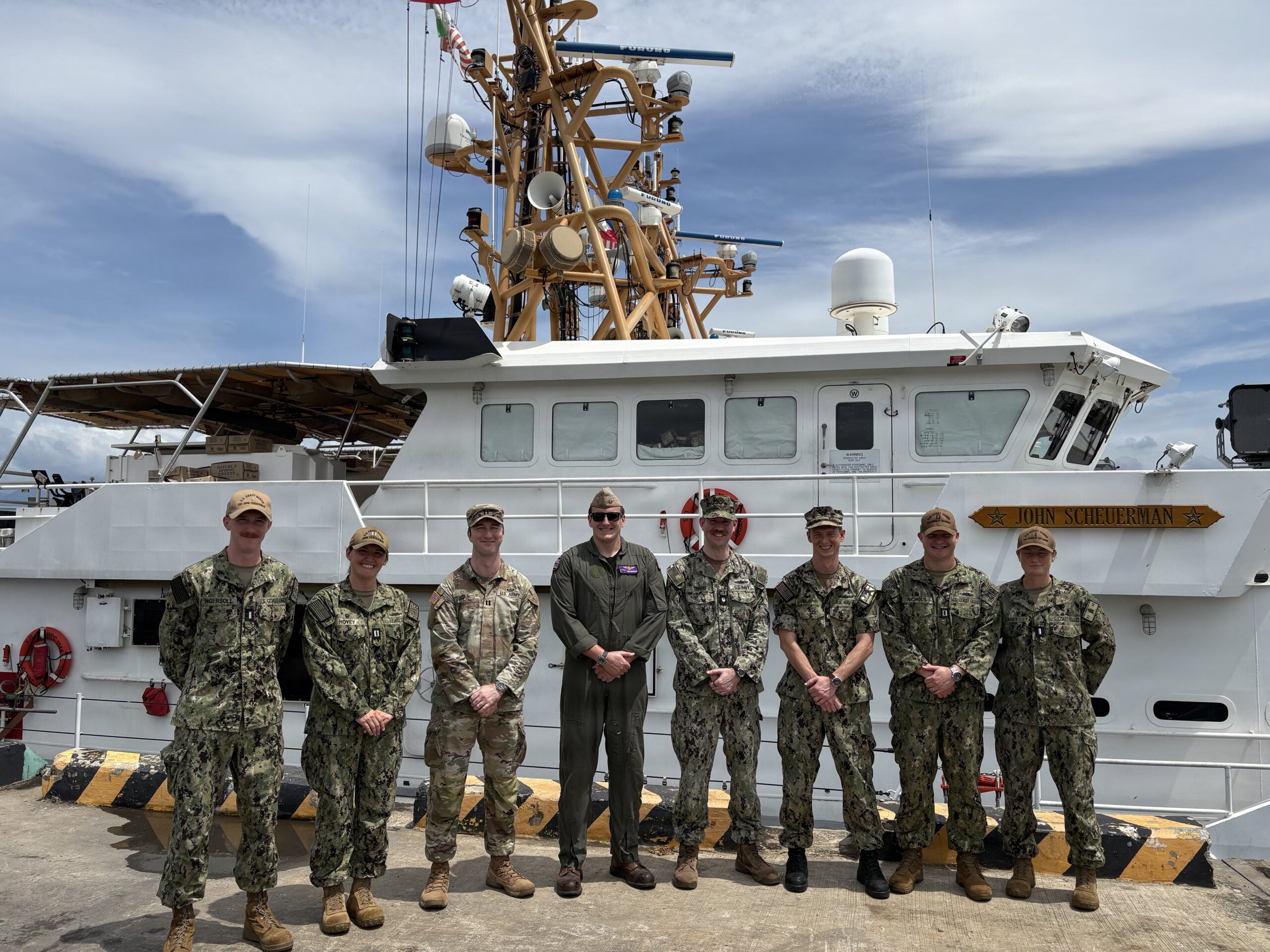
Colby also pushed back, in Manila and on the road, on reporting that US stockpiles are strained after Operation Epic Fury. "There's been a lot of news about the United States military being stretched. Please don't be misinformed," he said. He touted an eight-point partnership plan signed with the Philippine armed forces for 2027 and the rotational deployment of four US Coast Guard fast response cutters for Philippine maritime security.
But the tour's own context undercuts the reassurance. The FY2027 budget request is $1.45 trillion, up 44 percent, with more than half of discretionary funding going to procurement and R&D — an acknowledgment that the arsenal needs rebuilding precisely because the Middle East campaign consumed it. The $11.7 billion Pacific Deterrence Initiative, up $1.6 billion, funds posture and infrastructure, not new hulls. As USNI News summarized the tour's message last week: quiet collaboration, not tub-thumping. Quiet, though, reads differently in Manila than in Washington. Taiwan Strait transits by US warships have fallen to roughly one in seven months. Allies track those numbers.
The Base China Renovated
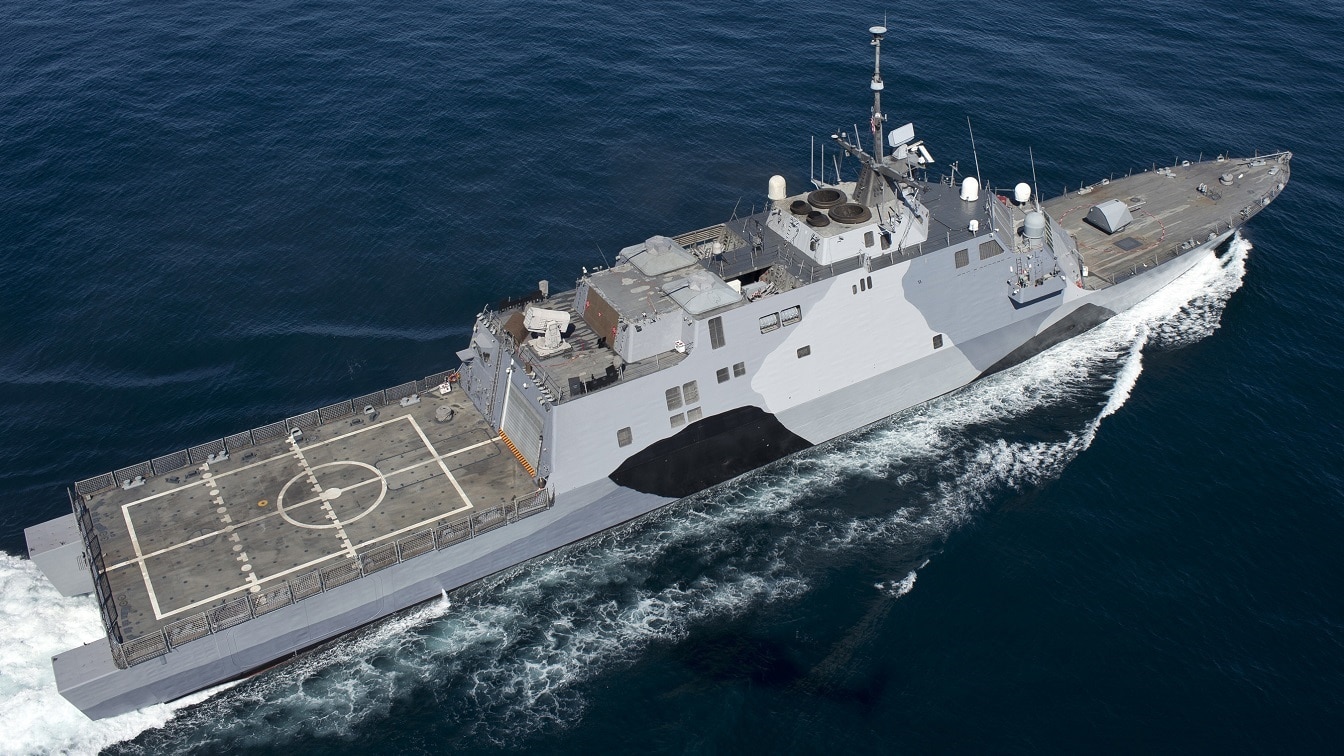
Cambodia was the tour's final stop for a reason. The US lifted its arms embargo in November 2025 — reversing restrictions imposed in 2021 over China's military influence at Ream — and the change took effect in February 2026. In January, the Independence-class littoral combat ship USS Cincinnati made the first US Navy port call at Ream since its Chinese-funded renovation. Pacific Fleet commander Admiral Steve Koehler visited Phnom Penh in early August. Colby's visit, per the US Embassy, seeks to move the relationship into a more "operational" phase: Angkor Sentinel returning in 2027 after a decade-long suspension, plus expanded professional military education and personnel reforms.
Read that trajectory against the doctrine. Washington spent four years sanctioning Cambodia over Chinese access to Ream. Now it is negotiating for more port visits to the same facility, framing Cambodian "commonsense military reforms" as a regional contribution. Phnom Penh, meanwhile, has said all along the base is open to friendly navies — a formulation that lets Hun Manet take Chinese construction and US exercises at the same time. That is not partnership. That is a hedge, and Washington is paying for the privilege of participating in it.
What the Region Actually Heard
Burden-sharing is the oldest ask in the alliance book, and Colby's version is more honest than most: he wants allies to buy their own denial capabilities because the US arsenal is finite. The logic is sound. The accounting is not. The Philippines' modernization budget cannot close the gap between China's carrier strike groups operating in the West Philippine Sea and the forces required to contest them. Thailand and Indonesia are further from the threat and further from spending. And the one ally the tour was designed to reassure — the Philippines, still smarting from the July 20 Second Thomas Shoal clash in which a Chinese coast guard officer struck a Philippine sailor — got a doctrine instead of a commitment.
The deeper problem is that Colby's tour collided with the region's actual complaint. Southeast Asian governments have never doubted that the US shows up militarily. What they doubt is everything else: tariff policy that taxes their exports, and a Middle East war that cut off Hormuz oil. Colby's "flexible realism" offers no answer to either, because the doctrine is designed for deterrence, not economics. As one regional framing put it, the US remains an economically disruptive force — and military reassurance does not pay for disrupted trade.
The Receipts Are the Alliance
Colby told Manila the US military is at "apex predator status" and that anyone projecting power into the Indo-Pacific "is going to come up against the very best military in the world." Fine. But the tour's own itinerary was the more accurate statement of the balance of power. It began with a demand for more allied spending and ended with the US Navy seeking dock space at a base China renovated. "Partners, not protectorates" is a reasonable line — until the partner in question is Cambodia, and the price of the partnership is accepting a Chinese-built pier as the venue.
That is the catch the tour could not resolve. Washington wants Southeast Asia to buy more deterrence at exactly the moment its own stockpiles are rebuilding and its transit signals are shrinking. Colby's doctrine is coherent on paper. On the ground, the region is doing the math: the US asks for partners, offers quiet collaboration, and takes what it can get — even at Ream. Allies will shoulder more burden, all right. They will just charge market rates.
Elbridge Colby concluded his Southeast Asia tour in Phnom Penh on August 15, 2023, focusing on military partnerships with Cambodia and the Philippines. The U.S. Navy requested dock space at the Ream Naval Base, renovated by China, highlighting a shift in U.S. military policy. Colby emphasized the importance of allies investing in their own defense capabilities, while the U.S. lifted its arms embargo on Cambodia, allowing for increased military cooperation.
- Elbridge Colby concluded his Southeast Asia tour on August 15, 2023.
- The U.S. Navy requested dock space at Ream Naval Base, which was renovated by China.
- Colby emphasized the need for allies to invest in their own defense capabilities.
- The U.S. lifted its arms embargo on Cambodia in November 2025, allowing for military cooperation.
- Colby's tour aimed to reassure allies amid concerns over U.S. military stockpiles.