
Iran Closes the Strait of Hormuz in July 2026, Qatar and Oman Attempt to Save the Oil Channel
 Ahmed Al-Rashid
Iran Closes the Strait of Hormuz in July 2026, Qatar and Oman Try to Save the Oil Channel
On July 11 and 12, 2026, the crisis in the Strait of Hormuz was no longer just a matter of fiery statements. Iran announced that the passage was closed to unauthorized vessels, and Washington returned to strikes after commercial ships were hit, while Qatar and Oman moved at the same moment to keep the door to negotiations open. Militarily, this is the most dangerous type of crisis; not because it declares a full-scale war, but because it mixes civilian navigation with missile deterrence and political bargaining in a passage that cannot tolerate improvisation.
The most important information in the last hours is that Iranian Foreign Minister Abbas Araghchi discussed with his Omani counterpart mechanisms for safe passage in the strait, while media reports spoke of an attempt to arrange a negotiation channel involving Iran, the United States, Qatar, and Pakistan. In contrast, U.S. officials stated that Washington wants a public Iranian commitment to stop attacks on ships and to open all passages without fees. Here lies the essence of the crisis: the United States speaks of freedom of navigation, Iran speaks of sovereignty and prior permission, and the Gulf states pay the price before sitting at the table.
The Strait as an Administrative Weapon, Not Just a Naval Weapon
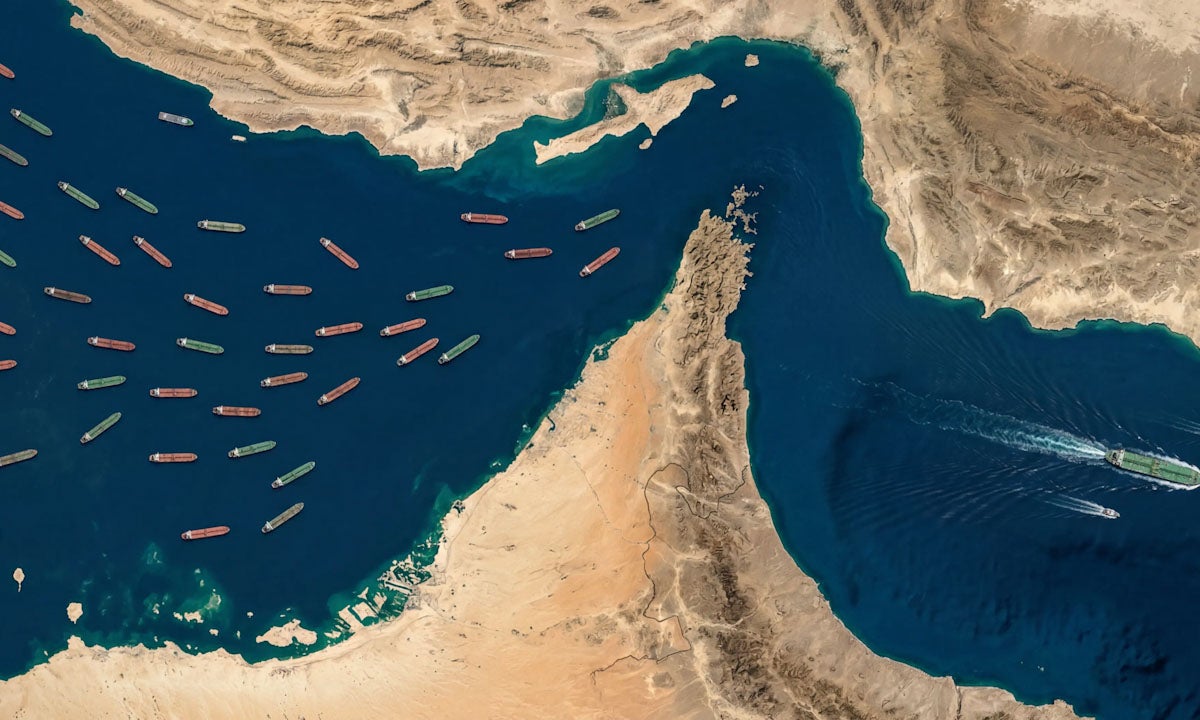
It is a mistake to understand the closure of Hormuz as we understand the closing of an iron gate. Iran does not need a single button to paralyze the strait. It is enough to make insurance companies hesitate, to confuse the captains of tankers, and to impose the idea that a ship that does not pass through an Iranian-approved channel may become a target. Before the war, about one-fifth of global oil supplies passed through Hormuz. This figure does not mean that Iran can control one-fifth of global oil forever, but it means that it can turn every maritime journey into a high-cost political decision.
In my estimation, what Tehran is doing is closer to militarizing maritime administration. It is not just a matter of the number of fast boats or coastal missiles, but who has the right to say that this ship is allowed and that one is prohibited. When Muscat suggests, according to American reports, a free southern passage in Omani waters and a northern passage that requires Iranian approval without fees, it is not offering an innocent technical solution. It is trying to separate navigation from full recognition of Iranian control, but this separation is as difficult at sea as it is on maps.
The American Condition and Its Practical Dilemma
The American condition is clear on paper: no attacks, no fees, no closures, and all passages open. Militarily, this condition seems natural for a naval power that sees itself as a guarantor of the maritime order. But the problem is that Washington wants Iran to give up its basic negotiating card at a time when it says the ceasefire is over. Donald Trump announced that talks would continue but also wrote that the truce was over. This formula suits political rhetoric, but it creates an operational problem for commanders at sea and in the air.
Any commander who has served in the region knows that ambiguous rules of engagement are more dangerous than clear aggressive rules. If talks are ongoing, is every Iranian boat approaching a potential target tanker? And if the truce is over, can Qatar or Oman guarantee the safety of mediation delegations? And if the attacks on ships are, as reported by American officials, the result of a rogue element within the Iranian system, is negotiating with the Foreign Ministry enough to rein in the Revolutionary Guard? These are not just diplomatic questions, but questions of command and control.
Qatar and Oman Between Mediation and Security Calculations
The moves by Qatar and Oman do not mean that the two countries are neutral in the naive sense of the word. Qatar's maritime and gas interests have come under direct pressure, and Oman knows that any long war in Hormuz will hit its position as a mediator and alternative passage. Mediation here is a form of national defense. It is less costly than purchasing additional Patriot batteries, but it is not less important.
However, the crisis reveals the limits of the Gulf security model. The Gulf has money, weapons, and modern air facilities, but it still does not have an independent regional system to manage a maritime crisis of this magnitude. When commercial ships are hit, Gulf capitals wait for the American statement, then wait for the Iranian response, and then try to salvage negotiations. This is not a moral failing, but a result of years of building capacity around equipment rather than building shared institutions. The triad of capability that I always repeat—equipment, training, and institutions—shows here clearly. The equipment is present, but the regional institution that decides quickly and speaks with one voice is not present.
Iran Does Not Want Economic Suicide but Wants a Price for Passage
Iran knows that completely closing Hormuz will hurt it as well. Its oil, trade, relations with China and Asia, and even its ability to claim it is a responsible state will all be harmed. Therefore, I do not see Tehran's goal as a permanent closure. The closer goal is to impose a new rule: passage in the Gulf is not an automatic right, but a privilege that requires an understanding with Iran.
If this rule is established, even partially, it will be a political gain for Tehran greater than any missile strike. For a missile's effect ends after the explosion, while a maritime permission system creates a new norm. And those who know the region know that customs in maritime passages gradually turn into norms, then into legal demands. This is why Washington pressures for the phrase "without fees and without permission," as it understands that the battle is not over a single tanker but over who writes the rules of the road.
The Nuclear Dimension Cannot Be Separated from the Sea
Introducing the enriched uranium file into the conditions for de-escalation complicates the picture. Washington wants to link the opening of the strait to nuclear concessions, while Iran wants to separate its maritime sovereignty from its nuclear file. Practically, both sides are using the same card with two different faces. The United States says that freedom of navigation is a condition before any easing of sanctions or serious discussion on nuclear issues. Iran says that maritime pressure is what forces Washington to take its demands seriously.
This linkage is dangerous because it prolongs the crisis. If the dispute were only over the passage of ships, Oman could formulate a maritime monitoring mechanism within days. And if the dispute were only over uranium, the file would be in nuclear negotiation rooms. But when the passage of a tanker becomes entangled with the fate of centrifuges, every maritime incident turns into a vote with ammunition on the future of the agreement.
What This Means for the Gulf
Saudi Arabia, the UAE, Kuwait, Bahrain, and Qatar are not just a stage for this crisis. They are affected parties even when no shots are fired. Rising insurance costs, slow tankers, threats to American bases, and declining confidence in the regularity of energy exports are all direct Gulf costs. But the Gulf response is still mostly diplomatic and individual, while the Hormuz crisis should be the natural test for any collective maritime security structure.
The paradox is that Gulf states have spent hundreds of billions over the past two decades on aircraft, air defense, and ships, yet they still rely on the United States at the moment when it should be determined who escorts the ships, who responds, and who negotiates. Buying weapons gives the state tools, but it does not automatically grant it decision-making capability. As we say in the military, a rifle in the hands of a soldier not tied to clear command can become a burden to its owner.
Military Summary
The July 2026 crisis in Hormuz is not just a new chapter in the U.S.-Iranian conflict. It is a test for a whole system built on the assumption that the United States guarantees the sea, Iran threatens from the shore, and the Gulf buys protection and funds stability. Now this assumption is shaking. Washington wants an open passage without a political price, Tehran wants passage to be recognition of its role, and the mediators want a ceasefire before every tanker turns into a message.
The real dilemma is that the Gulf wants maritime sovereignty without direct confrontation, the United States wants deterrence without a long war, and Iran wants influence without economic suicide. These are three desires that do not easily converge in a strait that is narrow in width but whose impact is broader than the maps of all capitals.
Sources: Reuters via The Straits Times, Al Jazeera, The National, UPI, and Google News follow-up reports published between July 10 and 12, 2026.
Iran closed the Strait of Hormuz to unauthorized vessels in July 2026, prompting Qatar and Oman to negotiate a solution to the oil channel crisis. U.S. officials are demanding Iran publicly commit to halting attacks on vessels. The situation reflects a complex mix of military deterrence and political bargaining, impacting global oil supply routes.
- Iran has closed the Strait of Hormuz to unauthorized vessels.
- Qatar and Oman are negotiating to keep the oil channel open.
- U.S. officials demand Iran publicly commit to stopping attacks on vessels.
- Iran's actions are seen as a mix of military deterrence and political bargaining.
- The closure affects global oil supply routes.