
Iran demands exclusive control of the Strait of Hormuz in 2026 after 4 drones and new American strikes
 Ahmed Al-Rashid
Iran Demands Sole Management of the Strait of Hormuz in 2026 After 4 Drones and New U.S. Strikes
On June 28, the crisis in the Strait of Hormuz is no longer about a damaged ship or a coastal radar struck near Qeshm and Sirik. The most significant statement came from Tehran when Iranian Foreign Minister Abbas Araghchi pushed the idea that Iran would manage traffic in the strait alone, while the UAE condemned new Iranian attacks on Bahrain and Kuwait, and Doha dealt with the death of a Qatari citizen from shrapnel during a military operation. Here, the issue shifts from a maritime incident to a sovereign question: who has the right to control the artery through which Gulf energy flows?
According to circulating data from reports by The National, UKMTO, and U.S. military data, a suicide drone struck a commercial vessel flying the Singaporean flag, the M/V Ever Lovely, while it was moving off the coast of Oman outside Hormuz, while the U.S. president stated that Iran launched four suicide drones at ships in the area, three of which were shot down and one hit a cargo ship. Following that, Washington announced strikes on Iranian missile, drone, and coastal radar storage sites. Militarily, this is a small sequence in size, but significant in meaning: Iran is testing traffic rules, the U.S. is striking control tools, and Gulf countries stand between the two as if the strait lies outside their operations rooms.
The Strait is No Longer a Maritime Passage but a Control System
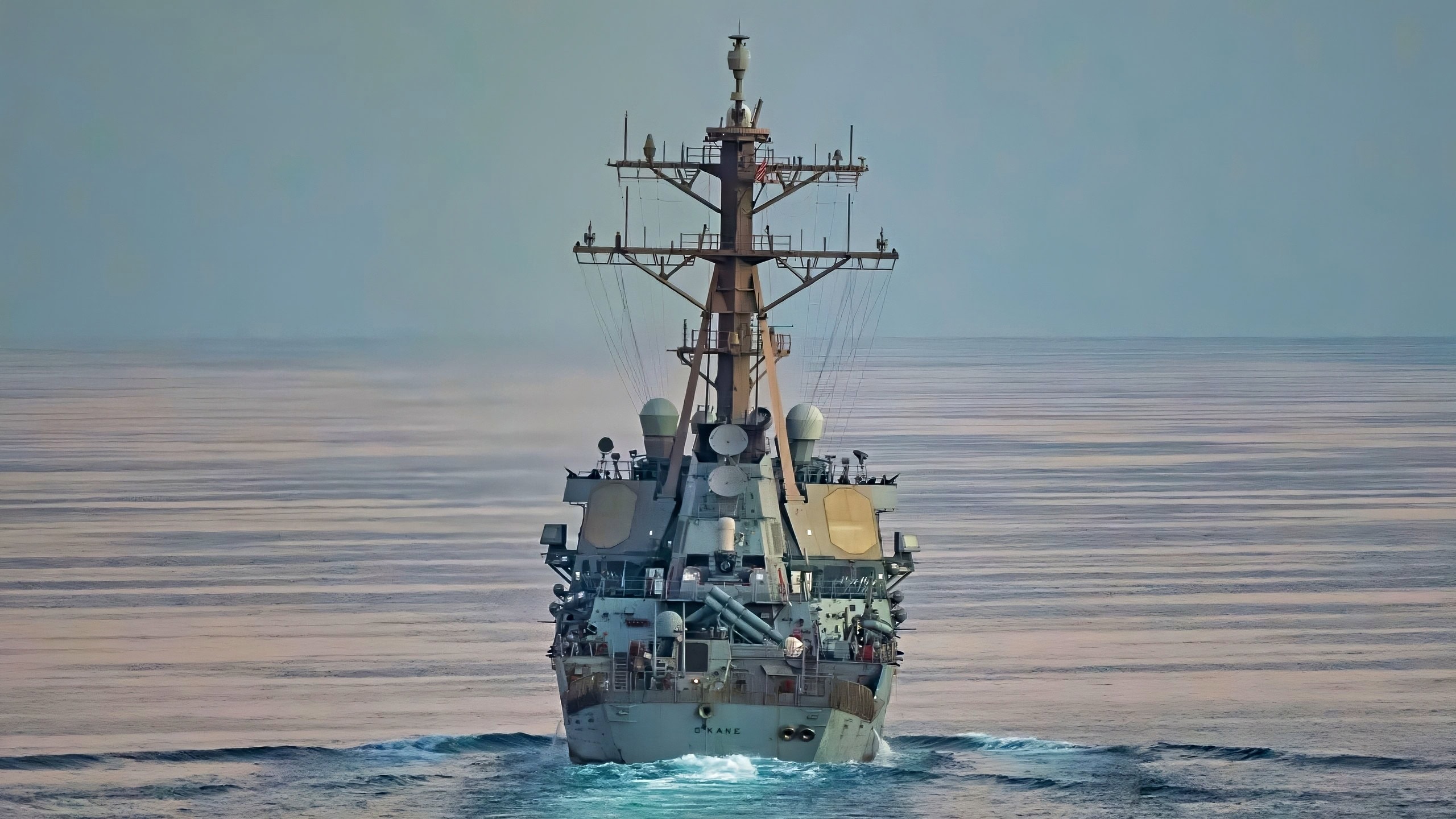
The strait, with its relatively narrow width, does not require a large fleet to become a danger. A mix of coastal radars, fast boats, suicide drones, potential naval mines, and anti-ship missiles is enough to turn every crossing into a process of approval. Therefore, I do not read Tehran's statements about sole management as merely political rhetoric. Iran is practically saying that whoever has the ability to disrupt has a stake in management, and this is a rule known to any military personnel who has served in the region: control does not always mean occupying a place; sometimes it means the ability to make others ask for permission.
The recent U.S. strike on missile, drone, and coastal radar storage sites reveals what Washington considers the real center of gravity. It did not strike a ministry building or a symbolic base, but rather the sensor and launch chain. The coastal radar identifies the target, the drone storage provides cheap and repeatable ammunition, and the missile site gives the threat its range. This is not a classic naval system, but a distributed coercion network along the coast. Therefore, destroying one or two nodes does not end the problem; it raises the cost of the next round.
The Gulf Bought Air Defense but Did Not Buy Maritime Management
The paradox is that Gulf countries have spent tens of billions over the past two decades on Patriot and THAAD systems, F-15 and F-16 fighters, Rafale, and Typhoon, yet they still ask at the first crisis in Hormuz: Where is the American umbrella? The problem is not the quality of the weaponry. The Patriot can intercept aerial threats, and THAAD is useful against ballistic missiles, and modern Gulf radars are not primitive. The issue is that defending a tanker or a commercial passage is not the same as defending a capital or an airbase.
Protecting maritime passages requires immediate joint leadership, clear rules of engagement, sufficient patrol vessels, continuous maritime reconnaissance drones, timely data exchange that does not lag due to political sensitivities, and the ability to distinguish a civilian ship from a suspicious target within minutes. This type of operation cannot be bought with a delivery contract; it is built through daily maneuvers. In my estimation, this is where the gap in the triangle of capability that I often refer to appears: the equipment is available, training is varied, and the joint institution among Gulf countries is weaker than the size of the threat.
The UAE has relatively alternative ports and energy lines, Saudi Arabia has land depth and export lines to the Red Sea, and Qatar, Kuwait, and Bahrain are more sensitive to maritime and aerial pressure. However, Iran does not need to strike everyone equally. It is enough to create uncertainty in insurance and shipping to raise the cost of passage for everyone. A drone that costs tens or hundreds of thousands of dollars may impose millions of dollars in insurance on an oil or gas tanker. This is not just a military equation, but an economic and psychological one.
Washington Strikes to Prevent Tehran from Turning This into a Norm
It is a mistake to portray U.S. strikes as merely an angry reaction. Washington fears that Iranian behavior could become a new norm: ships passing through designated routes, undeclared permits, limited threats that do not escalate to full-scale war, and then gradual international acceptance that Iran has the actual right to manage the strait because it has the ability to disrupt it. If this happens, the U.S. presence in the Gulf will lose part of its political function. What is the value of the Fifth Fleet if the rules of passage are written in Tehran?
However, the U.S. strike does not solve the Gulf dilemma. It delays the imposition of the Iranian norm but does not grant Gulf countries independent capacity to manage the crisis. This is why statements from some Gulf capitals appear sharp in public but constrained in action. The UAE condemns, Bahrain and Kuwait raise readiness, Qatar tries to protect its citizens and navigation, but the decisive operational decision remains between Washington and Tehran. Practically, this is the price of long reliance on an external guarantor.
The old military adage says that the road you cannot guard yourself does not become safe just because you paid for the weapons that guard another city.
Iran Bets on the Gray Area, Not on Total War
Tehran does not necessarily want to completely close Hormuz; a full closure would provoke a harsh international response and harm China, India, and Iran's trade partners. The smarter bet is the gray area: limited disruption, partially deniable drones, threats against selected ships, talk of passage protocols, and then presenting Iranian management that appears organizational on the surface but is essentially institutional extortion.
This explains why incidents occur at a moment when negotiations to stop the U.S.-Iranian war intersect with the Lebanon file and a Gulf objection to the exclusion of regional countries from post-war arrangements. Iran tells Gulf countries: you cannot bypass us in Hormuz. It tells America: you cannot guarantee energy without an understanding with us. And it indirectly tells Israel that any pressure on the Lebanese front could return as pressure on trade and energy.
In Conclusion, Maritime Sovereignty Cannot Be Borrowed
The question facing the Gulf after the drone attacks and U.S. strikes is not whether Washington will succeed in destroying another radar or another drone storage. The question is whether Gulf countries can build a regional system to guard the sea that goes beyond political statements. There is a need for a real Gulf maritime operations center, non-seasonal joint patrols, declared rules of engagement for unmanned vessels, and direct links between air defense and coastal and maritime defense. Without that, each country will continue to buy its own system and then discover in a crisis that the sea does not recognize administrative borders.
The most dangerous aspect of Iran's proposal for sole management of Hormuz is that it places the Gulf in front of a harsh mirror. The region that possesses some of the most expensive defense systems in the world still relies on external power to prevent a regional neighbor from turning a shared passage into a political inspection gate. This is not a weapons problem, but a problem of will and institution. As we say in the military: a weapon that does not fit within a clear command plan becomes an expensive piece in the warehouse, not a capability in the field.
Iran announced plans to independently manage the Strait of Hormuz by 2026 following drone attacks on vessels and U.S. military strikes. Four Iranian drones targeted ships, with one successfully hitting a commercial vessel. The U.S. responded with strikes on Iranian military assets, highlighting the ongoing tensions in the region and the strategic importance of the Strait.
- Iran's Foreign Minister stated Iran will manage the Strait of Hormuz alone by 2026.
- Four Iranian drones were launched against ships in the region, with one hitting a Singapore-flagged vessel.
- The U.S. conducted strikes on Iranian missile and drone storage sites.
- Gulf states are caught between U.S. and Iranian interests regarding the Strait.
- Iran's actions are seen as testing maritime control and influence in the region.