
Israel's Occupation of the Shakif Castle in 2026 Expands the Lebanon War and Tests the American Ceasefire
 Ahmed Al-Rashid
Israel's Occupation of Beaufort Castle in 2026 Expands the Lebanon War and Tests the U.S. Ceasefire
On May 31, 2026, the image of the Israeli flag over Beaufort Castle was not just a promotional shot from an old hill in southern Lebanon. It was a military announcement that the ceasefire, which was born six weeks earlier under U.S. sponsorship, no longer controlled troop movements on the ground, and that Israel had moved from deterrent strikes to engineering a new security zone extending from the Litani River towards Zahrani. This is the point that should be read with military coldness, not with the emotion of slogans.
From the Castle to the Frontline
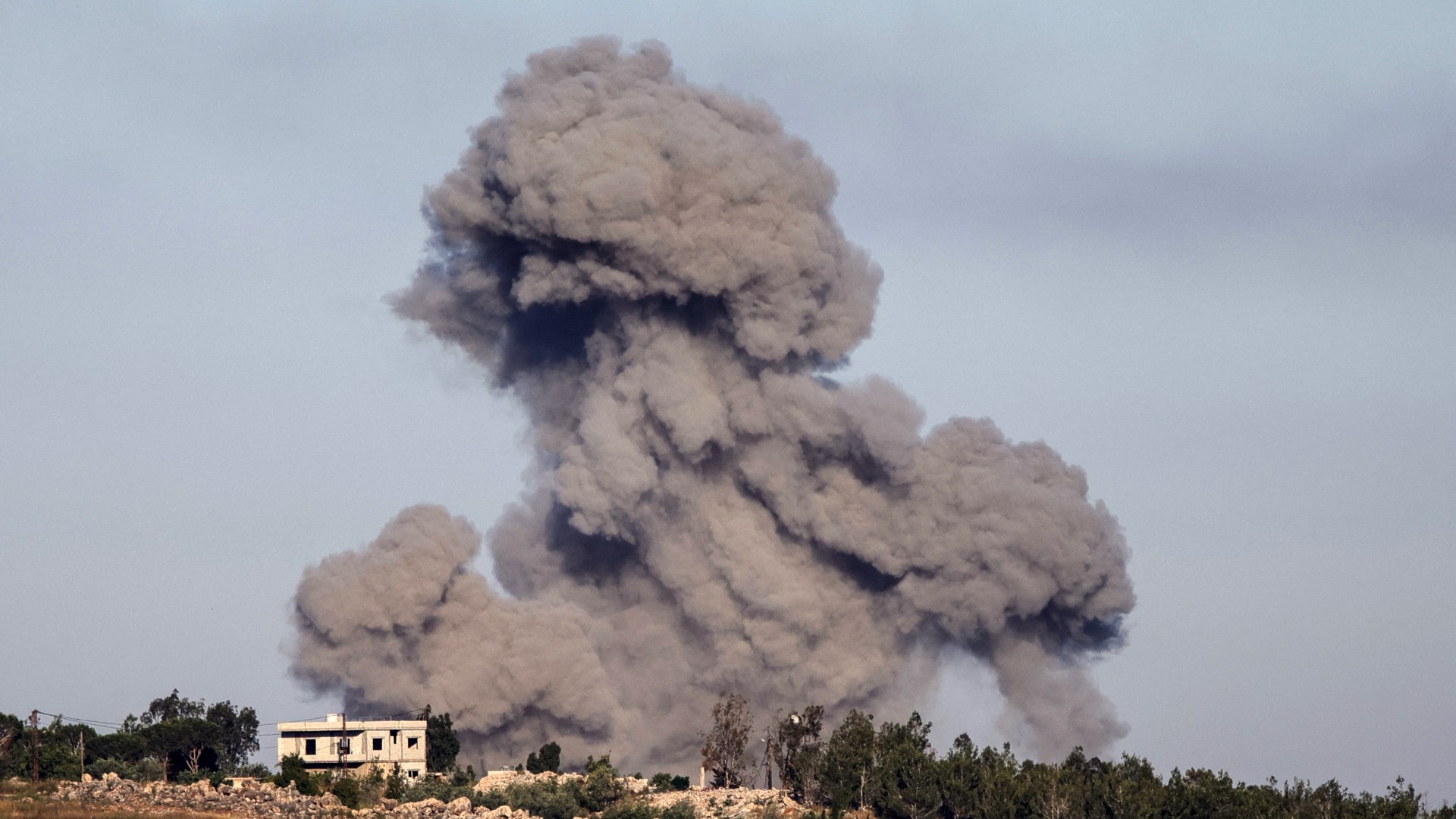
The Israeli army announced that it had begun operations in the heights of Shuqif and the Saluki Valley to dismantle Hezbollah's structure and remove the threat from the towns of Galilee and Metula. The Israeli statement is significant not only because it speaks of a castle that is about 900 years old, but because it uses the language of operational control and expanding the frontline. In military terms, this is not a fleeting raid or a limited sweep, but an attempt to establish commanding terrain from which to monitor movement routes, launch areas, and entrances to Nabatiyeh.
Reuters reported that Prime Minister Benjamin Netanyahu ordered the army to expand ground maneuvers inside Lebanon, and that Israeli forces were controlling up to the Litani and then moving towards Zahrani, about ten kilometers further north. This small number on the map is large in the balance of politics; it transforms the ceasefire from an arrangement to stop clashes into a fragile cover for a competition on the ground before any settlement.
Why Beaufort is Not Just a Symbol
Any soldier who has served in this area knows that the hills do not lie. Beaufort Castle overlooks a wide part of southern Lebanon and northern Israel, granting whoever controls it better observation, firepower, and guidance than many lower sites. This is why various armies have fought over it for decades, and why its name has remained in the military memory of both Israel and Lebanon since the invasion of 1982 until the Israeli withdrawal in 2000.
Practically, controlling Beaufort gives Israel three immediate benefits. The first is monitoring the Saluki Valley and the approach routes towards Nabatiyeh. The second is pushing Hezbollah's fire positions away from some northern Israeli towns. The third is producing an image of internal victory at a time when airstrikes alone are not enough to convince the Israeli public that the army is changing the equation. But each of these benefits carries a corresponding cost: a high position that can be defended, but is also a fixed target for cheap drones, guided munitions, and close ambushes.
Testing Cheap Drones
The problem facing Israel in southern Lebanon is no longer just the Katyusha rocket. Field reports indicate that Hezbollah has relied on small, cheap suicide drones that are difficult for conventional air defenses to intercept at a reasonable cost since the ceasefire. This point is crucial. Systems like Iron Dome and David’s Sling are designed to manage specific threats from missiles and projectiles, but they cannot economically turn into a comprehensive solution against every drone made in a local workshop carrying a limited warhead.
Israel can take the land, but it cannot eliminate the economic calculus of war. If every forward position requires electronic protection, close radars, small anti-aircraft fire, and ongoing engineering against explosives, then the security zone becomes a project of attrition, not just a deterrent project. Here lies the gap between the ability to maneuver and the ability to survive. A soldier enters the valley within days, but the military institution remains responsible for him for months, perhaps years.
Hezbollah Between Losing Land and Preserving Capability
Hezbollah has lost something important in this round: the freedom of public movement in some hills and villages that it used as military depth. But losing land does not necessarily mean losing capability. The organization that built its strength on small tunnels, decentralized cells, drones, and short- to medium-range missiles knows how to turn Israeli control into a daily burden. This does not mean that Hezbollah is in a comfortable position. On the contrary, the number of casualties and displaced persons in Lebanon, the popular pressure on southern villages, and the possibility of expanded strikes into Beirut all narrow its margin of maneuver.
However, there is a difference between breaking an armed organization and pushing it into a less visible and more costly mode of war for the occupying forces. In my estimation, the image of the flag over the castle may be electorally useful in Tel Aviv, but it does not answer the more difficult military question: Can Israel prevent Hezbollah from using small drones and short-range missiles from further lines, or will it only move the line of engagement ten kilometers north?
Washington Between Mediation and Cover
The United States has tried in recent hours to salvage the ceasefire initiative. Axios reported on communications made by Secretary of State Marco Rubio with Lebanese President Joseph Aoun and Netanyahu, at a time when Israel was seeking a green light for broader strikes on Hezbollah targets in Beirut. This is the usual American contradiction in the Middle East: Washington wants direct negotiations between Israel and Lebanon, but it does not want or cannot set a clear ceiling on Israeli military movements when it ties them to fighting Hezbollah.
From an Arab perspective, this creates a deeper problem than just southern Lebanon. If Beirut sees that negotiations do not prevent the expansion of field occupation, no Lebanese government will be able to sell a security agreement internally. If Israel sees that every field advance improves its terms before the table, it will have incentives to continue until the last moment. Between these two logics, the ceasefire is lost.
Lebanon's Connection to the Iran War
The current Lebanon war is not a separate file from the Iran war that began on February 28, 2026. Reuters described the Lebanon front as the broadest backlash to that war, with more than 1.2 million Lebanese displaced since March, and over 3,370 dead according to the Lebanese government, compared to Israeli losses that included 24 soldiers and four civilians during the same period. These numbers are not just a humanitarian backdrop; they indicate that Lebanon has become a pressure point in negotiations with Iran, just as the Strait of Hormuz is a pressure point on the world economy.
If Israel expands towards Beirut or establishes a long-term security zone to the south, Tehran will find an argument to say that the regional ceasefire is incomplete or insincere. If Hezbollah responds with greater intensity, Israel will say that its presence inside Lebanon has become a necessity, not a choice. Thus, the war turns into a closed circle, with each side using the other's actions to justify the next step.
The Military and Political Dilemma
The cold conclusion is that Israel has achieved a real tactical gain in Beaufort, but it is not a decisive victory. Controlling a hill does not equal dismantling a network. Expanding the frontline does not equal ending the threat of drones. And pressuring Hezbollah does not equal building a Lebanese authority capable of filling the security vacuum south of the Litani. This is the dilemma we have seen repeatedly in armies that enter hostile territory: access is easier than management, and management is easier than exit.
As for Lebanon, it is once again paying the price of a conflict for which it does not hold all the keys. Hezbollah has linked part of the south to Iranian calculations, Israel links its presence there to northern security, and Washington links the ceasefire to larger regional negotiations. Between these loops, civilians, the Lebanese army, and the Lebanese government remain in the narrowest space. The Arab proverb says: He who sleeps among the graves sees disturbing dreams. Southern Lebanon today is not sleeping among the graves; it is living within a military map drawn by others over its homes.
Sources
- Reuters via Internazionale, May 31, 2026, on the expansion of the Israeli incursion and control of Beaufort Castle.
- Israeli army statement, May 31, 2026, on operational control of the heights of Shuqif and the Saluki Valley.
- Associated Press, May 31, 2026, on the deepest Israeli incursion into Lebanon in 26 years.
- Axios, June 1, 2026, on the stalling of the U.S. ceasefire initiative and the possibility of broader strikes in Beirut.
Israeli Defense Forces expanded their operations in southern Lebanon on May 31, 2026, occupying Château de Cheikh and launching efforts to dismantle Hezbollah's infrastructure. This military action aims to establish a new security zone and has resulted in significant territorial gains. The U.S. is mediating a ceasefire as the conflict continues to escalate, with over 1.2 million Lebanese displaced.
- Israel has occupied Château de Cheikh as of May 31, 2026.
- Israeli forces are conducting operations to dismantle Hezbollah's infrastructure.
- The U.S. is attempting to mediate a ceasefire amid expanding Israeli military actions.
- Hezbollah has lost significant ground but retains operational capabilities.
- Over 1.2 million Lebanese have been displaced since the conflict escalated.