
Italy's six A330 MRTT reveal Europe's tanker problem despite 1.39 billion euros
 Dr. Klaus Weber
Italy's six A330 MRTT highlight Europe's tanker problem despite 1.39 billion euros
Six tanker aircraft for 1.39 billion euros sound like a clean modernization. In fact, Italy's decision for the Airbus A330 MRTT primarily shows how slowly Europe is repairing a capability that has been known to be critical for more than a decade. According to the TED contract notice published on May 19, 2026, the contract between the Italian government and Airbus was already signed on April 16. It is set to replace four KC-767 of the Aeronautica Militare in the long term and includes not only aircraft but also a logistics package lasting about ten years.
This makes military sense. But is it enough? For Italy, yes; for Europe, only to a limited extent. The contract nominally increases the Italian fleet size from four to six strategic tankers. However, it does not change the institutional fundamental fact that air refueling in Europe continues to be predominantly planned nationally, improvised multilaterally, and often operationally supplemented by American capabilities.
From KC-767 to A330 MRTT
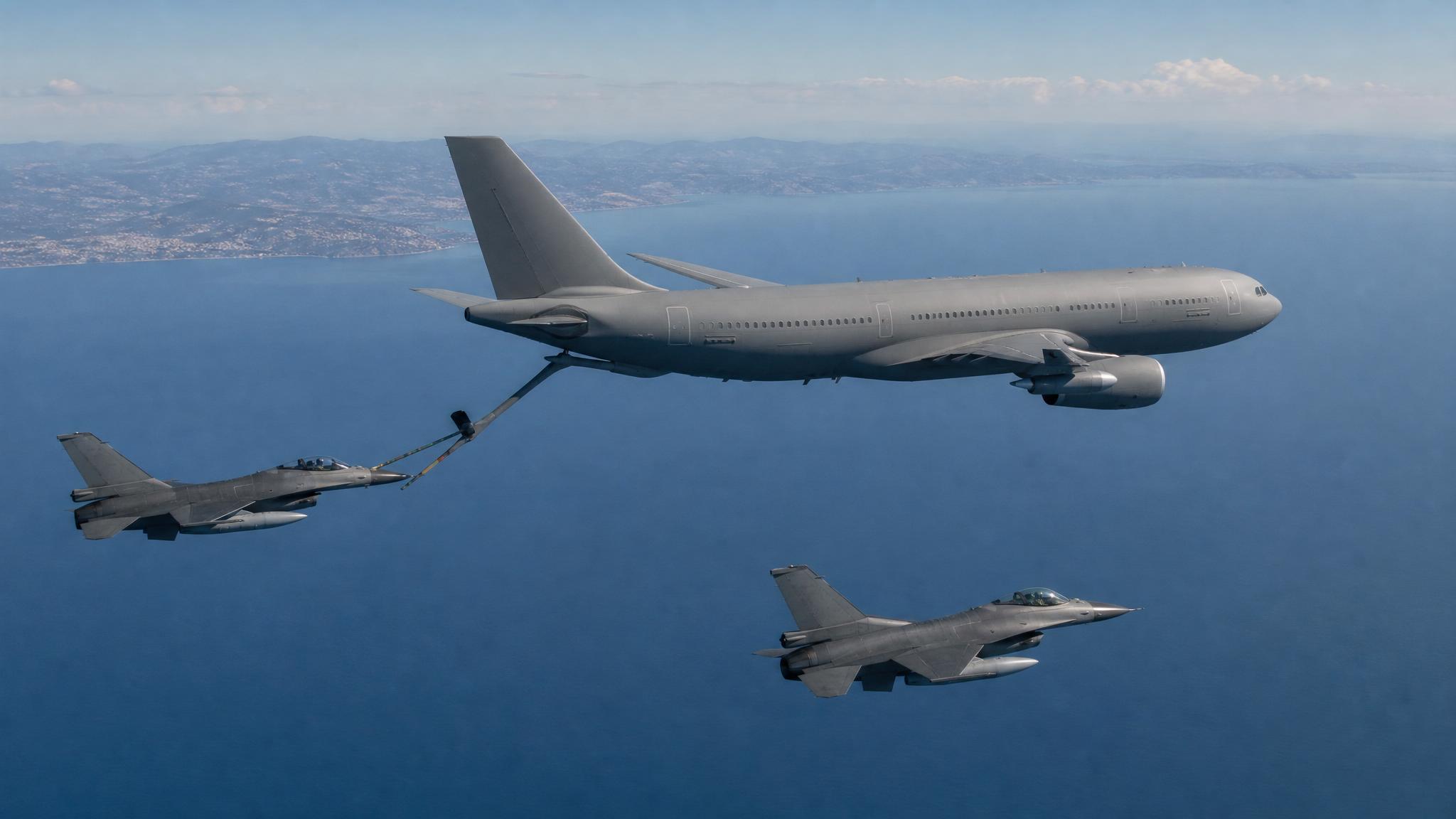
Conceptual representation of a European tanker operation. The image does not show a confirmed Italian A330 MRTT aircraft or a real operation.
The chronology is more revealing than the purchase itself. Initially, Italy considered two Boeing KC-46 Pegasus and the modernization of its four KC-767A in 2022. This solution promised continuity on paper, as the Italian Air Force already operates Boeing 767-based tankers. Then it became clear what procurement policy often obscures: the same civilian origin does not mean the same military system architecture. Differences in airframe, configuration, and engines made modernization technically unattractive.
The subsequent attempt to procure six KC-46 directly also failed. Negotiations with Boeing were concluded in June 2024 without a clear public statement following. Only then did an open procedure emerge, in which Airbus was the only supplier that met the technical requirements as presented. The result is a European platform, but not necessarily a European procurement model.
The A330 MRTT is plausible for Italy's needs. Airbus cites up to 111 tons of fuel capacity, up to 70 tons of fuel delivery during a one-hour holding pattern at 1,250 nautical miles away, 8,700 nautical miles of range, up to 300 passengers, and up to 45 tons of payload. Equally important is the dual role: boom refueling for F-35A, F-16, or C-17 and hose systems for Eurofighter, Rafale, Tornado, or F-35B. For an air force that must cover the Mediterranean, NATO's eastern flank, and expeditionary operations, this flexibility is not a luxury.
Europe's old shortfall is only slowly becoming visible
The European Defence Agency has described air refueling as a critical European capability shortfall since 2012. Mali, Libya, and Kosovo are explicitly mentioned as operations where European forces heavily relied on US assets. This is not a historical footnote. Air refueling determines whether combat aircraft can only take off or actually generate range, dwell time, and operational density.
Here, the difference between the number of platforms and alliance capability is important. Italy is getting six national tankers. In parallel, the Multinational MRTT Fleet exists with Germany, the Netherlands, Luxembourg, Norway, Belgium, the Czech Republic, Denmark, and Sweden. France, the United Kingdom, and Spain operate their own A330 MRTT variants. From a PowerPoint slide, this creates a European tanker landscape. In operational planning, however, national availabilities, different clearances, maintenance cycles, crew models, and political reservations emerge.
The EDA formulates the crucial sentence soberly: A tanker without clearances is not a tanker. This means that not only the aircraft must count, but also the certified relationship between the tanker, the receiving aircraft, procedures, crew, and national aviation authority. Europe's problem has never been solely about having too few large aircraft. The problem has been that existing aircraft do not automatically translate into a common, readily available operational capability.
The NATO test lies in operational planning
NATO defines capability not as equipment, but as the ability to produce an effect through doctrine, organization, training, material, leadership, personnel, infrastructure, and interoperability. This definition may seem academic, but it is precise in the case of tankers. Six Italian A330 MRTT are only a gain for the alliance when they are embedded in NATO procedures, European training cycles, joint certifications, and robust logistics.
The new NATO capability goals for 2025 place greater emphasis on more forces, industrial capacity, resilient supply chains, air and missile defense, long-range weapons, logistics, and large land maneuver units. Tankers are rarely prominently mentioned in such lists because they are politically less visible than frigates or combat aircraft. But without air refueling, exactly these visible capabilities shrink. A Eurofighter without a tanker remains a regional tool; with a tanker, it becomes part of an operational chain.
Therefore, Italy has not only solved a procurement problem but also reduced a credibility problem. Rome wants to play a larger role in the Mediterranean, participates in NATO air operations, and must simultaneously secure the range of its F-35 and Eurofighter fleet. Four aging KC-767 are a thin foundation for that. Six A330 MRTT are better. Yet the question remains whether this improvement will disappear in national operational calendars or become available as a planable European reserve.
Industrially European, institutionally national
The contract is also interesting from an industrial policy perspective. After the failed Boeing options, Italy lands with Airbus. For proponents of European defense autonomy, this is good news: a European country is buying a European platform for a critical support capability. But one should not make a bigger institutional success out of it than it is. Italy is not primarily buying European sovereignty. Italy is buying a replacement for a national fleet whose previous modernization path had become implausible.
This distinguishes the case from genuine joint capability planning. The Multinational MRTT Fleet is the more important European test because it organizes ownership, use, and availability among several states. The Italian contract remains national. It can increase Europe's overall capability, but it does not force Europe into a common doctrine, a common pool of operations, or a common prioritization.
Here lies the Weber paradox of European arms policy: Europe increasingly opts for European systems without automatically generating European armed forces. The A330 MRTT is a good aircraft. According to Airbus, it has achieved more than 340,000 flight hours and over 310,000 air refueling contacts with the platform family. This speaks to technical maturity. However, it does not answer the political question of who possesses this capability in a crisis.
What this contract really changes
For Italy, much changes. The Air Force receives a larger, more capable, and long-term supported tanker fleet. The transition from the KC-767 to the A330 MRTT creates more range, more payload, more interoperability with European receiving aircraft, and better connectivity to other European operators. For Airbus, it is further evidence that the A330 MRTT has effectively become the Western standard tanker outside the USA.
For Europe, less changes than the figure of 1.39 billion euros suggests. The contract reduces a national bottleneck, but it does not eliminate the structural scarcity of jointly available air refueling. It strengthens the European industrial base, but not automatically European operational planning. It makes Italy less dependent on Boeing, but Europe not independent from American strategic depth.
This is not an argument against the purchase. On the contrary: Europe needs more of these unspectacular, heavy support capabilities. But the political temptation to celebrate every European platform as strategic autonomy remains dangerous. Autonomy does not arise when six tankers are ordered. It arises only when these tankers can conduct a joint operation in a crisis without lengthy national coordination, without missing clearances, and without American reserve planning.
Italy's contract is therefore a step forward with limited reach. It shows that European industry can deliver. It also shows that Europe's defense policy still prefers to count aircraft rather than organize availability. More tankers are necessary. But as long as Europe does not decide who politically owns this capability, even an A330 MRTT remains a national aircraft with a European label.
Italy signed a contract on April 16, 2026, to acquire six A330 MRTT aircraft for 1.39 billion euros, enhancing its aerial refueling capabilities. This acquisition replaces four aging KC-767 aircraft and aims to improve interoperability with European forces. The European Defense Agency has long identified aerial refueling as a critical capability gap, highlighting the importance of this procurement for NATO operations.
- Italy signed a contract for six A330 MRTT aircraft for 1.39 billion euros.
- The contract replaces four KC-767 aircraft in the Italian Air Force.
- The A330 MRTT enhances Italy's aerial refueling capabilities and interoperability with European forces.
- The European Defense Agency has identified aerial refueling as a critical capability gap since 2012.
- The acquisition reflects Italy's intent to play a larger role in NATO operations.