
JNIM and Africa Corps in Mali in 2026 — drones open a front of impunity
 Marie Dubois
JNIM and Africa Corps in Mali in 2026 — drones open a front of impunity
In Tombonkore, in the Bandiagara circle, a market was struck on August 19. Human Rights Watch (HRW) attributes the death of six civilians and at least twenty injuries to a Malian drone strike. In Talahandak, in the Kidal region, another strike had partially destroyed a health center three weeks earlier. These two incidents are not mere macabre details of a legal case. They illustrate how the drone war, imported to regain the initiative against JNIM, can produce exactly the opposite effect on the ground.
A chain of violence that closes in
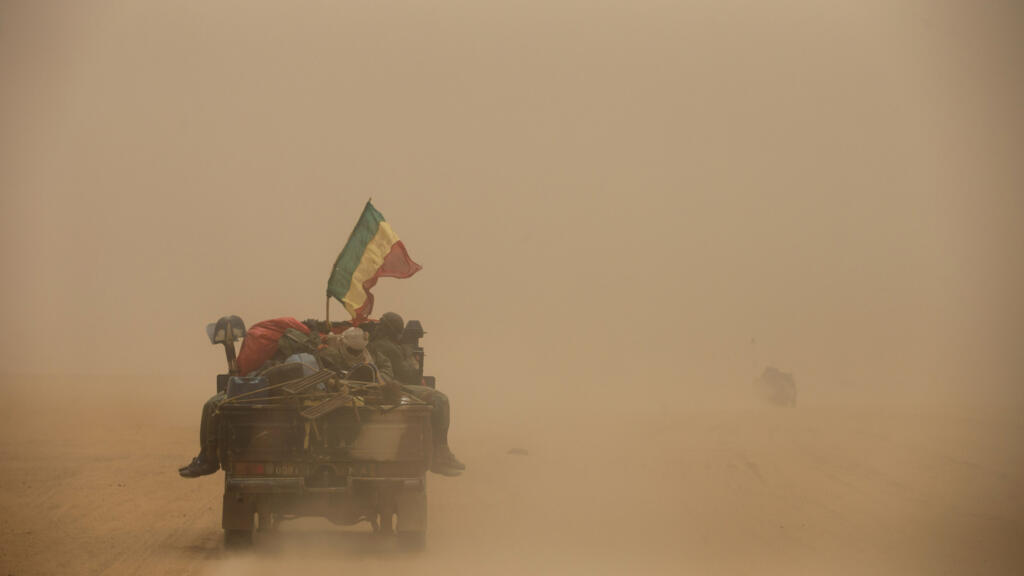
The report published by HRW on October 19 is based on thirty interviews conducted between July 30 and September 20, as well as geolocated videos and photographs of debris. It describes two apparently indiscriminate strikes, but also the death of five girls shot by soldiers in the Ségou region and three civilians killed by dozo militias in the Mopti region. The Malian authorities have not responded to the organization's questions.
On the other side, the Support Group for Islam and Muslims (JNIM), a Sahelian branch linked to Al-Qaeda, and the Azawad Liberation Front (FLA) are not protective actors. On July 18, after an attack on a convoy in Tabrichat, in the Gao region, at least nineteen captured Malian soldiers were tortured and then executed, according to HRW. JNIM acknowledges that prisoners were killed while denying having given the order. This semantic nuance does not change the tactical reality of a force that does not guarantee the survival of those who surrender.
On the ground, the population thus finds itself caught between two mechanisms. The first strikes from a distance, with drones that shorten the loop between intelligence and fire. The second imposes its armed justice in areas where the state no longer controls the roads. Each abuse provides the opposing camp with a narrative for recruitment, revenge, or taxation. It is an operational chain, not just a moral crisis.
The drone does not replace ground control
Bamako and the Russian Africa Corps now have an advantage in range and surveillance that the Malian army lacked after the French departure. But a precise strike on the wrong target remains a bad strike. In the north, the distance between a military position, a weekly market, and a pastoral hamlet can be measured in a few minutes of track, not in visible borders on a digital map. Human intelligence is scarce, communities are suspected by affiliation, and units operating with foreign allies do not always have a clear chain of accountability.
The broader toll confirms the problem. According to ACLED data cited by HRW, Malian forces and the Africa Corps conducted 49 airstrikes between April and August 2026, killing 89 civilians, compared to 22 strikes and 44 deaths during the same period in 2025. Over these five months, Malian forces are said to have killed 268 civilians, while JNIM is reported to have killed 134. The figures remain dependent on available data, often impossible to collect in areas off-limits to journalists. They nonetheless indicate a worrying asymmetry: the state is increasing its firepower faster than it is improving its ability to distinguish a fighter from a civilian.
Amnesty International, in a report published in September on operations from 2023 to 2025, documents at least 34 civilians killed in seven localities in Ségou, Mopti, and Timbuktu. The organization also describes torture, enforced disappearances, and two drone strikes that killed at least 23 civilians, including five children. The important point is not to confuse these episodes with those of 2026, but to note the alleged continuity of methods. The substitution of Wagner by the Africa Corps in June 2025 did not, by itself, create a new operational discipline.
A tactical victory that can become a theater defeat
The regime of Assimi Goïta has chosen military sovereignty as a response to Western criticism and the collapse of regional cooperation. This posture gives it political leeway in Bamako, but it also reduces verification mechanisms. Mali's withdrawal from the Rome Statute, notified in June 2026 and effective in June 2027, further narrows the prospect of accountability, even though the International Criminal Court retains jurisdiction for crimes committed before this date.
For JNIM, the stakes are concrete. A strike that destroys a market transforms an area of distrust into a recruitment zone. An arrest without due process pushes families into the bush, to smugglers, or to armed groups. A video of an execution in Tabrichat deters soldiers from surrendering and makes each ambush more deadly. In this theater, the battle for information is not separate from the battle for the roads.
The available data do not allow for establishing the responsibility of each actor in all incidents. This is precisely the problem. Without an independent investigation, Bamako can deny, JNIM can minimize, and the Africa Corps can remain behind the fog of military cooperation. The absence of complete evidence does not constitute proof of innocence.
The next test will be a road, not a statement
The operational question in the coming months will be whether the Malian army can sustainably secure an axis without punishing the surrounding population. To achieve this, it will need to protect markets, verify targets before firing, and preserve captured prisoners. Otherwise, drones will only expand the area where the state is visible from the sky but absent on the ground.
Sources
On August 19, 2026, a Malian drone strike killed six civilians and injured twenty in Tombonkore. Between April and August 2026, Malian forces conducted 49 airstrikes, resulting in 89 civilian deaths. The JNIM admitted to executing captured soldiers, reflecting ongoing violence and instability in the region. The report underscores the challenges faced by the Malian military in distinguishing between combatants and civilians.
- Six civilians killed and at least twenty injured in a drone strike in Tombonkore on August 19, 2026.
- A health center was partially destroyed by a drone strike in Talahandak three weeks prior.
- Malian forces conducted 49 airstrikes between April and August 2026, resulting in 89 civilian deaths.
- The JNIM acknowledged killing prisoners but denied orders for such actions.
- The report highlights a concerning trend of increasing civilian casualties due to military operations.