
Lavrov courts Equatorial Guinea in 2026 and promotes the Russian model towards the Gulf of Guinea
 Marie Dubois
Lavrov Courts Equatorial Guinea in 2026 and Promotes the Russian Model Towards the Gulf of Guinea
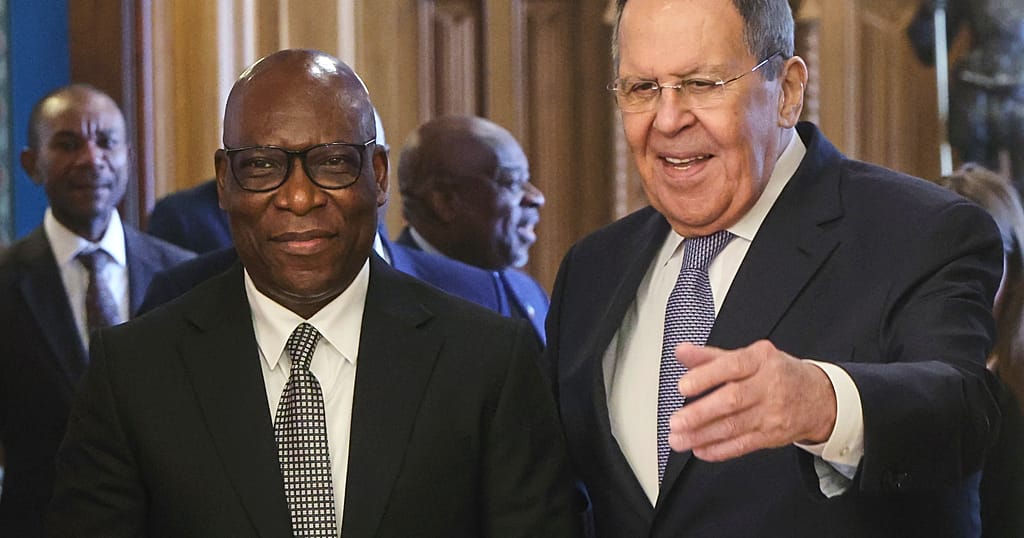
On May 18, in Moscow, Sergey Lavrov received Simeon Oyono Esono Angue, the Equatorial Guinean Minister of Foreign Affairs. The scene was diplomatic, almost routine. But the important phrase was not protocol: Moscow expressed its readiness to continue military-technical cooperation with Malabo and to respond, "as much as possible," to Equatorial Guinea's defense needs.
This is not the announcement of a Russian base in Malabo. Nothing in the available public elements allows us to assert that. It is more subtle, and perhaps more useful for Moscow: an open offer, placed before a Gulf of Guinea oil partner, at a time when Sahelian regimes are already presenting Russia as a more acceptable security provider than the former Western powers.
The most revealing detail came from the Equatorial Guinean side. Angue praised the Russian role in the Sahel and the Central African Republic, presenting this involvement as a factor of peace and stability. In the mouth of a Central African minister, this phrase carries political weight. It connects Malabo to a narrative that has been constructed in Bamako, Ouagadougou, and Bangui: Russia would be the partner that does not give lessons, does not condition its support, and is willing to work with isolated or contested regimes.
A Defense Offer More Political than Technical
On the ground, Equatorial Guinea does not have the same needs as Mali or Burkina Faso. It does not face a jihadist insurgency comparable to the Support Group for Islam and Muslims (JNIM) or the Islamic State in the Sahel. Its problem lies elsewhere: regime protection, maritime security, surveillance of oil facilities, control of island and continental borders, and the ability to deter external pressures in a space where energy interests, residual piracy, and diplomatic rivalries intersect.
This geography changes everything. Malabo looks towards the Gulf of Guinea, not towards the Niger bend. Its sensitive points are Bioko, Bata, offshore terminals, maritime approaches, and the command axes of a highly centralized state. Therefore, Russian cooperation would not need to resemble a Sahelian counter-insurgency package. A few advisors, training, maintenance, coastal surveillance systems, anti-drone capabilities, or close protection would be enough to give Moscow real political access.
I emphasize this point because the usual mistake is to immediately look for armored vehicles, camps, or uniforms. In many African theaters, military influence begins before visible deployment. It starts with dependence on a supply chain, with a training contract, with an officer sent for training, with a protection team learning the habits of the palace and ports.
The Sahel Becomes an Exportable Showcase
The reference to the Sahel by Angue is not trivial. Since the successive breaks between Paris and the Sahelian juntas, Moscow has been selling a simple promise: to replace a politically toxic Western presence with a more transactional relationship. The military results of this promise remain highly debatable. In Mali and Burkina Faso, jihadist groups maintain operational depth, strike at axes, isolate localities, and exploit the weakness of national forces as soon as they leave the main garrisons.
But Russian success in Africa is not only measured by the number of villages recaptured. It is also measured by the ability to transform a security relationship into diplomatic loyalty. On this front, the model works better. When an Equatorial Guinean official cites the Sahel and the Central African Republic to justify cooperation with Moscow, he is not just describing a military reality. He is reiterating an argument.
For Malabo, this argument is useful. Equatorial Guinea is a small state rich in hydrocarbons, long governed by a compact security apparatus. A partner like Russia offers three things: equipment without public debate, political protection in certain forums, and a form of assurance against Western isolation. This is not necessarily decisive militarily. It is decisive for the survival of a regime that primarily thinks in terms of power security.
Why the Gulf of Guinea Interests Moscow
The map explains the interest. The Gulf of Guinea provides access to the Atlantic, energy routes, and a maritime front where external powers can operate without going through the Sahelian corridors. For Russia, which has lost much of its diplomatic depth in Europe, every friendly port, every defense agreement, and every accessible ministry counts. Malabo is not Bamako. But Malabo can serve as a political foothold, a showcase, and a relay in an area where Europeans remain present but less dominant than before.
One must also look at the neighborhood. To the northeast, Cameroon monitors the fallout from Boko Haram and the anglophone crisis. Further east, the Central African Republic remains one of the most advanced laboratories of Russian security influence. Further south, Gabon and Congo-Brazzaville live with their own military and oil balances. Equatorial Guinea is situated in the middle of an arc where internal security, energy, and diplomacy constantly intersect.
In this type of environment, Moscow does not need to promise a large intervention. Military-technical cooperation can be calibrated, discreet, and gradual. It can involve surveillance equipment, training for presidential units, maritime patrols, or simply a regular presence of experts. This is often how sustainable positions are built: in thin layers, without spectacular declarations.
The Risk for Western Partners
For Paris, Washington, and Brussels, the danger is not that Russia will immediately transform Equatorial Guinea into a military bastion. This scenario would be premature. The risk is slower: to see the vocabulary of Russian security become normalized in African capitals that were not at the center of the Sahelian framework. When this vocabulary normalizes, Western offers arrive with a political handicap. They appear conditional, slow, moralizing, or linked to external electoral cycles.
From experience, a local force rarely accepts a partner for its doctrines. It accepts it because it delivers quickly, repairs quickly, advises without publicly exposing weaknesses, and allows national command to save face. African armies are well aware of the limits of their partners. They sometimes choose the least intrusive, not the most effective.
This is where the Russian proposal finds its space. It does not necessarily promise better security for the populations. It promises more comfortable security for the rulers. In a state like Equatorial Guinea, this distinction is central.
What Remains Uncertain
Several elements must remain conditional. We do not know the precise content of Malabo's requests, the existence of a timeline, or the nature of the equipment mentioned. Public statements speak of military-technical cooperation, not a detailed operational agreement. It would therefore be unwise to announce a Russian deployment or the arrival of instructors without further confirmation.
But uncertainty does not diminish the importance of the signal. It even makes it more interesting. Moscow often tests its African openings in this gray area: official enough to be heard, vague enough to remain reversible. Malabo, for its part, can display a strategic alternative without breaking with other partners.
The next thing to watch is not a grand summit. It is the small traces: a military delegation in Moscow, a maintenance contract, a delivery of vehicles, a coastal guard exercise, a visit from instructors, or a discreet budget line in security purchases. On the ground, shifts rarely begin with a fanfare. They start with a plane landing, a crate of spare parts, and an officer who does not leave right away.
Main sources: Africanews, May 18, 2026, on the Lavrov-Angue meeting in Moscow; contextual elements from the hiwars follow-up on Russian security partnerships in the Sahel and Central Africa. The operational details of a potential agreement remain to be confirmed.
On May 18, 2026, Russia expressed its readiness to enhance military-technical cooperation with Equatorial Guinea during a meeting in Moscow. The Equatorial Guinean foreign minister praised Russia's involvement in the Sahel, framing it as a stabilizing force. This cooperation aims to address Equatorial Guinea's defense needs, focusing on regime protection and maritime security, while positioning Russia as a key partner in the Gulf of Guinea.
- Russia is ready to continue military-technical cooperation with Equatorial Guinea.
- Equatorial Guinea's foreign minister praised Russia's role in the Sahel and Central African Republic.
- The cooperation focuses on regime protection, maritime security, and surveillance of oil facilities.
- Russia aims to establish a political foothold in the Gulf of Guinea.
- The report indicates a shift in security partnerships in Africa, favoring Russia over Western powers.