
Liaoning Aircraft Carrier's Four Training Exercises in the Western Pacific Exposed: The Real Challenge of the J-35 on the Ski-Jump Deck is Not Takeoff
 Li Minghui
Liaoning Aircraft Carrier's Four Training Exercises in the Western Pacific Exposed: The Real Challenge for J-35 on the Ski-Jump Deck Is Not Takeoff
On May 23, CCTV Military provided a more detailed breakdown of the Liaoning aircraft carrier group's realistic training exercises in the Western Pacific. The most eye-catching aspect is certainly Fu Qianshao's assessment that the J-35 and J-15T can be adapted to ski-jump carriers. However, I am more concerned about another detail: the four publicly disclosed subjects are not merely a "show of strength," but are intended to give the Liaoning and Shandong carriers a head start in preparing for the future reception of a new generation of carrier-based aircraft.
According to a report from the People's Liberation Army Navy on May 19, the Liaoning carrier group conducted long-range tactical flights, live-fire exercises, support and cover operations, and comprehensive rescue training in relevant waters of the Western Pacific. Xinhua News Agency, China Daily, and USNI subsequently cited this set of subjects. The South China Morning Post reminded that this action occurred amid tense Sino-Japanese relations, following the close confrontation between Liaoning's carrier-based aircraft and Japan's Air Self-Defense Force fighters last December, thus Tokyo will inevitably interpret it within the context of the air-sea situation east of the first island chain.
The Most Informative Subject Among the Four is Rescue
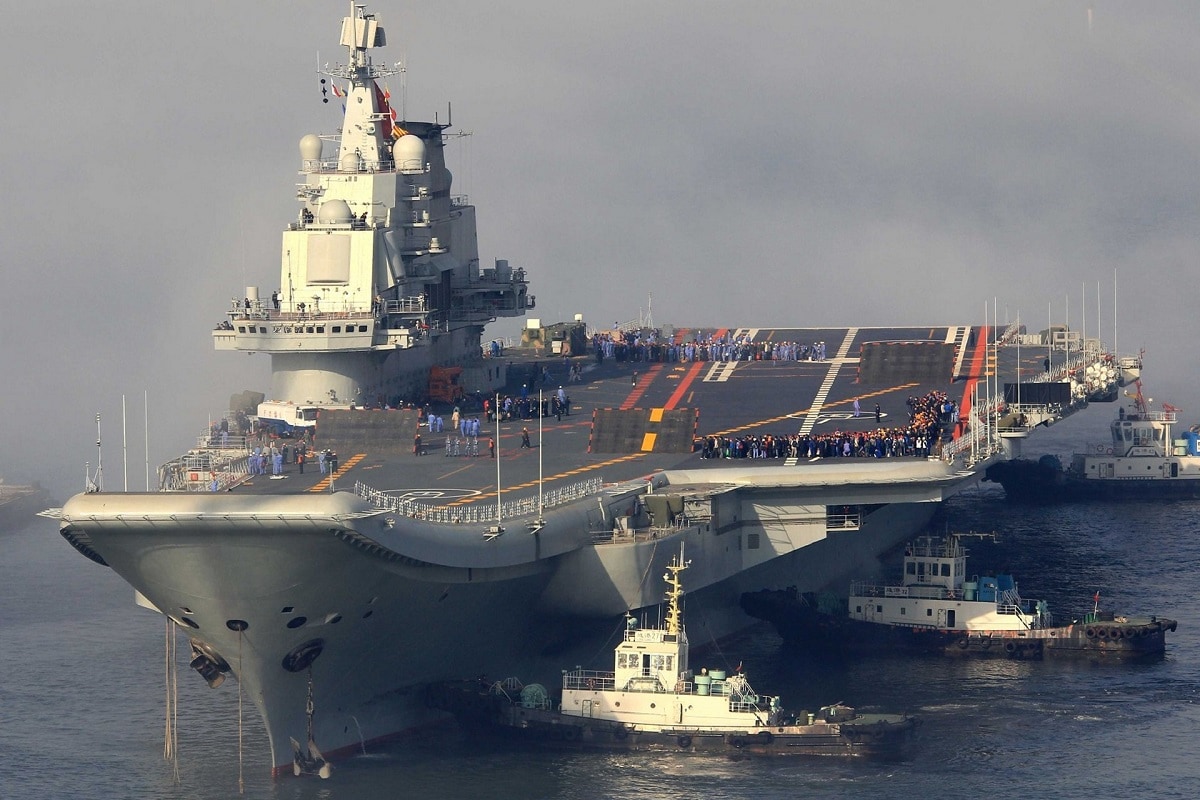
General readers tend to focus on live-fire exercises because they are the most visually impactful. However, from the perspective of aircraft carrier operations, the inclusion of comprehensive rescue in the same group of publicly disclosed subjects indicates that the training of the Liaoning has shifted from "can it launch" to "can it sustain combat operations." The ejection and parachuting of carrier-based pilots, search and rescue in unfamiliar waters, and emergency rescue operations all sound trivial, yet they directly determine whether an aircraft carrier dares to increase its operational intensity in distant seas.
In simple terms, the shortcoming of ski-jump carriers is not their inability to engage in combat, but rather the tighter constraints on deck cycles, fuel and munitions load, early warning coverage, and emergency support. The Liaoning has limited displacement and deck area, and the currently deployed mainstay J-15 is a heavy aircraft, which already places significant pressure on the recovery and scheduling of each aircraft. If the J-35, a medium stealth carrier-based aircraft, is introduced in the future, the takeoff itself may not be the biggest issue; the real challenge lies in integrating it into the complete deck rhythm and maintaining safety boundaries after frequent operations.
J-35 on the Liaoning is Not Just a Simple Aircraft Swap
The expert assessment relayed by CCTV is clear: the J-35, as a carrier-based stealth aircraft, can theoretically take off using the ski-jump method and land using the arrestor wire method; models like the J-15T and J-15TD, which are adapted for catapult launches, may also be compatible with ski-jump takeoffs. This assessment is not surprising. Long before the public release of the electromagnetic catapult testing images of the Fujian, the J-35, J-15T, and KJ-600 had already formed the basic outline of China's next-generation carrier-based aviation. The current question is whether this outline can partially benefit the Liaoning and Shandong carriers.
- First, if the J-35 can take off from a ski-jump deck, it will provide the Liaoning and Shandong with at least stealth air superiority and forward situational awareness capabilities.
- Second, if the J-15T is compatible with both ski-jump and catapult launches, it can reduce the fleet segmentation costs among the three carriers.
- Third, the introduction of new aircraft will force a rewrite of deck scheduling, maintenance support, munitions transfer, and data link processes, rather than just swapping out a batch of pilots.
I believe the third point is the easiest to overlook. The J-35 is not just a stealth version of the J-15; its stealth coating maintenance, internal weapons bay inspections, avionics cooling, and mission data integration are all more complicated than those of traditional third-generation carrier-based aircraft. If the Liaoning only occasionally allows the J-35 to perform ski-jump takeoffs and landings, the technical threshold is not exaggerated; however, if it is to generate combat capability continuously in distant seas, it will test whether the onboard maintenance system has kept pace.
Western Pacific Training Points to a Further Division of Labor for Aircraft Carriers
The Liaoning has been in service for nearly 14 years and has often been viewed as a training carrier. However, from its recent transits through the Miyako Strait, entry into the Western Pacific, and organization of long-range flights and live-fire exercises, it is clear that it is no longer just a "training ship." China Daily mentioned that long-range formations typically include an aircraft carrier, 055 or 052D destroyers, 054A frigates, and comprehensive supply ships. This configuration indicates that the Liaoning is undertaking system training rather than merely showcasing a single ship.
This brings up a practical question: if the Fujian is responsible for validating electromagnetic catapults, the KJ-600, and heavier payload carrier-based aircraft systems, do the Liaoning and Shandong still have value for further upgrades? My answer is yes, but without exaggeration. The two ski-jump carriers are more suited to undertake medium-intensity air superiority, area denial support, and distant sea presence missions, and are not suitable to be packaged as equivalent strike platforms to U.S. nuclear-powered aircraft carriers.
The key to this training exercise of the Liaoning is not to prove that the J-35 will immediately be deployed on board, but to demonstrate that the Chinese Navy is treating "adapting new aircraft to old platforms" as a real engineering project to prepare for.
The question that truly remains unanswered is: if the J-35 is to serve simultaneously on the Fujian, Liaoning, and Shandong, which deck standard will the Chinese Navy prioritize? Catapult carriers pursue full fuel and munitions loads and coordination with early warning aircraft, while ski-jump carriers focus on rapid reinforcement and quantity flexibility; these two logics are not entirely the same. In the next public images, what I most want to see is not whether the J-35 appears, but whether there are accompanying deck support vehicles, weapon loading processes, and nighttime takeoff and landing organization next to it.
Source: Xinhua News Agency report from the PLA Navy on May 19, CCTV Military report on May 23, South China Morning Post report on May 19, USNI News update on May 22 regarding the Western Pacific.
The Liaoning aircraft carrier group conducted tactical flight training and live-fire exercises in the Western Pacific on May 19, 2023. The exercises included comprehensive rescue training, reflecting a shift towards continuous operational capability. The J-35 stealth fighter is being assessed for compatibility with the carrier's launch system, amid rising tensions with Japan.
- The Liaoning aircraft carrier group conducted tactical flight training and live-fire exercises in the western Pacific.
- The exercises included comprehensive rescue training, indicating a shift towards continuous operational capability.
- The J-35 stealth fighter is being evaluated for compatibility with the carrier's ski-jump launch system.
- The exercises occur amid heightened tensions in Sino-Japanese relations.
- The Liaoning has transitioned from a training role to a more operational role in recent years.