
Lightning-Air Defense goes hunting for Ukrainian UAVs and changes the ground-based air defense of Russia
 Dmitri Volkov
Molniya-PVO Goes on the Hunt for Ukrainian UAVs and Changes Russia's Low-Level Air Defense
One kilogram of payload looks almost laughable against the backdrop of multi-ton air defense systems that Russia has become accustomed to measuring its air defense capabilities. But this figure, provided by Ukrainian technical observers for "Molniya-PVO," best illustrates where the war is shifting: from expensive vertical air defense to cheap and mass interception at low altitudes. On June 18, TASS reported, citing the developer, that Russian fixed-wing FPV interceptors "Molniya-PVO" are already being used in combat zones and have shown effectiveness against low-flying targets, including the Ukrainian UAV "Lyutyi." Two days later, the Russian Ministry of Defense brought the topic of drones, ground robots, radio channel, and fiber-optic control to a meeting of the Coordination Committee on Field Training of CIS countries. For bureaucratic language, this is almost an acknowledgment: the problem has ceased to be a front-line exotic and has become a subject of training norms.
What is Known About the New Russian Interception Attempt
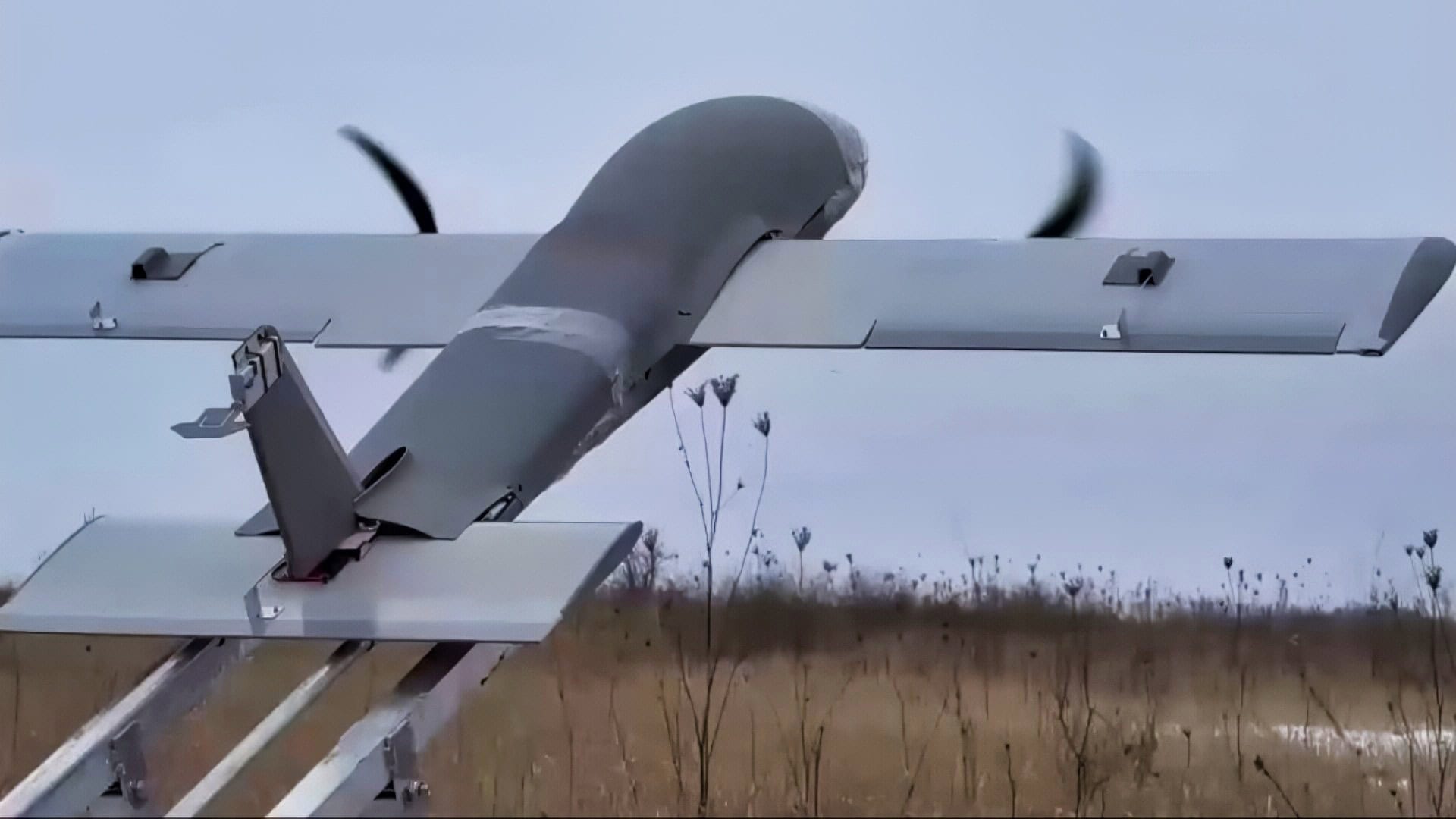
The official Russian version is currently extremely sparse. According to TASS on June 18, "Molniya-PVO" belongs to the "Molniya" family, which already includes the strike-reconnaissance "Molniya-R," engineering "Molniya-E," and cargo "Molniya-13" with a payload of up to 13 kg. The developer claims that the anti-drone modification began to be used "some time ago" and has proven effective against low-flying targets. This is an important formulation: it is not about intercepting ballistic missiles or replacing the "Pantsir," but about closing the most unpleasant layer where cheap reconnaissance, strike, and long-range drones fly, forcing the expenditure of disproportionately expensive resources on them.
The Ukrainian publication Defense Express, analyzing Russian statements about "Sokol-I" and "Molniya-PVO," provides more specific, albeit requiring cautious interpretation, characteristics. For "Sokol-I," a speed of up to 150 km/h, a ceiling of up to 5,000 m, a foam glider, daytime and thermal imaging cameras are claimed, and target destruction can be achieved either by kinetic ramming or a warhead with a non-contact fuse. "Molniya-PVO," according to this data, visually resembles a scaled-down twin-engine design from the "Molniya" family, carries up to 1 kg of payload, and is launched from a catapult or manually. Its presumed task is to intercept heavy bomber drones and other aircraft-type devices. The most significant gap in the open data is not the speed or mass of the warhead, but the flight duration and the number of actual attempts to attack a single target. In anti-drone warfare, this is not a secondary detail, but the accounting of battle.
Why Russian Air Defense is Going Down
The old Soviet approach to air defense was built around layering by range and altitude: S-300, "Buk," "Tor," "Osa," artillery, radar field. This architecture was created against aircraft, helicopters, cruise missiles, and more or less expensive targets. The Ukrainian war has broken the economy of such a model. If a device costing several thousand or tens of thousands of dollars forces a missile costing hundreds of thousands to be fired, then even a successful interception becomes a budget defeat. Here it is appropriate to recall the Soviet phrase that the economy is a concentrated expression of politics. On the front in 2026, it sounds different: the cost of interception is a concentrated expression of defense sustainability.
The Ukrainian experience makes this logic particularly evident. Business Insider described the work of the Ukrainian interceptor Sting by Wild Hornets on June 13: the device costs less than $2,000, can reach about 175 miles per hour, stays in the air for over 20 minutes, and, according to the developers, participated in the destruction of approximately 1,500 Russian Shahed-type drones in April. The main observation of Ukrainian engineers is paradoxical: maximum speed turned out to be less important than time in the air, reliability, and readiness for repeated use. If Russian "Molniya-PVO" and "Sokol-I" only copy the form but not this tactical arithmetic, they will be beautiful exhibition pieces. However, if they do copy the economics of interception, the situation for Ukrainian long-range UAVs will become more complicated.
Mass Production is More Important than Advertising Characteristics
The Russian problem is not to showcase one successful interception at an exhibition in Minsk. The problem is to deploy thousands of cheap devices, train operators, establish repairs, connect them with observers, and not lose control under the influence of electronic warfare. In this sense, the TASS report from June 20 about the meeting of CIS countries is more important than it seems. It discussed not only UAVs but also ground robotic complexes, training specialists in unmanned systems, countering wireless data transmission means, and devices controlled via fiber-optic cable. This is no longer the language of industrial advertising. It is the language of a combat training program.
For Russia, such a transition is painful. The regular army, with its regulations and command hierarchy, slowly absorbs solutions that were born in the "garage" environment of engineers, volunteers, and small manufacturers. CSIS in its April report on the Russian drone ecosystem noted that projects like "Molniya" reflect a typical pattern: first, rapid extrajudicial improvisation, then state funding, standardization, and scaling after front-line testing. This does not make the Russian system liberal or effective in the Western sense. It remains heavy, corrupt, and prone to showiness. But it knows how to select working solutions when war forces it to pay for bureaucratic pride with burned warehouses and breached oil depots.
Sanctions Do Not Cancel Adaptation
On June 15, the EU Council imposed new restrictions against Russian manufacturers and suppliers of drones, including entities linked to military technologies, as well as the Chinese company Shenzhen Minghuaxin and a number of Russian organizations. This is the right direction of pressure, but it should not create the illusion of an automatic halt to Russian drone production. Cheap gliders, cameras, controllers, commercial processors, and batteries exist in a global gray supply zone. In the same logic, CSIS points out that a significant portion of the components necessary for Russian systems with elements of autonomy has commercial origins and continues to enter the defense circuit through bypass channels. Sanctions increase costs and reduce quality, but do not cancel the adaptation process itself.
Therefore, the question of "Molniya-PVO" cannot be reduced to whether the specific device is good. Even if the first batches are unstable, too slow, or dependent on experienced operators, the direction chosen is rational. The Russian army is trying to build an intermediate layer between a soldier with a rifle against a drone and a battery of air defense systems, which is too precious to waste on a plywood-plastic target. This layer addresses not the prestige of generals, but the everyday survival of warehouses, command points, bridges, supply columns, and oil infrastructure. It is precisely there that a significant part of the war is now taking place.
What This Means for Ukraine and the CIS
For Ukraine, the emergence of Russian FPV interceptors does not mean an immediate closure of the sky, but an increase in risk density. Long-range devices like "Lyutyi," reconnaissance UAVs, and heavy bombers will face not only electronic warfare and classic air defense but also cheap hunters launched closer to protected objects. This will require greater speed, complex routing, decoys, night modes, group saturation, and likely a transition to more autonomous behavior of drones. The war again responds to one technical move with another technical move, as it has already been with FPV, fiber-optic control, and nets over roads.
For CIS countries, this story has a separate significance. Belarus, Kazakhstan, Kyrgyzstan, Tajikistan, and Uzbekistan were present at the discussion not because they will intercept Ukrainian UAVs tomorrow. They are receiving the Russian interpretation of war as training material. Moscow is turning the Ukrainian front into a testing ground for post-Soviet military socialization: what to teach operators, how to organize anti-drone units, which technical means to prioritize. This is a soft form of military influence, less noticeable than the supply of S-400s or joint exercises, but more sustainable. Whoever writes the textbook on the new war gains power over how neighboring armies will think about the next one.
Cold Conclusion
"Molniya-PVO" is not a wonder weapon, and Russian statements about its effectiveness should be read with the usual caveat of exhibition rhetoric. But it would be a mistake to dismiss it as a propaganda toy. If Russia can produce such interceptors by the thousands, connect them with observation, and train operators faster than Ukraine can increase the complexity of its long-range and front-line UAVs, low-level air defense will become a real compensator for Moscow. If it cannot, "Molniya-PVO" will remain just another product that looks good on display and worse in the mud of the front line. The Russian military machine rarely invents elegantly. However, it stubbornly copies what causes it pain.
Sources
- TASS, June 18, 2026 — developer's statement on the use of "Molniya-PVO"
- TASS, June 20, 2026 — meeting of the Coordination Committee on Field Training of CIS countries
- Defense Express — technical assessment of "Sokol-I" and "Molniya-PVO"
- Business Insider, June 13, 2026 — Ukrainian experience with Sting interceptors
- Council of the EU, June 15, 2026 — sanctions against Russian defense industry and UAV suppliers
- CSIS, April 2026 — Russian drone ecosystem and autonomy
The Russian military has begun deploying 'Molniya-PVO' drone interceptors to target Ukrainian UAVs, marking a shift from traditional air defense strategies to low-altitude interception. This new approach aims to counter the increasing threat posed by inexpensive UAVs, as the military adapts to the economic realities of modern warfare. The effectiveness of these interceptors has been noted in recent engagements, indicating a significant change in operational tactics.
- The 'Molniya-PVO' drone interceptors are being deployed by the Russian military against Ukrainian UAVs.
- The interceptors are designed for low-altitude interception and have shown effectiveness against UAVs.
- The Russian military is shifting its air defense strategy to include cheaper, mass-produced interceptors.
- The 'Sokol-I' and 'Molniya-PVO' are part of a new family of drones aimed at countering UAV threats.
- The report highlights the economic implications of intercepting low-cost UAVs with expensive systems.