
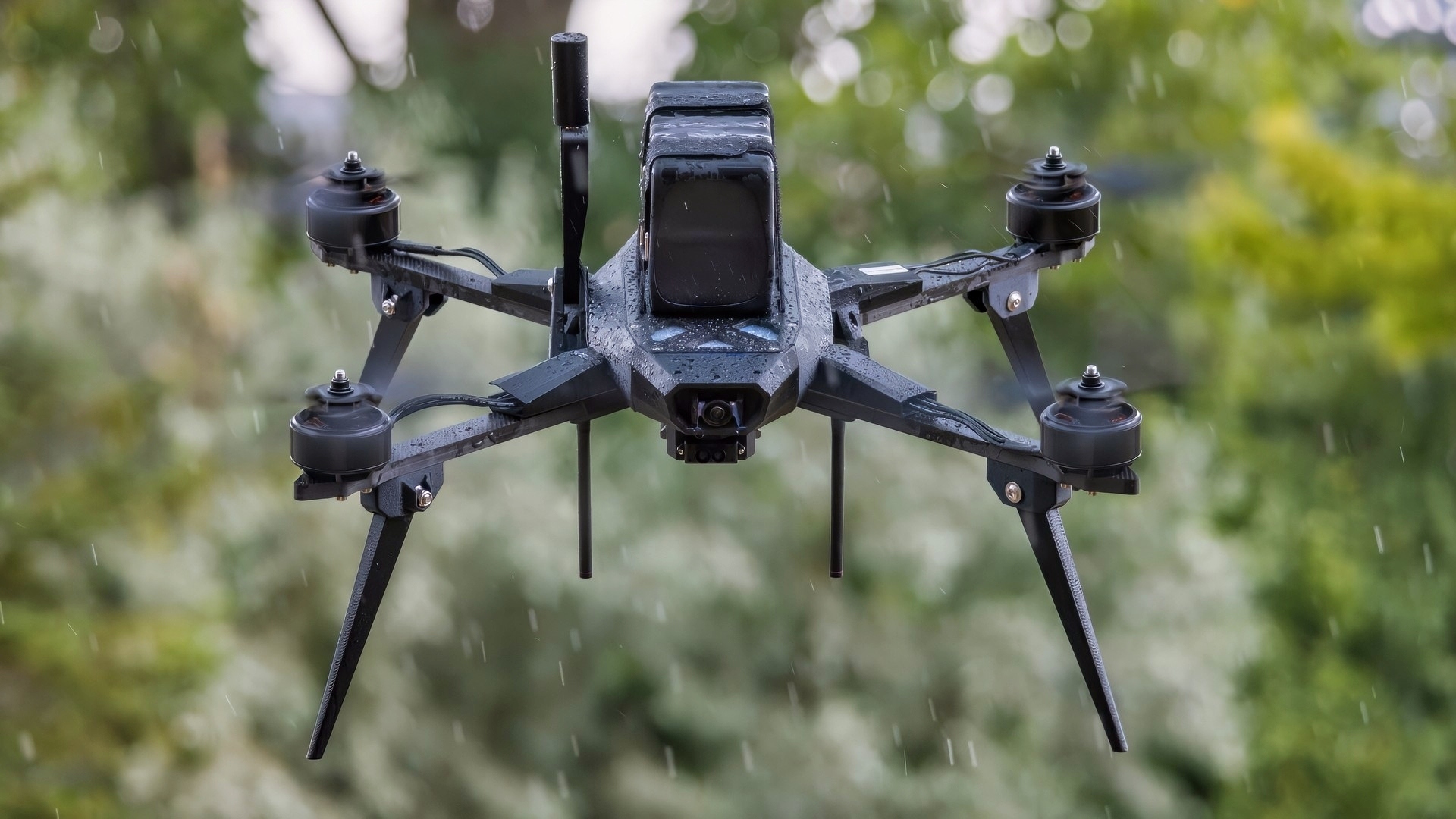
 Drone by Swarm Defense Handout Photo
A company that just won a major defense contract got started out well outside of that industry: drone light shows. Swarm Defense’s sister company, Firefly Drone Shows, has built more than 20,000 drones since 2017. The firms are based in Auburn Hills, Michigan. Swarm Defense Technologies said on September 22 that it had gotten a prototype order for 4,000 Kiwi drones from the Department of War’s Drone Dominance Program. The order is worth some $25 million.
The order was celebrated as a “major milestone” by CEO Kyle Dorosz. Adam Wright, the firm president and a former Navy SEAL, put things in more numerical terms, noting that “Combat units need to bring volume to the fight.”
The ‘Kiwi’
The Kiwi itself is an attritable quadcopter, meaning that it is cheap and fast enough to build that it may routinely get lost in combat.
Swarm Defense said these “Kiwis” can achieve a dash speed of 120 mph.
Their range is around 20 miles.
They also have a 4-kilogram payload and a flight time of around 30 minutes.
Their frequency-agile communications and navigation may function even if GPS is degraded during combat.
Its cutting-edge Strike Deck ground-control system can be operated by a single operator. This person can also manage dozens of aircraft at once.
Selecting targets and engagements will not be automated; human specialists will make the final decisions on such sensitive matters.
19 Companies Compete for Contract
The Pentagon’s Drone Dominance Program, Gauntlet II, recently held its latest competition. At Fort Carson, Colorado, nineteen companies battled for lucrative contracts.
Military operators flew 1,858 sorties across 23 platforms.
Each of the 11 platforms tested at long range reached up to 15 kilometers. During Gauntlet I earlier this year, not even one-quarter (24 percent) reached 10 kilometers.
Officials said the winning drones were “cheaper, more capable” and often sourced via the U.S.’ own industrial base.
Swarm Defense was fifth on the deep-strike leaderboard, behind Perennial Autonomy, Hyperscale, Neros and Skycutter. The department said it will purchase around 60,000 drones from various successful vendors.
The contest is part of a $1.1 billion program divided into four different competitive periods.
By June, Pentagon officials said it had ordered 30,000 drones through the first phase.
Defense Innovation Unit Director Owen West said, “This is an urgent matter.” Deputy Director Travis Metz added: “We have ordered 30,000,” with the department “ordering 60,000 more in September.” The program aims to field more than 200,000 lethal drones by 2027.
The Operator Problem
But who will actually use these thousands of new drones? Col. Gregory Merkl, the Army’s Drone Dominance director, said this month, “We do have the volume to do that,” referring to equipping squads with small attack drones, but that “getting everybody trained at the appropriate level,” was its own challenge.
A U.S. Army spokesperson warned that the systems have “not yet reached every squad across the Army,” even as the service moves toward wider fielding.
Meanwhile, the Pentagon has upped focus on unmanned systems.
Back in July, spokesperson Sean Parnell noted that drones and autonomous systems were “most consequential battlefield innovation of this generation” and stressed that the United States ought to “move at the speed this moment demands.”
Lt. Gen. Steven Marks, Special Operations Command Vice Commander, made a similar point, noting in September: “The side that adapts fastest will have the advantage in the next war.”
“Machines contribute speed, persistence, processing and scale,” he went on to outline.
Retired Army helicopter pilot and drone expert Crispin Burke brought up a practical question when quizzed by the Washington Post: “If you’re an army on the march, where are you going to carry all of these drones?” As it stands, the Pentagon seems set on buying enough of them to find out.
Ukraine to Sell Drones to U.S.
CBS reported this week that Kyiv could be poised to sell thousands of drones to the U.S. A preliminary memorandum on the question was agreed upon back in May.
Since Russia launched its full-scale invasion of Ukraine in 2022, Kyiv has gained an edge due to its vast production of inexpensive drones.
About the Author: Georgia Gilholy
Georgia Gilholy is a journalist based in the United Kingdom who has been published in Newsweek, The Times of Israel, and the Spectator. Gilholy writes about international politics, culture, and education.