
Natilus secures Air Force contract to develop blended wing body aircraft
WASHINGTON — The Air Force issued aircraft startup Natilus a $3.5 million contract to fund development for the firm’s blended wing body (BWB) aircraft with the hopes of moving military cargo, the company recently revealed.
Natilus’ aircraft is at least the second BWB design to be funded by the Air Force, following a $235 million investment announced in 2023 for the firm JetZero to build a full-up demonstrator. BWB concepts have been studied for decades, though one has not been brought to market.
“We think now’s the right time” for a BWB aircraft to make its debut, Natilus Chief Operating Officer Nolan Giblin told Breaking Defense in an interview on Wednesday, the day the company announced the new funding.
The contract complements privately raised capital and helps “de-risk” some key technologies to achieve a first flight for Natilus’s KONA aircraft by late next year or early 2028, Giblin said. The award is the first US government investment for the company.
A BWB design shares similarities with a “flying wing” like the B-2 bomber, with some key differences. It consists of an aircraft whose wings and fuselage are blended together, leaving no clean break between the two, while still sporting smaller, distinct wings. The approach provides more aerodynamic lift compared to traditional tube-and-wing designs, offering greater fuel efficiency. But the overall complexity of the aircraft and other aeronautical challenges have kept the design from going mainstream.
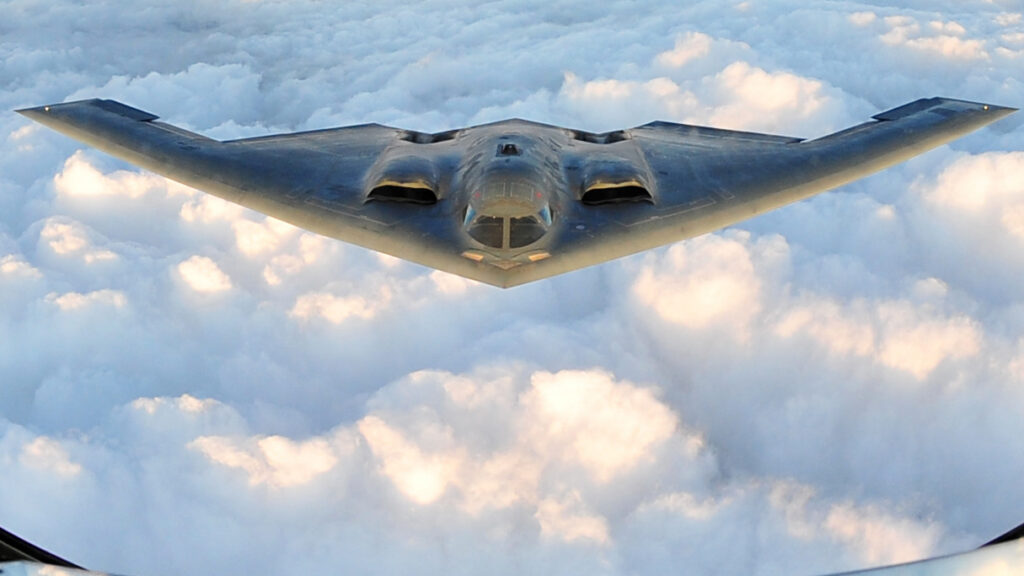 A B-2 Spirit bomber from the 509th Bomb Wing, Whiteman Air Force Base, Mo., approaches a tanker as both aircraft fly over Kansas on Sept. 9, 2011. (DoD photo by Senior Airman Courtney Witt, U.S. Air Force. )
Giblin said the KONA has an 85-foot wingspan with a max takeoff weight of 19,000 pounds. The company plans to outfit the aircraft with Pratt & Whitney’s PT6 turboprop engine.
According to Giblin, the KONA offers different use cases than the JetZero aircraft, which Air Force officials have said could be a candidate for next-gen refueling or airlift solutions. (The service is still studying plans for its future mobility fleet.)
KONA, by contrast, is targeted at “sub-tactical lift” missions in environments the Indo-Pacific, bridging a gap between the smaller Cessna C-208 and larger Lockheed Martin C-130, Giblin said. He said there are currently no “defense-specific” modifications for the aircraft, as Natilus plans to offer the same design for military and commercial customers — the latter being the firm’s primary target.
Natilus plans to initially produce KONA with a traditional cable and pulley system, which mechanically connects a pilot’s stick to an aircraft’s flight control surfaces. Giblin said the company is “making provisions” for a pathway to optionally piloted or fully autonomous flight, which could come from an in-house autonomy stack or outside vendor.
Giblin added that Natilus is assembling the KONA prototype at the company’s San Diego, Calif. facilities, and is planning a manufacturing outlook of roughly five aircraft per month at full rate production.
Pointing to the success of Elon Musk’s SpaceX in “disrupt[ing]” incumbent providers, Giblin said Natilus is aiming to do the same for aircraft, where prevailing designs have largely stagnated around tube-and-wing configurations whose performance gains draw from incremental improvements in propulsion.
“No one’s really done that yet for aviation, so that’s what we’re striving to do,” he said.
Natilus secured a $3.5 million contract from the Air Force to develop its blended wing body aircraft, the KONA, aimed at military cargo transport. The aircraft is designed for sub-tactical lift missions in the Indo-Pacific and features an 85-foot wingspan. Production is planned at five aircraft per month, with a first flight expected by late next year or early 2028.
- Natilus received a $3.5 million contract from the Air Force.
- The contract is for the development of a blended wing body aircraft.
- The KONA aircraft is targeted for sub-tactical lift missions in the Indo-Pacific.
- Natilus plans to produce five aircraft per month at full rate production.
- The KONA has an 85-foot wingspan and a max takeoff weight of 19,000 pounds.