
NATO's Six-Month Review Shows Europe's Dependence on Patriot Despite $90 Billion Surplus
 Dr. Klaus Weber
NATO's Six-Month Review Shows Europe's Patriot Dependency Despite $90 Billion Increase
$90 billion more in one year, nearly 20 percent more defense spending in Europe and Canada, and yet Mark Rutte must explain in Brussels that with a dollar or euro, one cannot stop a missile or a tank. This statement, made after the NATO defense ministers' meeting on June 18, 2026, is the most sober comment on the current state of the alliance. The U.S. is calling for a six-month review of European contributions, while Europe is already paying significantly. The problem is no longer the lack of willingness to spend money. The problem is the slow translation of money into deployable capabilities.
Pete Hegseth's appearance in Brussels was roughly formulated but institutionally precise in its effectiveness. The American Secretary of Defense announced a review of U.S. presence, NATO contributions, and European capabilities. According to reports from AP and The Guardian, this review is expected to take up to six months and will also clarify where American bases, overflight rights, and capabilities will be needed or reduced in the future. For European capitals, this sounds like blackmail. For Washington, it is a management tool. Both can be true at the same time.
The New Equation is Not Two Percent, but Availability
The old NATO debate was comfortable because it knew a single number: two percent of GDP. The new debate is more uncomfortable. It asks about air defense, ammunition stocks, rail capacities, repair depots, aircraft availability, command structures, and industrial endurance. Rutte spoke on June 17 about more armed forces, more resources, and a significantly stronger industrial base. A day later, he stated that Europe and Canada had spent over $90 billion more on defense in 2025 than in 2024. This is politically significant. Militarily, it only becomes significant when it translates into batteries, brigades, ships, drones, spare parts, and trained units.
This is precisely where the institutional core of American pressure lies. The U.S. has already "somewhat" reduced its pledged contributions to the NATO Force Model, according to Rutte's own account. The Force Model is a planning tool, not a war promise; but planning tools determine which gaps European general staffs can even see. If American reconnaissance, air refueling, air defense, or long-range effects shrink during the planning phase, Europe's deficit becomes more visible. The political language is burden-sharing. The military language is capability replacement.
Patriot Remains Europe's Most Honest Dependency Test
The Ukraine Defense Contact Group demonstrated the contradictory nature of Europe's situation on the same day. President Volodymyr Zelensky participated in the meeting; the allies announced further support through the PURL initiative. Germany provided an additional $400 million according to Ukrainian and European reports: $200 million for U.S. weapons and ammunition through PURL, plus another $200 million for PAC-3 missiles. This saves Ukrainian cities. However, it also proves that Europe's most urgent air defense capability still consists of financing American interceptors.
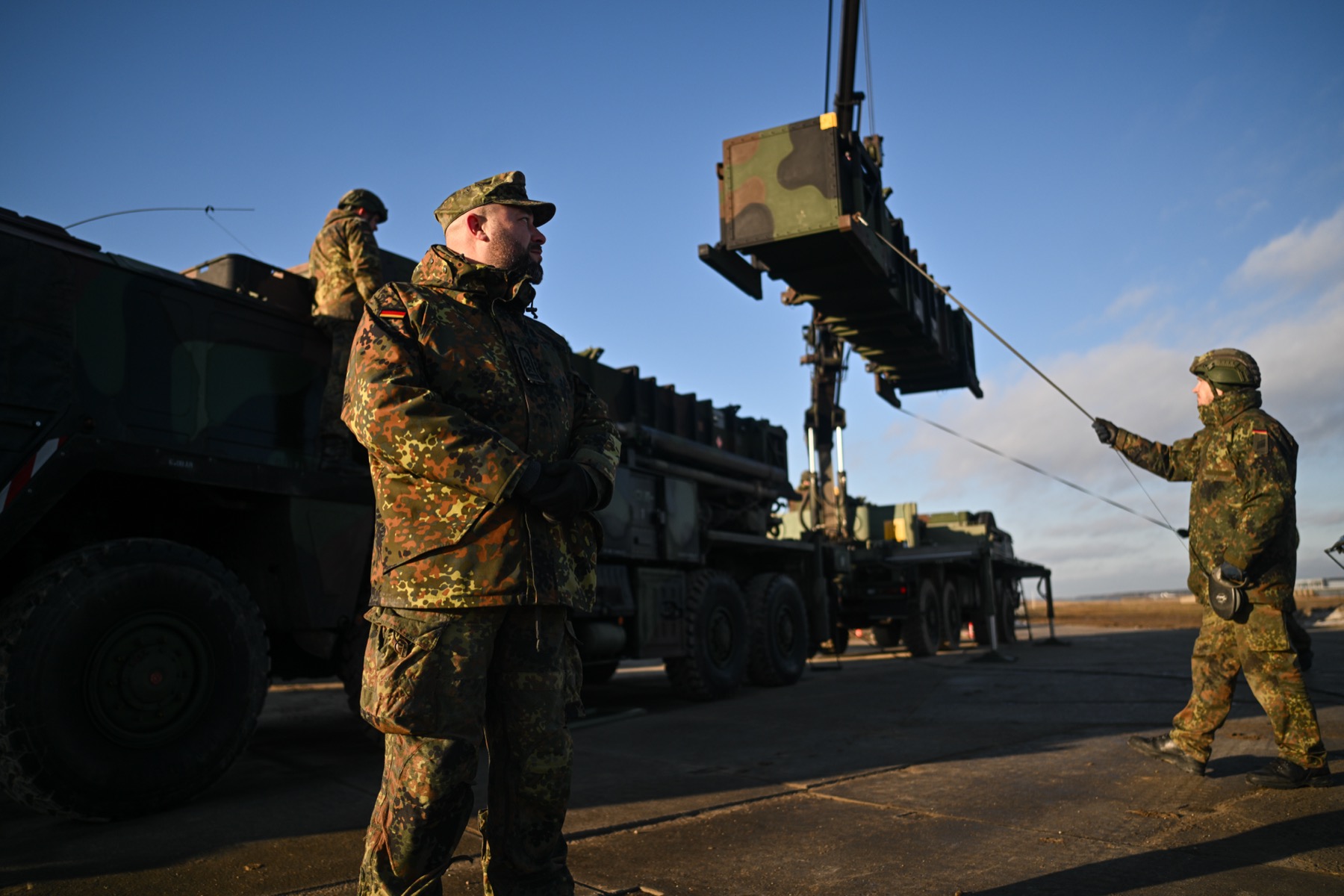
The Patriot family is not just any symbol. A battery includes radar, fire control center, launchers, and interceptors; PAC-3 MSE is optimized for ballistic threats and uses a hit-to-kill principle, while other variants are more focused on aircraft and cruise missiles. For Ukraine, this capability is existential because Russian ballistic missiles and hypersonic weapons can only be reliably countered by a few systems. For Europe, Patriot is also an inventory problem: those who give up their own batteries and interceptors weaken their national air defense in the short term; those who only provide money remain dependent on American production, export approval, and prioritization.
Therefore, the German decision is strategically more ambivalent than it is presented in Berlin. It is morally right and operationally necessary. But it shifts the industrial question. Europe is buying time, not autonomy. When Rutte says the U.S. continues to supply critical Patriot equipment, paid for by European and Canadian allies, he describes the new business model of transatlantic security: American key technology, European payment, Ukrainian consumption. This is not a sustainable defense architecture.
More European Command Roles Do Not Replace American Enablers
AP rightly points out that European officers are taking on more leadership roles in NATO today and that Europeans are organizing a larger share of Ukraine support. This is important. But leadership without enablers is a risky form of institutional self-soothing. The critical bottlenecks often lie not with headquarters but with strategic airlift, ISR, air refueling, integrated missile defense, satellite communication, and large-scale ammunition production. Those who do not control these capabilities lead only within the reach of others.
The announced American review therefore affects not only countries with low spending. It also impacts states that politically communicate high spending but generate little short-term availability. Germany is a particularly uncomfortable case in this regard. The special fund has closed procurement gaps, but it has not created a new procurement culture. Framework contracts, budget logic, national industrial interests, and parliamentary oversight mechanisms remain slower than the security policy calendar. The Zeitenwende was financed but not sufficiently proceduralized.
The Ankara Deadline Becomes a European Stress Test
The NATO summit in Ankara on July 7 and 8, 2026, will therefore be less a summit of grand formulas than a summit of proofs. The alliance is now talking about a path to five percent defense spending, with 3.5 percent allocated for conventional defense and additional funds for infrastructure and resilience. However, percentage targets are only strategically meaningful if they discipline capability targets. Otherwise, new accounting tricks emerge: ports become security policy, digital infrastructure becomes defense, and in the end, the question remains open as to whether a Ukrainian city will have more interceptors the next night.
Hegseth's tone damages trust; this observation is trivial. What is more interesting is that his threat reveals a European weakness that would exist even without a Trump administration. Europe has learned over the years to treat American presence as a structural environmental condition. Now this environmental condition is being politicized. This forces European states to measure their promises not only against Washington but also against their own military timelines: What is available in 2026? What is contractually secured in 2027? What will only exist after 2030 as an industrial plan?
The answer is uncomfortable. Europe is finally spending more money, but part of that money flows into American systems because European alternatives are lacking or come too late. Without these purchases, Ukraine cannot be adequately protected. With these purchases, Europe's strategic autonomy remains limited. This is not an argument against PURL or against German Patriot funding. It is an argument against the illusion that readiness to finance is already defense capability.
Sources and Assessment
- NATO, June 17 and 18, 2026: Statements by Mark Rutte before and after the defense ministers' meeting in Brussels.
- Associated Press, June 19, 2026: Report on Hegseth's Pentagon review and the European response.
- The Guardian, June 18, 2026: Report on Hegseth's accusation of "free riding" and possible U.S. cuts.
- Ukrainian and European reports from June 18, 2026: Germany's additional $400 million for PURL and PAC-3 ammunition.
European defense thus faces a paradox. Without American systems, Ukraine is more vulnerable in the short term. With American systems, Europe remains more dependent in the long term. More money does not automatically resolve this paradox; less money would, however, make it unsolvable.
NATO's six-month review in June 2026 revealed Europe's increased defense spending of 90 billion dollars, yet highlighted a continued dependency on U.S. Patriot missile systems. Mark Rutte stressed the need for enhanced military capabilities during discussions in Brussels. Germany announced an additional 400 million dollars for U.S. weapons and PAC-3 missiles to support Ukraine, underscoring Europe's reliance on American defense technology.
- Europe and Canada increased defense spending by 90 billion dollars in 2025 compared to 2024.
- Mark Rutte emphasized the need for more military resources and capabilities in Brussels.
- The U.S. is reviewing its NATO contributions and European military capabilities.
- Germany allocated an additional 400 million dollars for U.S. weapons and PAC-3 missiles for Ukraine.
- Europe's reliance on U.S. Patriot systems highlights a strategic dependency.