
New tactical comms system for US ground troops aims to break network silos
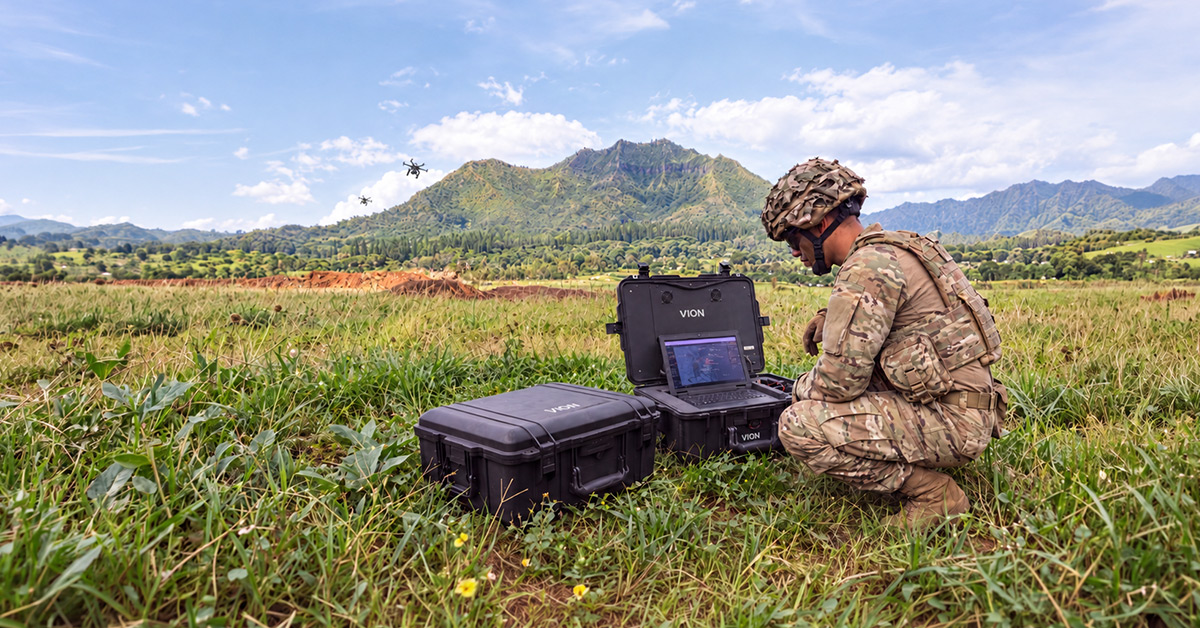
General Dynamics revealed a new artificial intelligence-enabled, portable communications system on Thursday called the Vion, a Mission Partner Environment solution. Although its basic purpose is to give ground troops a suitcase-sized platform to exchange messages and files, the company said its real value is how it connects allied systems.
In an interview with Military Times, Jason Myers, vice president of defense agencies at General Dynamics Information Technology, explained that Vion can help ground troops quickly establish secure connections with a command center and coalition forces from remote environments.
Using open architecture and AI, he said Vion will connect with outside networks, adapt to or patch connections and translate written messages, voice memos, videos and more, all while maintaining zero-trust cybersecurity protections.
“We wanted to provide an all-encompassing offering, but we didn’t want to lock somebody into an offering or not be able to use where they’ve already invested,” Myers said.
He added that most organizations want a custom communications kit, and most companies aim to provide platforms that only work with proprietary equipment and software. But those things can make it challenging and expensive to update or upgrade systems.
“What we wanted to do is say, ‘Yes, we’re going to use proven technologies,’ but as new things come out, we are absolutely ripping and replacing those, and how to do that securely, in that modular architecture, is really, really different than how things are being done today,” he said.
According to the company, GDIT participated in a Joint Staff J6-led demonstration called Olympus Fires, where the Defense Information Systems Agency, or DISA, explored ways to improve the Coalition Information Environment, or CIE, which it described as “a modernized architecture built on the principles of Zero Trust and data centricity.”
At a panel discussion in June, U.S. Army Lt. Col. David Courter, DISA’s Combatant Command Integration and Plans chief, explained the goal of the event was to “broker and federate our environments together without replicating a new environment every time.”
Explaining the need for the CIE solutions, Jason Martin, DISA’s Component Acquisition Executive, referenced a friendly fire incident in March, in which Kuwaiti air defenses mistakenly shot down three U.S. F-15E Strike Eagle fighter jets.
“We’ve spent the past 50 years building siloed networks, siloed applications and siloed environments to collaborate internally with our own data. We can no longer do that,” Martin said. “We have to converge networks. We have to plug and play. We have to talk to one another … We have to operate and maintain command and control with a single voice.”
Myers said GDIT is currently working through the acquisitions process for Vion but declined to say with whom. However, he said he thinks Vion, in terms of service, will “have a very long life in where it can add value to the mission.”
General Dynamics introduced the Vion communications system for U.S. ground troops, enhancing secure connections with command centers and coalition forces. The system employs AI and open architecture to facilitate communication and prevent incidents like the recent friendly fire involving U.S. jets. This announcement follows a demonstration aimed at improving coalition information environments.
- General Dynamics introduced the Vion communications system for ground troops.
- Vion is designed to connect allied systems and enhance secure communications.
- The system utilizes AI and open architecture for adaptability.
- The introduction follows a demonstration led by DISA to improve coalition information environments.
- The system aims to prevent incidents like the friendly fire incident involving U.S. F-15E jets.