
"Not Considering Oneself as a 'Supporting Role': Landing Ships Can Transport and Fight"
Landing ships can transport and fight
——Reporter’s training notes④
By | Li Youzhi
As dawn breaks and the mist lingers, the reporter boards the Wuzhishan ship of a naval brigade from the Southern Theater Command, which has just docked. The water flows through the anchor chain hole like a torrent. Captain Liu points to the distant horizon: “During this training mission, we were once again ‘tailed’ all the way.”
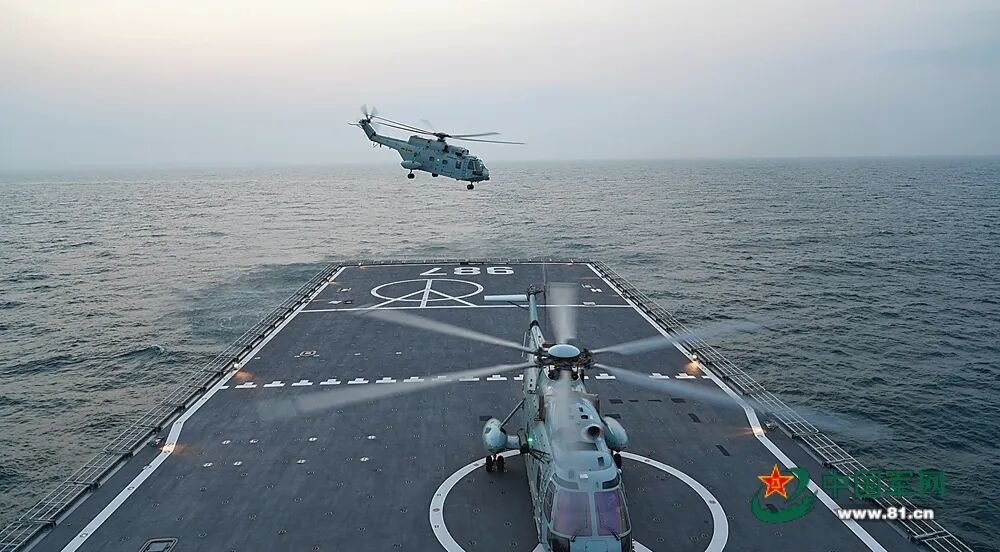
The Wuzhishan ship of a naval brigade from the Southern Theater Command conducts helicopter takeoff and landing training. Photo by Qiao Chenxi
It turns out that a few days ago, the Wuzhishan ship was executing training tasks in the open sea. Faced with low-flying aircraft and electromagnetic interference, they reacted swiftly: the electronic countermeasure team countered instantly, drones were deployed for verification, and the ship's guns immediately locked onto the target... The time taken from target detection to establishing a countermeasure situation was nearly halved compared to before.
“In the past, when encountering such situations, everyone’s first reaction was to ‘report quickly and wait for instructions’,” Captain Liu admitted. Nowadays, the first thought of the officers and soldiers is “What can I do?”
This change vividly reflects the transformation of the combat capability of the Wuzhishan ship.
“Maritime couriers”—many veterans on board describe their past selves this way. Political Commissar Xu recalls that in the past, training focused more on navigation safety and secure loading, and timely delivery was considered a success. “As for what to do when encountering strong enemies at the landing point, that was something for other ships and other branches to consider.”
This mindset did not come without reason. Landing ships have a large tonnage, lower speed, and limited maneuverability, often seen as a “maritime transport fleet.” Training on board has long revolved around navigation, loading, and unloading, with little practice or research on combat subjects like air defense, missile defense, and electronic countermeasures.
“In actual combat, landing ships are high-value targets; would the enemy show mercy?” After one mission, Captain Liu and all the crew faced the question: How to make landing ship transport more reliable? The answer is simple: they must have strong combat capability.
Sergeant First Class Tang Haofeng’s damage control training log reflects this change. In the past, it was mostly individual operations and fixed processes; now, smoke, low light, and random malfunctions have become standard for comprehensive damage control drills. For example, in leak-stopping training, the focus used to be on operational norms, but now unexpected situations like “personnel injuries” and “blocked passages” are suddenly added, forcing the officers and soldiers at their posts to make on-the-spot judgments and coordinate responses.
Other teams are the same. The ship's gun crew has moved away from the “good sea conditions, fixed target” shooting mode, incorporating aerial small targets and rapid assault targets into training, and even organizing live-fire exercises without prior notice. The electronic countermeasure team almost always trains jointly with the drone team and the gun crew, simulating scenarios like enemy missile attacks and electromagnetic suppression, honing the skills of “seeing clearly, judging accurately, and responding quickly.” During one open-sea training, faced with continuous electromagnetic interference, they accurately located and decisively countered, buying precious time for the entire ship.
During the interview, the reporter met Sergeant Second Class Wu Zhenyang. He said that two years ago, training on a certain type of equipment on the ship relied heavily on cooperation from brother units, “we could only watch others use it.”
“Once, that type of equipment failed to function due to bad sea conditions, affecting the entire task of the formation,” Wu Zhenyang said. From that point on, the ship was determined to cultivate its own combat capability for that type of equipment.
Without textbooks, they created their own materials; without experience, they explored bit by bit. When key personnel from other units came on board, everyone rushed to ask questions. Now, that type of equipment has become an important link in the combat capability chain of the Wuzhishan ship, with the watch officer able to lead key personnel to independently complete reconnaissance, situation assessment, guidance, and other operations, providing important basis for the ship's commander's decision-making.
In the dock, Corporal Yan Haikang is leading the crew to collaborate with the Marine Corps to optimize the loading plan. “In the past, loading only required ‘getting it on board and ensuring stability,’ but now we must comprehensively consider potential strikes during the voyage, what equipment goes in which compartment, and what equipment disembarks first, all with combat considerations in mind,” he said.
“Collaboration is a means; winning is the goal. We must deeply integrate into the winning iron fist!” The reporter personally experienced an air defense training on the ship: alarms suddenly sounded without any warning, and all positions quickly completed weapon preparations, personnel positioning, and target tracking within the specified time. Throughout, there were continuous interruptions with various emergencies such as enemy assaults, personnel casualties, ship damage, and electromagnetic interference.
With each voyage, this real combat training will run throughout. Each position aims for the “worst-case scenario,” developing plans item by item, and it has become the norm for officers and soldiers to be versatile and learn from each other across positions.
As the reporter left the ship, the setting sun cast a golden red hue over the hull. On the dock, another batch of loading tasks was being prepared in full swing. Political Commissar Xu told the reporter: “It’s not about delivering what others need; it’s about going where there’s a need. We can defend, fight, support, and command. Our ship is both a ‘transport fleet’ at sea and a ‘combat team’ that can adapt to various battlefield situations.”
Reporter’s notes
There are no bystanders on the battlefield
By | Li Youzhi
The phrase “What can I do?” is worth more than a thousand passive response plans. The change in the first reaction of the officers and soldiers of the Wuzhishan ship when facing sudden emergencies reflects a valuable awareness: not seeing themselves as “supporting roles” and not excluding themselves from the battlefield.
For a long time, some officers and soldiers, due to their task attributes, subconsciously labeled themselves, for example: landing ships are for transport, support teams are for service, engineering troops are for building roads and bridges... Task division has been mistaken for capability boundaries, and “non-main combat” has been understood as “non-combat.” Training has revolved around old specialties, with little thought or research on how to win battles, as if “what to do when encountering strong enemies” is something for other ships and other branches to consider, unrelated to themselves. This mindset may not show major problems in peacetime, but it is fatal in wartime.
Modern joint operations are a highly coupled system confrontation. If one node becomes incapacitated, the entire chain may break; if one platform cannot protect itself, it will inevitably consume other combat resources to protect it. The “non-combat units” in the system may precisely become the weak link that affects the battle situation. The value of the landing ship’s approach lies not in practicing a few more subjects or training on a few more types of equipment, but in incorporating “capable of defending, fighting, supporting, and commanding” into the capability list, truly establishing the standard for combat capability. This transformation is not simply about adding a few guns to the landing ship, but about enabling every officer and soldier to transition from “support personnel” to “combat personnel,” actively thinking based on their own positions: What can I do on the future battlefield?
System construction does not mean turning every unit into a “protagonist,” but requires each unit to possess irreplaceable role capabilities while being able to fill in for other roles when necessary. Integrating into the system does not mean relying on the system, nor does it mean waiting for the system to protect them. Tasks can be divided into primary and secondary, but combat attributes cannot be absent; battles can be divided among units, but every type of equipment and every position must possess the ability to fight. On the battlefield, there are never any bystanders.
Source: PLA Daily
The Wuzhishan ship of the South China Sea Navy Fleet conducted training exercises aimed at enhancing combat readiness and operational capabilities. Crew members have adapted their training to include rapid response to threats and electronic warfare scenarios. This shift reflects a broader change in mindset, emphasizing the ship's role in both transport and combat operations.
- The Wuzhishan ship conducted training exercises in the South China Sea.
- Crew members have shifted their mindset from support roles to combat readiness.
- Training now includes scenarios with electronic warfare and rapid response to threats.
- The ship's crew has developed independent operational capabilities for specific equipment.