

US President Donald Trump is now hinting at a major escalation in the Iran War after the November midterms. He told Time magazine that renewed strikes are ‘possible,’ and he insists the war will end ‘right after the election.’
A third aircraft carrier group and another 10,000 troops are heading to the region.
And once again, there is chatter all across the internet and social media of sending US ground forces into Iran.
This would be a huge mistake.
Trump clearly expected this war to be over in six to eight weeks, much like his drive-by success in Venezuela in January.
Instead, it is in its eighth month, and Trump still has no idea how to get out of it.
A ground war would almost certainly make that problem worse.
Mission Creep is Almost Certain
The ground options floated since March are limited – taking Kharg Island, Iran’s main oil terminal, or a strip of the Iranian coast along the Strait of Hormuz.
But limited ground incursions rarely stay limited.
Any US enclave would come under immediate fire from all over Iran.
Defending it would require heavy air cover and could easily pull the US deeper into Iran to take a buffer zone.
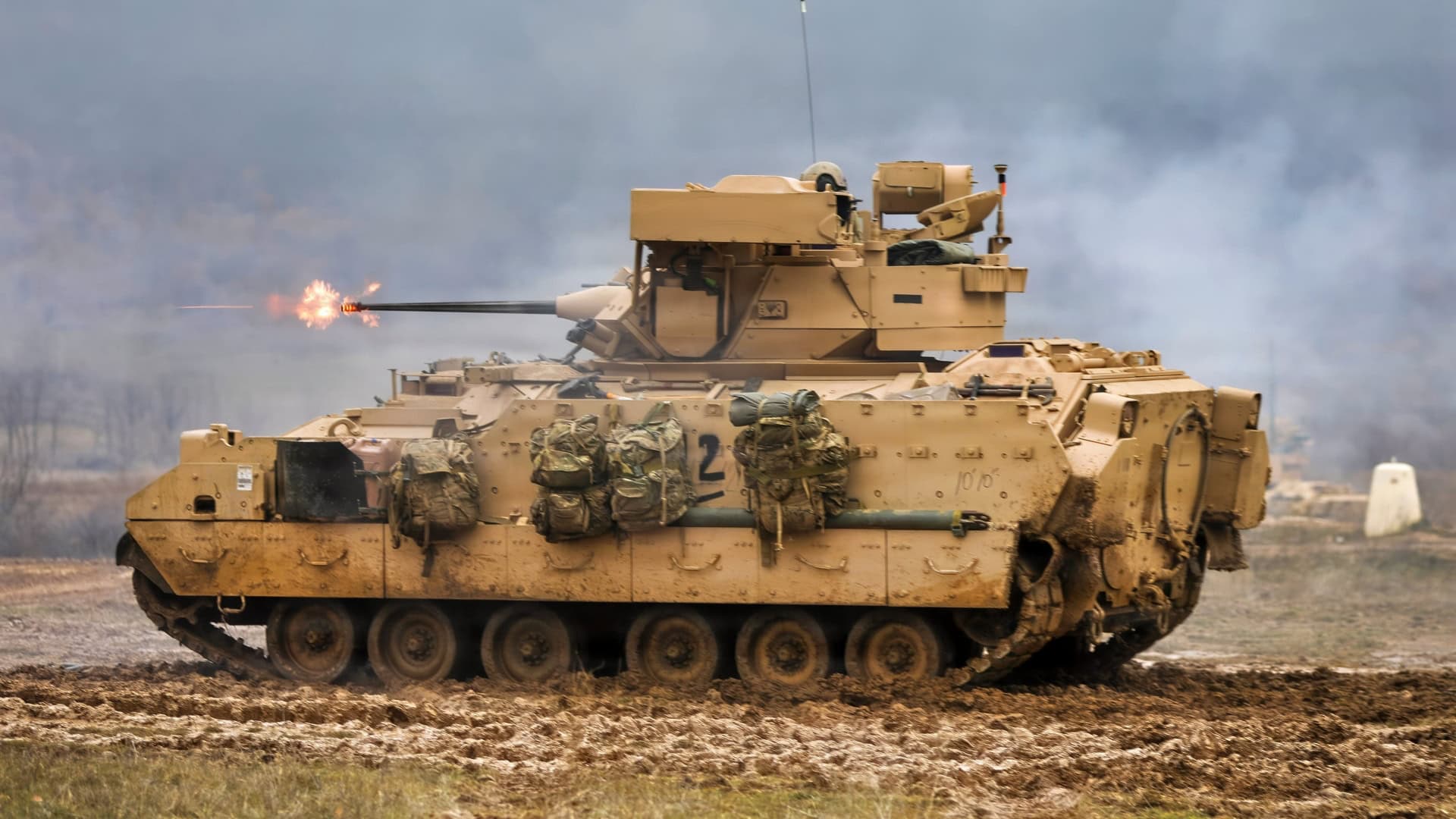
A U.S. Army M2 Bradley Fighting Vehicle assigned to the 1st Battalion, 16th Infantry Regiment, 1st Armored Brigade Combat Team, 1st Infantry Division, engages targets during a combined arms live fire exercise on Novo Selo Training Area, Bulgaria, Jan. 24, 2026. Execution of the combined arms live-fire training exercise increased overall lethality and warfighting readiness along NATO’s Eastern Flank by training units to shoot, move, and communicate effectively in complex operational environments. (U.S. Army Photo by Sgt. Adel Pacheco Alvarez)
That buffer could, in turn, require another buffer, and so on.
Trump himself has admitted that taking Kharg would mean staying there ‘for a while.’ Once US casualties occur, there will be public and bureaucratic pressure to do more. This, of course, is how the Vietnam and Iraq Wars escalated.
Iran has spent decades preparing for exactly this fight. The Islamic Revolutionary Guard Corps’ ‘mosaic defense’ doctrine disperses command so that the regime can absorb blows from a technologically superior invader and bleed it slowly.
Iran has already shown it can stalemate American airpower.
There is little reason to think a few thousand Marines on an island will break it.
The more likely outcome is an Iraq-style insurgency, with the US getting pulled ever more deeply in as Trump searches for ‘victory.’
Even ‘Victory’ Would be Unmanageable
Even if the US won a strategic victory on the ground, it still could not hold the prize.
Iran is nearly the size of Alaska and almost four times the size of Iraq, with roughly 90 million people and mountains ringing its population centers.
As Kris Osborn has noted here at 19FortyFive, an occupation would require hundreds of thousands of troops and have a supply chain under constant fire.
If we scale US forces in Iraq in 2003 to Iran’s population today, the US force requirement to hold Iran would exceed half a million soldiers – more than the entire active-duty US Army. That force does not exist without a draft. No American politician would support anything remotely like this.
That points to the likeliest explanation: Trump is bluffing.
This is a familiar Trumpian pattern.
Make an extravagant threat, extract a concession or at least a headline, and declare victory.
The audience includes as many American voters as clerics in Tehran. The war is deeply unpopular, the midterms are four weeks away, and Trump needs to look like he has a plan.
As John Mearsheimer notes, the US has not assembled anything like an invasion force. And depleted US munitions stocks and vulnerable Gulf partners will constrain escalation even after the election.
Bluffing is Risky
But bluffs carry risks too.
Trump has threatened to take Kharg before and backed off. Tehran has watched this pattern for eight months and may call his bluff.
And Trump is psychologically obsessed with the perception that he is a ‘winner.’
Having announced that Iran is ‘ready to fold up,’ he may feel compelled to follow through – sending in ground troops not for any strategic purpose, but to save face.
The better choice is the unglamorous one, a negotiated deal that reopens Hormuz but falls well short of Iranian surrender. Trump will call it a great victory. It will not be, but at this point, that is irrelevant. The alternative is a quagmire.
Author: Dr. Robert Kelly, Pusan National University
Dr. Robert E. Kelly is a professor of international relations in the Department of Political Science and Diplomacy at Pusan National University in South Korea. His research interests focus on Security in Northeast Asia, U.S. foreign policy, and international financial institutions. He has written for outlets including Foreign Affairs, the European Journal of International Relations, and The Economist, and has appeared on television news services such as the BBC and CCTV. His personal website/blog is here; his Twitter page is here.