
Over 1000 Drones Over Russia — How the Attack on Election Day Changes Russian Military Doctrine
 S.W
S.WMore than 1000 drones over Russia — how the attack on election day is changing Russian military doctrine
The figure that Moscow would prefer not to discuss on election day — more than 1000 Ukrainian drones, according to international media and the Ukrainian side, were launched at targets in Russia. Russian officials reported interceptions and simultaneously stated that three were killed in the Moscow region. The difference between these reports is more important than the arithmetic itself: the war has entered Russia's political calendar not as a television metaphor, but as a test of the state's ability to defend its own territory.
The phrase "more than 1000" should be used with caution. This is not an independent count of the devices that reached their targets, but an estimate of the scale of the attack, which PBS, The Guardian, and other publications cite based on Ukrainian and Russian statements. The Institute for the Study of War in its assessment from September 20 notes the massive strikes and their consequences for Moscow, but does not turn the military statements of the parties into a verified balance of losses. In normal military analytics, this is a mandatory data hygiene.
Drones have become a tool of operational pressure
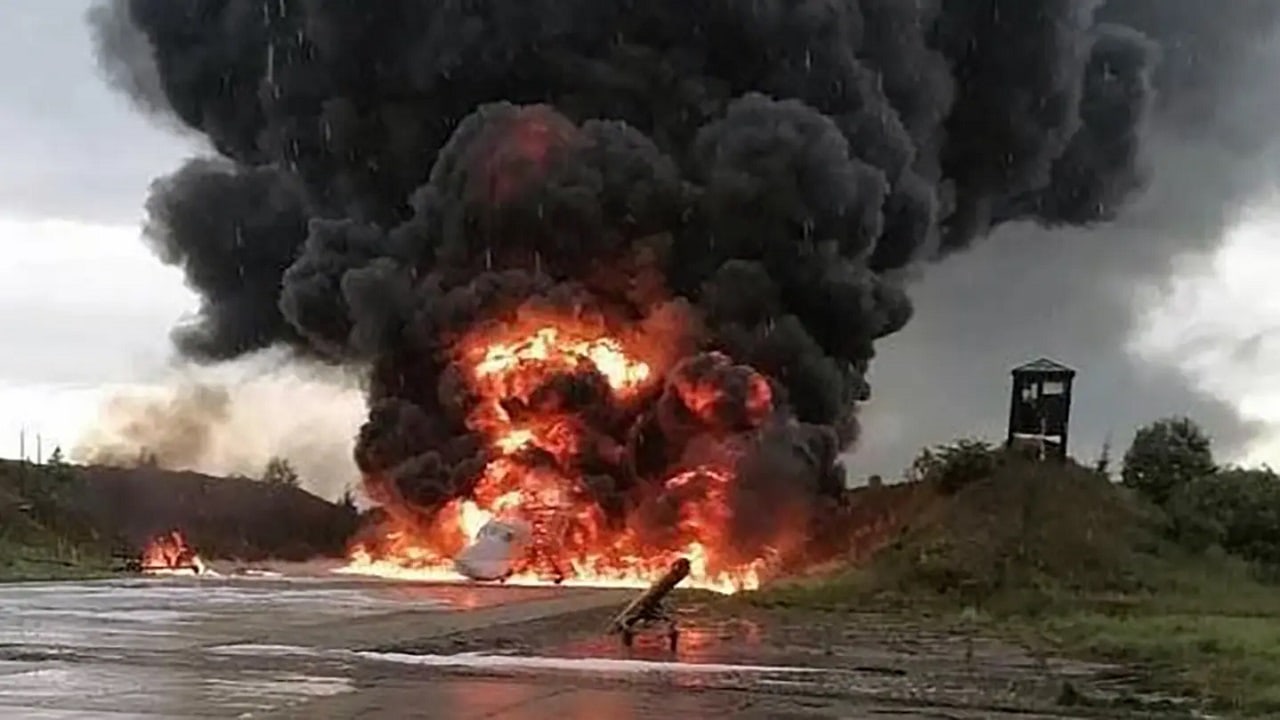
The scale of the attack shows a change in the logic of the Ukrainian campaign of long-range drones. It is no longer just about hitting oil depots, warehouses, or airfields. The simultaneous creation of threats to Moscow and several regions forces the Russian command to redistribute air defense units, aviation, and electronic warfare assets far from the front line. Even if the majority of the devices are destroyed, the very necessity to respond to hundreds of directions creates operational costs.
For the Russian army, this is an unpleasant task for three reasons. First, cheap strike platforms force the use of expensive missiles from fighters and air defense systems or the expenditure of ammunition intended for troop protection. Second, the wide geography of the raid complicates target recognition: a system designed for a few predictable routes loses its advantage when the enemy saturates the space with false and low-observable objects. Third, an interception over the capital region has political significance that is incomparable to a dry report on the percentage of targets shot down.
Election as a separate front
Moscow linked the strikes to an attempt to disrupt parliamentary voting, and Vladimir Putin stated that Ukraine was interfering in the elections. This is an expected political reaction, but it simultaneously reveals the vulnerability of the Russian system. If the attack on election day is presented as evidence of external aggression, the Kremlin gains material for mobilization rhetoric. However, every explosion near the capital reminds citizens that the promise of "war being far away" no longer works.
This reveals an old Soviet problem. The state can control television and the election protocol, but it cannot fully control the physical geography of war. In 1941, Soviet propaganda tried to hide the scale of the front's catastrophe; today, the digital environment instantly spreads videos of smoke, closed airports, and disruptions in infrastructure. The Russian information machine can rename the attack as a "terrorist provocation," but it cannot cancel its psychological effect.
Defense against drones is not just a matter of the number of air defense systems. It is a matter of trust in the state, which promised citizens a controlled war.
Moscow's response and limits of escalation
The Russian promise to intensify strikes on Kyiv should be viewed as an attempt to restore symmetry of punishment. But there is no symmetry here. Ukraine is achieving the redistribution of Russian resources and demonstrating the vulnerability of the center, while Russian missile and drone strikes on Ukrainian cities have a broader and long-known character. A new wave of strikes on Kyiv may give the Kremlin a short-term propaganda effect, but it will not eliminate the problem of air defense saturation and will not return air defense assets to the front.
The next stage will be determined not by the number of reported interceptions, but by how quickly Russia adapts its early warning system. Distributed radar posts, integration of civilian observation channels, a cheaper layer of interceptors, and a clear fire control procedure are needed. The Soviet model, in which the center collects information slowly while regional leaders wait for instructions, is poorly suited for a swarm of autonomous devices. New systems can be purchased, but a connected command network cannot be instantly bought.
What this means for Russian military doctrine
The attack on the days of parliamentary elections is not evidence of the collapse of Russian air defense, just as a high percentage of reported interceptions is not evidence of its complete success. It shows something else: Russia's strategic depth is no longer a homogeneous safe space. The enemy is capable of turning distance into a tool of pressure, and the internal political cycle into a window for demonstrating weakness.
In the coming weeks, Moscow will likely strengthen the protection of the capital, expand the use of electronic warfare, and increase pressure on Ukrainian infrastructure. This is a rational response at the tactical level. But at the strategic level, the Kremlin faces an unpleasant choice: withdraw air defense from the front or accept new strikes on the rear. The Russian military system will survive and adapt if it recognizes the problem as networked and institutional. If, however, the response remains only loud promises of revenge and embellished reports, drones will continue to turn Russia's depth from an advantage into a consumable resource.
Sources: Institute for the Study of War, Russian Offensive Campaign Assessment from September 20, 2026; The Guardian, PBS, Al Jazeera, and AFP, reports from September 20–21, 2026.
Ukrainian forces launched over 1000 drones at targets in Russia, resulting in interceptions and three reported casualties in the Moscow region. This operation coincided with parliamentary elections, highlighting vulnerabilities in Russian air defense. The scale of the attack signifies a strategic shift in Ukraine's military approach, aiming to pressure Russian defenses and disrupt political stability.
- Over 1000 Ukrainian drones launched at targets in Russia
- Three casualties reported in the Moscow region
- Russian officials confirmed interceptions of drones
- The attacks are linked to parliamentary elections in Russia
- The drone attacks indicate a shift in Ukrainian military strategy