
Pentagon wants new mobile radar to track hypersonic weapons
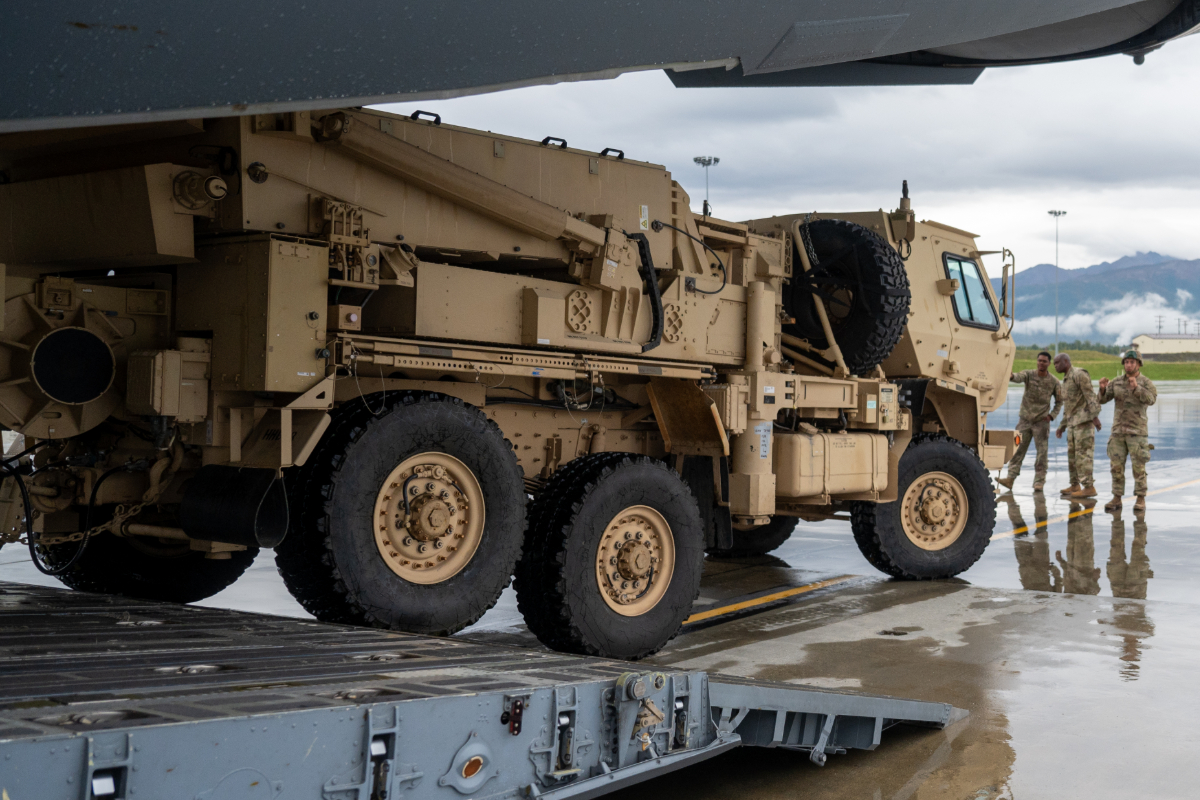 Q-53 radar system onto a C-17 at Joint Base Elmendorf-Richardson, Alaska, Sept. 11, 2024. Photo by Hunter Hites
The Missile Defense Agency wants industry to build a new mobile radar that can be flown into a war zone aboard a C-17, set up within hours and torn down again in minutes, according to a pre-solicitation notice posted September 16.
The program, called Forward Based Mode Radar Next, is meant to replace or supplement current forward-deployed missile-tracking radars with a system that can move fast enough to survive against an adversary trying to target it. The notice comes from the agency’s Mobile Land-Based Sensors Project Office and lays out plans to run the effort through NOBLE, the Missile Defense Agency’s existing Other Transaction Authority vehicle for prototype work.
The radar’s job is to provide early warning and tracking against ballistic missiles, cruise missiles and hypersonic weapons, then feed that data into the wider missile defense network. The agency says current forward-based radars are largely static or only semi-mobile, which makes them vulnerable to counterattack and slow to reposition as a fight evolves.
FBM Radar Next is meant to close that gap. Beyond fitting inside a C-17 and tactical ground vehicles, the notice calls for a design that can run with a minimal onsite crew, monitor its own health automatically, and reconfigure itself as either one large radar array or several smaller ones spread across a wider area. The agency also wants the system engineered to keep its physical, thermal and electromagnetic signatures low enough to avoid being easily targeted once deployed.
Cost is a central requirement rather than an afterthought. The notice specifically asks companies to show a path to high-volume, affordable production, framing the radar as something the military may need to replace quickly and repeatedly in a heavily contested environment rather than field as a small number of exquisite, expensive units.
Before any company can compete for the program, it has to clear what the agency calls an Entry Gate. That requires showing a fully documented subarray design and working hardware at the array element level, backed by real test data on things like transceiver performance and signal path continuity. Purely theoretical designs or software simulations without hardware behind them will not qualify.
Companies that clear the Entry Gate then move through four prototyping cycles, each ending in a competitive down-select. Cycle 1 covers concept development, Cycle 2 focuses on manufacturing readiness, Cycle 3 calls for a subscale prototype paired with modeling and simulation, and Cycle 4 culminates in a full-scale prototype and operational demonstration. The agency has not set specific timelines for any of the cycles, and no cost or contract value has been disclosed.
The Missile Defense Agency also flagged that only companies that complete the prototype effort will be eligible for what it describes as a likely sole-source follow-on production contract, and offerors will need to obtain a Facility Security Clearance before starting Cycle 1.
The agency stressed that the September 16 notice is not a request for proposals and does not commit it to a formal solicitation. It said it is not currently accepting questions or feedback on the notice, and a timeline for issuing an actual solicitation has not been announced.
Content preview only. Full article available at source. View Full Article
The Missile Defense Agency is developing a new mobile radar system, Forward Based Mode Radar Next, to enhance missile tracking capabilities. This system is designed to be rapidly deployable via C-17 aircraft and aims to provide early warning against ballistic and hypersonic threats. The agency emphasizes the need for cost-effective production and low detection signatures for operational effectiveness.
- The Missile Defense Agency is developing a mobile radar system called Forward Based Mode Radar Next.
- The radar can be deployed quickly in war zones using C-17 aircraft.
- It aims to provide early warning and tracking against various missile threats.
- The system is designed to be low-signature to avoid detection.
- Cost-effective production is a key requirement for the new radar system.