
The Fujian Ship's First Anniversary Coincides with a Peak of 49 Flights in the Taiwan Strait: The PLA's Dual Aircraft Carrier Deployment Tests Blockade Capability
 Li Minghui
Fujian Aircraft Carrier Marks One Year in Service Amid 49 Sorties Peak in Taiwan Strait, PLA's Dual Aircraft Carrier Deployment Tests Blockade Capability
Around November 4, Taiwan reported a continuous increase in PLA activities around the Taiwan Strait. The Taiwanese defense department stated that within a 24-hour period ending Tuesday morning, 49 sorties of Chinese military aircraft, 6 PLA Navy vessels, and 6 civilian ships were detected, with 31 sorties crossing the median line of the Strait and entering airspace near Taiwan's main island. Taiwanese media subsequently cited security department sources stating that the Chinese Navy and Coast Guard have deployed over 100 vessels in the Western Pacific, with the Liaoning aircraft carrier group located in the Philippine Sea and the Fujian aircraft carrier operating in the South China Sea.
Based solely on public numbers, this activity cannot yet be characterized as a complete blockade exercise. What Taiwan has disclosed are detection results, while the Chinese military has not released corresponding formations and missions. However, when considering the aerial peak, naval forces, and the simultaneous presence of dual aircraft carriers outside the first island chain, the signal is quite clear— the PLA is transforming its "pressure on Taiwan" from a single-direction aerial operation into a layered system of air and naval forces that combines both near and far capabilities.
The Value of Dual Aircraft Carriers Is More Than Just an Extra Deck
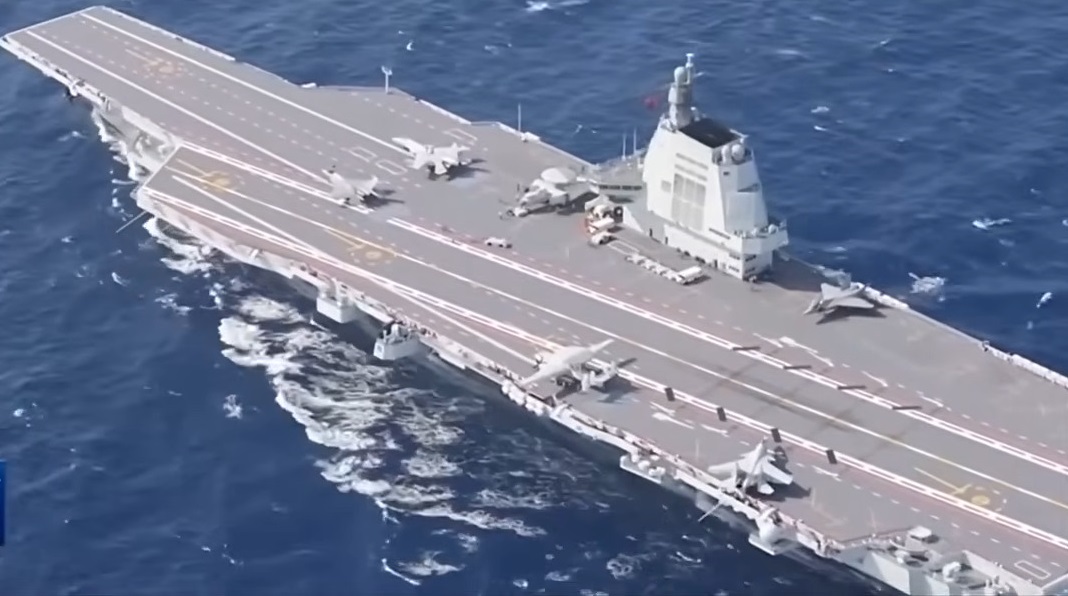
The Fujian is China's first conventionally powered aircraft carrier equipped with an electromagnetic catapult, with public data typically estimating its full-load displacement at around 80,000 tons, allowing it to carry heavier fixed-wing aircraft and more support aircraft than the ski-jump takeoff Liaoning. The value of the Liaoning lies in its mature experience in long-range training and fleet operations. The simultaneous operation of both ships theoretically allows one to be used for continuous aerial training and alertness, while the other can undertake longer-range air support, reducing fatigue on a single carrier group during high-intensity missions.
However, the number of decks does not equate to combat effectiveness. The real challenges lie in the rotation of carrier-based pilots, coordination between early warning and refueling aircraft, resupply of air defense munitions for escort destroyers, and the rhythm of continuous launches under complex weather conditions. With the Fujian having been in service for a full year, the most noteworthy aspect to observe is not the ship's appearance in promotional images, but whether it can maintain a stable sortie rate for several days without the cover of land-based air forces.
What Do 49 Sorties Mean?
The Taiwanese side claims that 49 sorties represent the highest single-day record since 2026, with 31 sorties approaching the island's side. This number itself may not necessarily indicate combat readiness, but it demonstrates that the PLA can concentrate reconnaissance, fighter, and support forces toward the Taiwan Strait in a relatively short time. More importantly, the simultaneous appearance of naval vessels and civilian ships means that Taiwan must simultaneously handle aerial identification, surface track monitoring, and enforcement pressure in gray areas, forcing a dispersion of defense resources.
From a military-industrial and support perspective, such operations test the "post-mass production usage costs." Whether fighter jets can remain airborne continuously depends on engine life, spare parts reserves, and ground crew shifts; whether an aircraft carrier can maintain its presence depends on the support of carrier-based aircraft, resupply of escort vessels, and long-range communications. The Chinese Navy has launched ships at a rapid pace in recent years, but high-intensity operations at sea remain a more challenging issue than simply building a new ship.
What Is Beijing Testing?
On the occasion of the Fujian's one-year anniversary, CCTV reviewed its training milestones, while Taiwan views the recent deployments as an increase in pressure. These two narratives are not contradictory: for Beijing, this is a window to showcase the aircraft carrier's combat capability and presence at sea; for Taipei, the key lies in whether warning times are shortened and whether air and naval forces are being constrained. I believe this operation is more like a test of the "multi-directional pressure" process rather than a countdown to an immediate blockade.
What truly needs to be tracked is the subsequent 48 hours: whether the Fujian continues its activities in the South China Sea, whether the Liaoning carrier group shifts east of Taiwan, and whether the PLA can turn the 49 sorties peak into a sustained rhythm over several days. If naval, air, and Coast Guard forces can stabilize and overlap, Taiwan will face not just a peak but a repeatable template of blockade pressure.
Sources: Taiwan News, TaiwanPlus, CCTV.com.
The Chinese military increased its activity in the Taiwan Strait, with 49 aircraft reported in a single day, including 31 crossing the median line. The People's Liberation Army Navy deployed over 100 vessels in the Western Pacific, with the Fujian and Liaoning aircraft carriers operating in the region. This coordinated military presence suggests a shift towards a multi-directional pressure strategy against Taiwan.
- 49 aircraft were reported in a single day, the highest since 2026.
- 31 aircraft crossed the median line into Taiwan's airspace.
- Over 100 vessels were deployed by the Chinese Navy and Coast Guard in the Western Pacific.
- The Fujian aircraft carrier is China's first to use electromagnetic catapults.
- The simultaneous presence of naval and aerial forces indicates a coordinated military strategy.