
Russia Fires 653 Drones and 51 Missiles as Ukraine Energy War Accelerates
 Dmitri Volkov
Russia Fires 653 Drones and 51 Missiles as Ukraine Energy War Accelerates
Six hundred and fifty-three drones and fifty-one missiles in one night is not merely a large salvo. It is a measurement of tempo. After the July 2 strike on Kyiv, which Ukrainian officials described as one of the heaviest attacks on the capital since the beginning of the full-scale war, Russia did not pause to assess political effect or conserve precision weapons. It returned almost immediately to the same operational language: saturation, mixed trajectories, and pressure on the electrical grid. According to the Associated Press, Ukrainian forces said Russia used 653 drones and 51 missiles in the overnight attack of July 5-6, while air defenses shot down or neutralized 585 drones and 30 missiles. Twenty-nine locations were struck, at least eight people were wounded, the Fastiv railway station was damaged and burned, and the Zaporizhzhia Nuclear Power Plant briefly lost all off-site power.
The salvo was a rhythm, not an exception
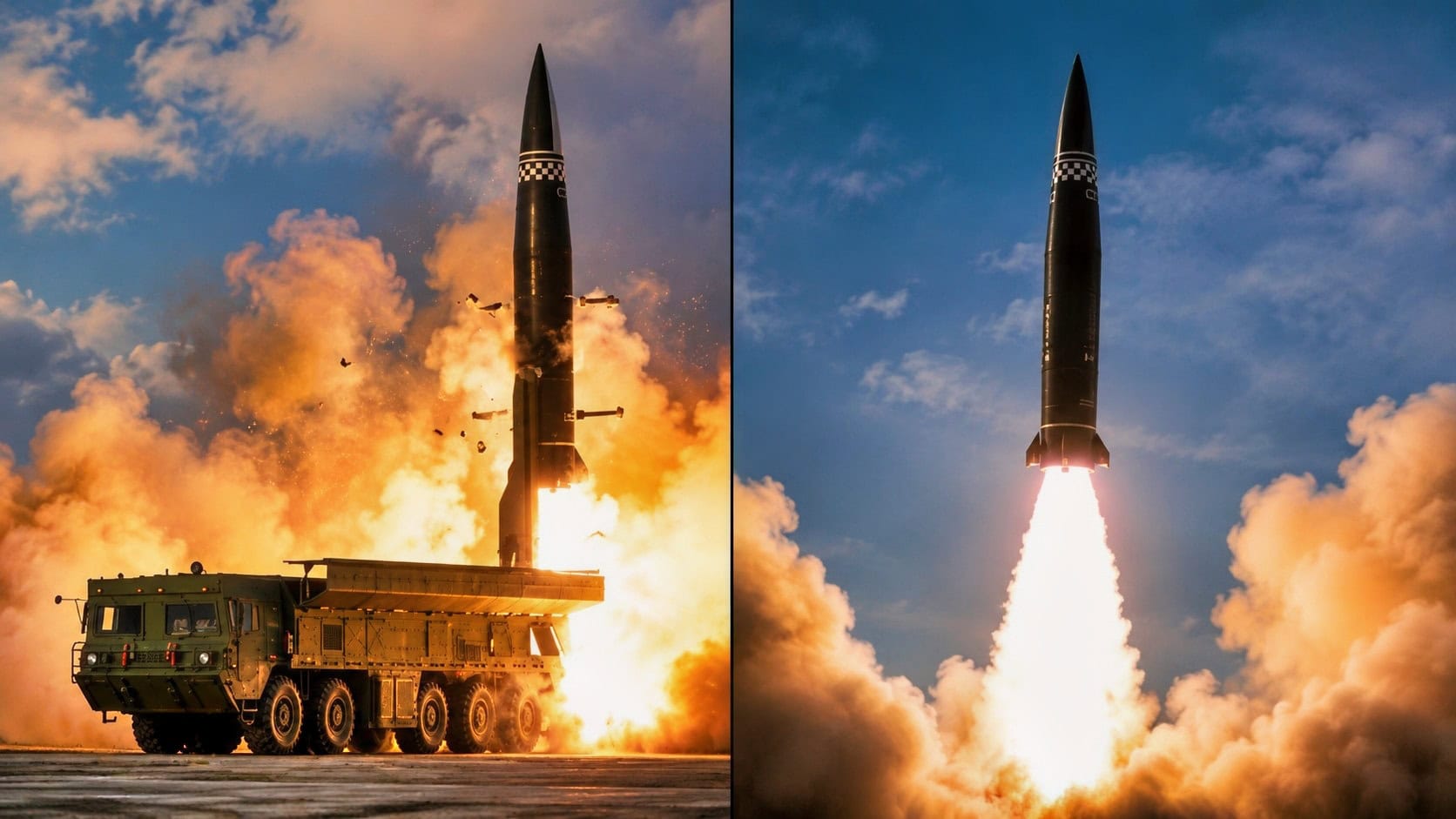
The most important military conclusion is negative: this was not a single punitive gesture after Ukraine's strikes or after diplomatic irritation around the NATO summit calendar. A one-off retaliation normally concentrates symbolism; this attack concentrated workload. The Ukrainian Air Force had already reported on July 5 that Russia launched 125 Shahed-type long-range drones, including jet variants, along with one Kh-31 anti-radar missile and three Kh-59/69 guided air-launched missiles. Kyiv Independent, citing that bulletin, reported that 112 drones and the three guided missiles were intercepted or suppressed, while the anti-radar missile failed to reach its target. President Volodymyr Zelensky warned the same evening that intelligence indicated another massive Russian strike was being prepared and tied his warning directly to the need for Patriot missiles.
That sequence matters. The July 5 wave forced Ukrainian air defense units, electronic warfare teams, mobile fire groups, and command centers to stay active before the larger July 5-6 package arrived. In Soviet operational writing, the distinction between a blow and a campaign was always temporal. A blow is a single act; a campaign is the ability to compel the enemy to solve the same problem again before he has restored readiness. Russia's current long-range strike system is not elegant, and its accuracy varies sharply by weapon type, but it is being used as a campaign system.
Energy targets create a second battlefield
The emphasis on energy infrastructure is not accidental. Against Ukraine, Moscow has learned that the electrical grid is both a civilian vulnerability and a military enabler. Rail junctions, repair depots, drone-production workshops, air-defense radars, mobile command posts, and hospitals all compete for power, fuel, generators, and repair crews. Fastiv railway station is therefore not a random railway target. Fastiv sits on the southwest approaches to Kyiv and belongs to the wider logistical system that lets Ukraine move people, ammunition, and repair assets under attack. Burning a station building is less significant than forcing Ukraine to route traffic, firefighting, police, engineers, and air-defense reporting through a disrupted node.
The temporary loss of off-site power at the Zaporizhzhia Nuclear Power Plant is more serious because it converts an air campaign into a nuclear safety problem. ZNPP's reactors are shut down, but spent fuel cooling, safety systems, and monitoring equipment still require reliable power. Whenever the plant loses external supply, diesel generators become not a backup in the ordinary sense but the last practical barrier against a cascading safety incident. Russia does not need to intend a nuclear accident for the risk to be strategically real. The danger comes from repeated stress on a plant located inside a militarized zone, with repair lines exposed and trust between the parties essentially nonexistent.
The Patriot problem is arithmetic
The July 5-6 numbers also explain why Kyiv keeps returning to Patriot missiles with almost monotonous persistence. Ukraine can defeat many Shahed-type drones with mobile guns, electronic warfare and cheaper interceptors. It cannot treat ballistic missiles, aeroballistic missiles, and some cruise-missile profiles the same way. Patriots are expensive, politically rationed, and logistically difficult, but they remain the most reliable available answer to certain Russian missile threats. When Russia combines hundreds of drones with dozens of missiles, the cheaper layer must sort drones quickly enough to preserve the premium layer for ballistic or high-value targets. If that sorting fails, the defender either spends scarce missiles on decoys and low-cost drones, or accepts penetrations into the energy system.
This is the cruel logic behind Zelensky's July 5 appeal. He was not asking for air-defense prestige systems; he was asking for depth in the ammunition stockpile. A battery without enough interceptors is a political symbol. A battery with enough interceptors and a layered sensor network is a strategic asset. Russia is trying to discover where Ukraine's layered defense becomes a series of local improvisations. The announced Ukrainian figure, 585 drones and 30 missiles neutralized out of 704 aerial weapons, is impressive. It is also an admission of scale: even a high interception rate leaves enough leakage to damage infrastructure when the salvo is this large.
Crimea and St Petersburg show the spiral
The Ukrainian side is not passive in this exchange. Kyiv Independent reported that Ukraine's General Staff said its forces struck Hvardiiske airfield in occupied Crimea, ammunition depots, and bridges overnight on July 5. Robert Brovdi, commander of Ukraine's Unmanned Systems Forces, said Ukrainian forces had hit 16 power stations across Crimea over 48 hours, causing blackouts across the occupied peninsula. Earlier reports also pointed to strikes against Russian air bases in Crimea and Ukrainian long-range pressure on Russian logistics and energy assets. In the same broader period, Ukrainian strikes against port and industrial infrastructure around St Petersburg demonstrated that distance is no longer a reliable Russian shield.
Here the strategic symmetry is imperfect but important. Russia attacks Ukraine's energy system to degrade society, logistics and morale. Ukraine attacks energy and transport infrastructure in occupied Crimea and inside Russia to degrade the war machine that sustains those attacks. Moscow calls the first coercive strategy and the second terrorism; Kyiv calls the first terror and the second legitimate military interdiction. The vocabulary is predictable. The operational result is more interesting: both sides are expanding the category of targets considered necessary for long-range war.
What follows next
There are three likely consequences. First, Russia will continue to mix cheap mass with expensive precision, because the combination gives it better odds than either category alone. The 653 drone figure should be read as an industrial and organizational indicator, not simply as a nightly statistic. Second, Ukraine will press the Patriot ammunition issue harder before and during NATO consultations, because the July 5-6 attack gives Kyiv a concrete argument: the problem is not one city, one night, or one spectacular missile. It is repeated exhaustion of the defensive system. Third, the nuclear dimension around Zaporizhzhia will return whenever the grid is hit near southern Ukraine. The plant does not have to be directly targeted for off-site power to become vulnerable.
My cautious forecast is that the summer campaign will not be defined by a single decisive strike. It will be defined by whether Russia can maintain this tempo without exhausting its missile stocks, and whether Ukraine can thicken its air-defense ammunition supply while continuing to punish Russian logistics in Crimea and deep rear areas. If Patriot rounds arrive slowly, Russian salvos will become more politically useful even when most incoming weapons are intercepted. If they arrive in quantity, Moscow will still inflict damage, but the cost-benefit ratio of these immense mixed strikes will deteriorate. In this war, arithmetic is rarely heroic. It is nevertheless often decisive.
Russia launched 653 drones and 51 missiles in a large-scale attack on Ukraine's energy infrastructure on July 5-6, 2023. Ukrainian air defenses intercepted 585 drones and 30 missiles, but significant damage occurred, including to the Fastiv railway station and the Zaporizhzhia Nuclear Power Plant. In response, Ukraine targeted Russian positions in Crimea, demonstrating an ongoing exchange of strikes between the two nations.
- Russia launched 653 drones and 51 missiles in an overnight attack on Ukraine.
- 585 drones and 30 missiles were intercepted by Ukrainian air defenses.
- The Fastiv railway station was damaged and burned during the attack.
- The Zaporizhzhia Nuclear Power Plant briefly lost all off-site power due to the strikes.
- Ukrainian forces retaliated by striking Russian positions in Crimea.