
Russian A-50U returned to daily duty after 60 takeoffs in the summer of 2026
 Dmitri Volkov
Russian A-50U Aircraft Return to Daily Duty After 60 Sorties in Summer 2026
Four A-50U aircraft in the air on July 7 — this is not a show of force, but rather an almost accounting record of the limit of the Russian long-range radar detection system. According to the Ukrainian project "KіберБорошно," summarized by Militarnyi, an analysis of more than 1600 reports from June 4 to August 2 shows a sharp change: from June 4 to June 22, Russian A-50Us were virtually not deployed for duty against Ukraine, and after June 23, one aircraft began to operate almost daily at night over the rear areas of the Ulyanovsk and Samara regions. By the end of the period under review, this resulted in about 60 sorties. For the AWACS aviation, such statistics are more important than victorious press releases: they show not only the presence of the aircraft but also the degree of compulsion to use it.
Why the Return of A-50U Became Necessary
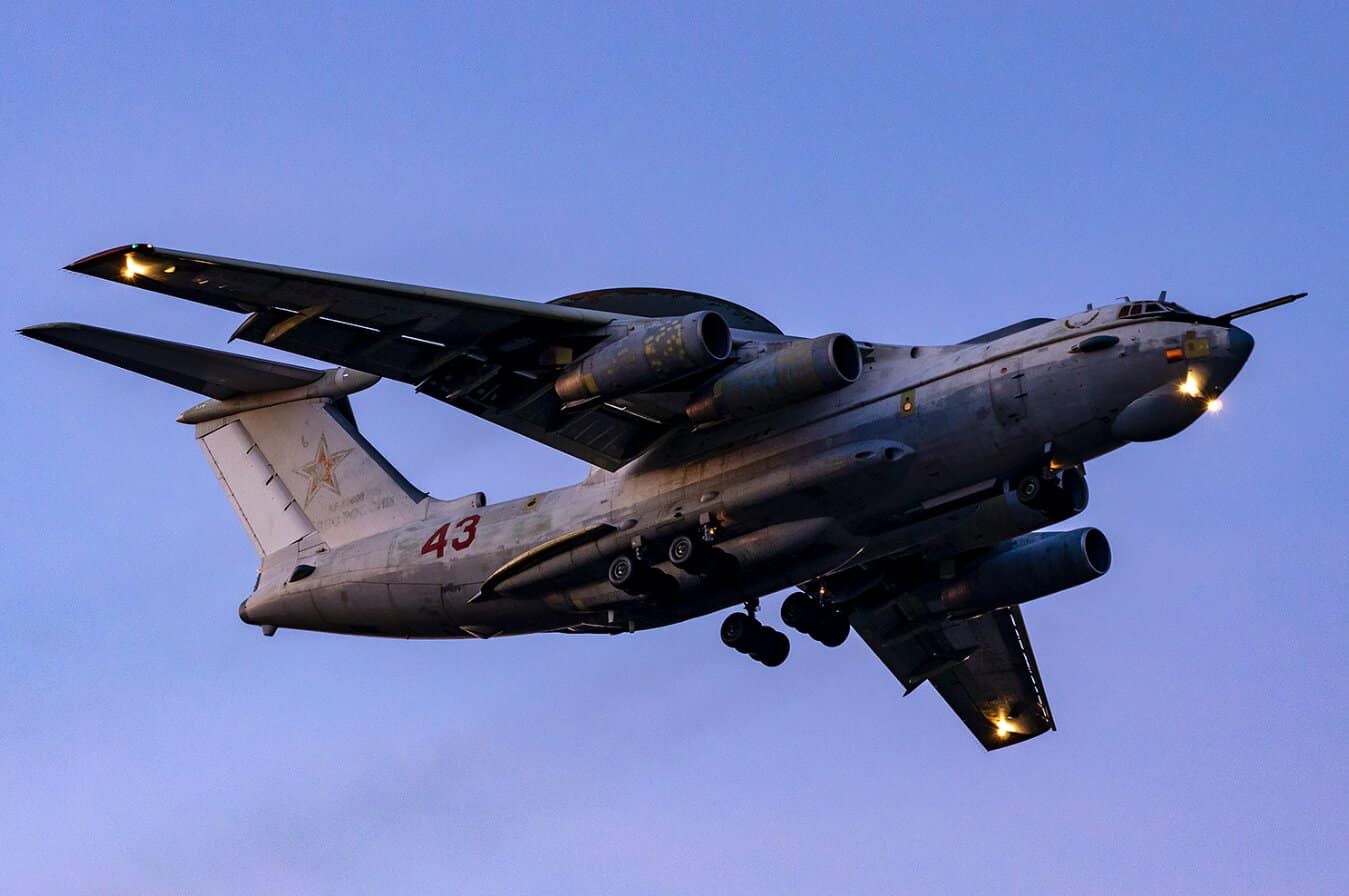
The Russian logic here is simple. Ukrainian strikes on airfields, oil refineries, warehouses, and air defense nodes deep within Russia forced the Aerospace Forces (VKS) to once again take to the skies those machines that they had been trying to preserve after losses in 2023-2024. The ISW noted in its assessment on August 2 the Ukrainian strikes on the Saratov Oil Refinery, the Engels-2 strategic aviation base, and radar facilities in the Krasnodar region. Against this backdrop, the A-50U is needed not as a symbol of the Soviet engineering school, but as a practical tool for the early detection of cruise missiles and drones approaching industrial and aviation infrastructure. This is why Militarnyi points out that on July 4, the A-50U played a crucial role in repelling the attack of Ukrainian cruise missiles.
But the necessity is evident in the geography. Until July 4, the aircraft were mainly launched from Ivanovo and Ulyanovsk, then flights from there ceased, and the basing was dispersed deeper into the rear — Bolshoye Savino near Perm, Orenburg-2, and Chelyabinsk. On the map, this looks like an expansion of the defensive contour. In military practice, this often means the opposite: the command withdraws rare assets from a zone of predictable risk and pays for safety with distance, reaction time, crew wear, and increased maintenance complexity.
A Fleet Too Small for a Big War
Technically, the A-50U remains a valuable aircraft. It is a modernized version of the Soviet A-50 based on the Il-76, designed for detecting aerial targets, managing fighters, and supporting a unified air situation picture. In a normal war of a large state, many such machines are needed: some are on duty, some are preparing for takeoff, some are undergoing maintenance, and some are used for crew training. The Russian problem is that after three and a half years of war, this arithmetic no longer adds up.
Defense Express, citing the Russian bmpd, reported that no more than four A-50Us remain in periodic operation. The VKS received a total of eight modernized aircraft, but at least three have been lost or taken out of full operation: "41 red" was damaged at the Machulishchy airfield in Belarus on February 26, 2023, "37 red" is estimated to have been shot down over the Sea of Azov on January 14, 2024, and "42 red" was destroyed over the Krasnodar region on February 23, 2024. The return of the repaired "47 red" in May 2026 improved the situation, but did not change the main point: even Russian sources speak not of a full fleet, but of the periodic operation of several aircraft.
The simultaneous launch of four A-50Us on July 7 therefore looks not like a luxury, but like an emergency mode. If almost the entire operational fleet is in the air, then the command has no normal reserve for equipment failure, weather factors, crew error, or a sudden second strike. In Soviet terminology, this would be called the strain of combat duty. In today's Russian bureaucratic language, it will likely be referred to as "increasing the efficiency of application." Paper can tolerate a lot, but the D-30KP engine tolerates less.
Connection to the Front and Bombing Campaign
The A-50U is important not only for rear protection. It supports the operation of Su-35S and MiG-31BM with long-range R-37M missiles, which means it affects the freedom of action of Ukrainian aviation. The fewer air radars Russia has, the harder it is to maintain a continuous radar field and to guide fighters over long distances. This is especially important against the backdrop of the future integration of the JAS 39 Gripen and Meteor missiles, which Defense Express has also reported on. The Gripen alone will not negate Russia's superiority in the mass of aviation, but it raises the cost of every hour of operation of the Su-34 with guided bombs if Russian cover fighters lack stable external illumination.
There is also a connection to the new Russian campaign of air interdiction against Ukrainian logistics. The ISW in its August materials describes how Russian troops use guided bombs, "Geran," fiber-optic FPV drones, and long-range strike assets to pressure roads, railways, UAV operator positions, and rear areas. Such a campaign requires reconnaissance and command connectivity. The A-50U does not replace satellites, ZALA drones, or ground-based radars, but it is the upper tier of the system, especially when it comes to aerial targets, fighter operations, and protecting launch areas.
Strategic Conclusion
The paradox is that the activation of the A-50U simultaneously strengthens Russian air defense and reveals its vulnerability. Russia is forced to defend too large a territory with a limited number of rare aircraft produced by the Soviet industrial system. Restoring the production of such machines quickly is impossible: it is not the assembly of a cheap quadcopter or the modernization of a truck into a launch platform. It requires the Il-76 airframe, radio-technical complex, qualified crews, a repair base, and years of production discipline that cannot be bought with a single budget order.
In Russian military history, one pattern has often repeated: the shortage of a quality asset is compensated by the intensity of its use. This was the case with tanks in 1941, with aviation in Afghanistan, and now with AWACS aircraft. Sometimes this yields a tactical effect. Almost always, it accelerates the wear of the system.
In the coming months, the A-50U will likely remain in a daily or near-daily duty cycle as Ukraine continues long-range strikes on Russia's energy, aviation, and radar infrastructure. But this is not a sign of restoring a full-fledged Soviet echeloned air control. It is a sign that the war has reached those rare nodes that Moscow wanted to keep out of the expendable logic of the front. Russian air defense will become denser over certain corridors but less flexible across the entire country if each new Ukrainian strike forces almost the entire fleet of A-50Us into the air.
Sources
- Militarnyi, August 3, 2026 — The Russian Federation has transitioned to daily duty for A-50U aircraft due to Ukrainian missile attacks.
- Defense Express, 2026 — Russia can keep no more than four A-50U AWACS aircraft flying.
- Institute for the Study of War, Russian Offensive Campaign Assessment, August 2-3, 2026.
Four A-50U aircraft of the Russian Aerospace Forces returned to daily duty on July 7, 2026, following increased operational activity due to Ukrainian strikes. The aircraft had conducted approximately 60 flights over the summer, primarily from bases in Ivanovo and Ulyanovsk. This operational shift reflects a response to the need for enhanced air surveillance and early warning capabilities amid ongoing military engagements.
- Four A-50U aircraft were operational on July 7, 2026.
- The A-50U returned to daily duty after 60 flights over the summer.
- Ukrainian strikes prompted the increased operational tempo of A-50U aircraft.
- Only four A-50U aircraft remain in service after losses in previous years.