
Russia’s 40-Dead Komyshuvakha Strike Expands Winter Pressure on Ukraine’s Logistics
 Dmitri Volkov
Russia’s 40-Dead Komyshuvakha Strike Expands Winter Pressure on Ukraine’s Logistics
The number that matters is not simply 40. It is the sequence 24, then 37, then 40: the Ukrainian official death-toll updates from the strike on the aid centre in Komyshuvakha, Zaporizhzhia oblast. Such a sequence describes more than a single moment of destruction. It describes rescuers working through a ruined building while the casualty count rises, communications are disrupted and the site remains dangerous. President Volodymyr Zelenskyy said on 4 November that 40 people had been killed; Ukrainian officials had previously reported 24 and then 37 fatalities. The dead include four police officers and two rescue workers, according to the Ukrainian authorities. Their figures are the appropriate baseline; reports that more than 30 people may still be beneath the rubble remain unconfirmed and must not be added to the confirmed toll.
Ukrainian accounts say the school building, repurposed as an aid centre, was hit by several Russian aerial bombs and then struck again while people were sheltering below ground. Russia has not provided a public account that independently establishes this description. But if the reported follow-on strike is confirmed, it fits a grim operational method: turn the first explosion into a magnet for responders, then make the response itself hazardous. Persistent drone activity reportedly forced interruptions to rescue work. The military purpose is not only physical destruction; it is to make emergency services slower, more cautious and less able to sustain repeated crises.
A changing target set rather than one more raid
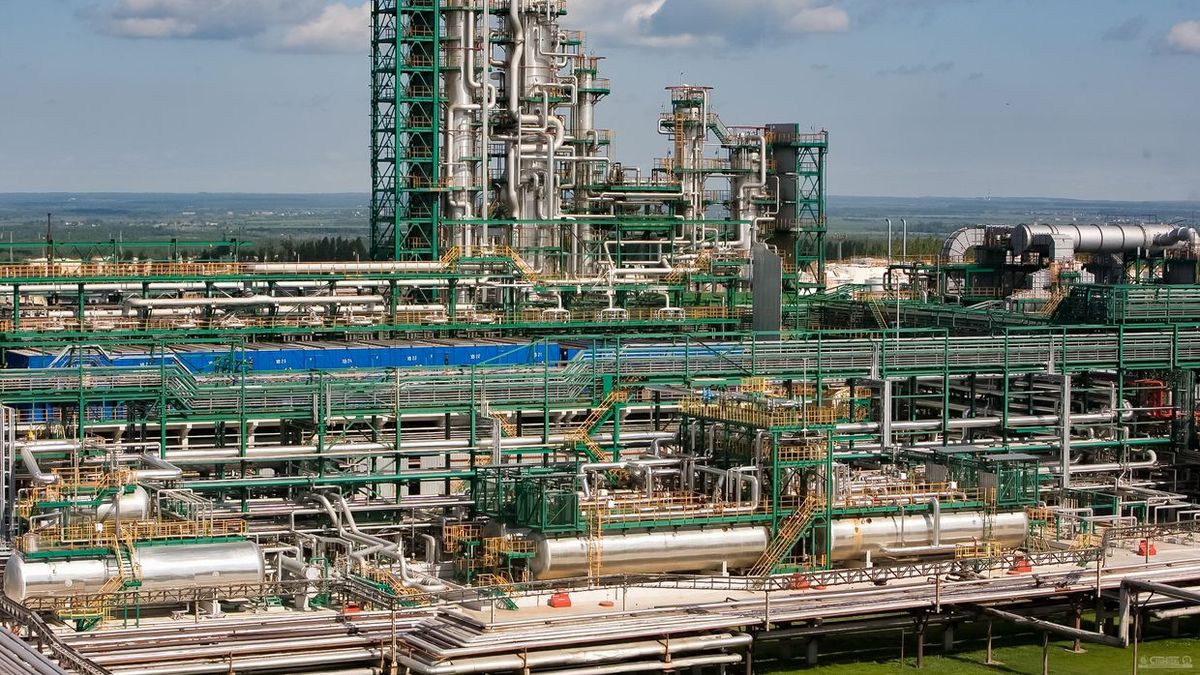 Yaroslavl refinery, an asset relevant to the renewed Ukrainian campaign against Russian refining capacity.
The Komyshuvakha attack should be read alongside the previous concentration on crowded civilian-support nodes. The late-October strike around the Dnipro railway station and the 3 November attacks that affected medical facilities had a common effect even where their immediate targets differed: they impose costs on the institutions that keep people moving, treated and supplied. This is not evidence that every hit came from a single centrally defined target list. It is evidence that attacks on the network’s human nodes can compound the damage already done to energy infrastructure.
Russia’s Defence Ministry on 5 November claimed three additional categories of target. It said drones struck a Nova Poshta logistics terminal at Novyi Korotych in Kharkiv oblast, a 330-kV substation in Dnipropetrovsk oblast, and an unnamed dry-cargo vessel 52 km southwest of Odesa that it said was carrying military equipment. These are Russian claims and the ship’s identity, cargo and the munition used have not been independently confirmed. Still, the categories matter. Nova Poshta is a civilian delivery network whose depots can also sit at the junction of commercial activity, volunteer supply and military last-mile movement. The available reporting supplies no independent evidence that the terminal was being used for a particular military consignment; that distinction should not be erased. Yet disruption to such a terminal can affect civilian resilience even when the asserted military rationale is accepted at face value.
A 330-kV substation is likewise not a power station. It is a transmission-level node: damage there can constrain the movement of electricity between generating capacity and consumers, or force operators into less efficient routing. The reported vessel strike points to a third layer. An unverified claim against a merchant ship is not proof that a sea lane has been closed, but it raises insurance, routing and crew-risk calculations on the same Black Sea routes that carry grain, commercial cargo and potential military supplies. Taken together, the pattern is pressure across four connected layers—energy, rail and road movement, parcel logistics, and ports—not a substitute for battlefield advances, but a way to make the rear area less usable.
The winter threshold is measurable
Kharkiv oblast authorities reported more than 80 Russian drones used against the city and 17 other settlements over the preceding day, injuring six people including a child. Donetsk oblast officials reported four civilians killed and five wounded on Wednesday, including two deaths in Serhiivka and two women killed by a glide bomb in Yasnohirka. A logistics site in Kyiv oblast’s Bucha district also caught fire after a strike, injuring one person. These reports do not establish a single campaign design. They do show how dispersed attacks consume repair crews, ambulances, police and air-defence attention at once.
The humanitarian threshold in Kyiv can be stated without melodrama. Rotating outages have continued since mid-October; some residents report days without electricity and water. The city authorities’ stated rule is that central heating is activated after five consecutive days below minus 5°C. Near 0°C, an outage is already a safety issue for households dependent on electrically pumped water, lifts, communications and improvised heating. The critical condition is therefore not merely a colder forecast. It is the conjunction of multi-day sub-minus-5°C weather, constrained power distribution, water interruption and a repair system repeatedly pulled toward new impact sites. That is a testable threshold for municipal failure, not a rhetorical one.
Ukraine resumes the refinery contest
Ukraine’s long-range campaign has resumed after a short late-October pause. Ryazan’s governor said more than 200 Ukrainian drones targeted the region overnight, reporting an industrial fire, damaged power lines, local outages and one injury before saying supply had been restored. Video reviewed by the independent Russian outlet Astra showed a fire at Rosneft’s Ryazan refinery. Yaroslavl refinery had reportedly been struck two days earlier. These are meaningful indicators of operational reach, but not yet a measure of durable production loss: fires and power cuts do not reveal damaged units, throughput lost, repair time or usable fuel stocks.
For the campaign to change Russian military logistics rather than merely its news cycle, it must repeatedly reduce refined-product availability faster than stocks, rail redistribution and repairs can compensate. The more useful indicators are sustained outages at conversion units, regional retail shortages, queues at filling stations, military fuel allocations and the diversion of air defences from the front. Claims of fuel shortages and queues suggest pressure, but they do not by themselves demonstrate a battlefield supply break. Moscow has a large domestic fuel system and can re-route product; it is also vulnerable because that system rests on a finite number of high-value refineries, depots and rail links. The contest is one of tempo and repair capacity, not spectacular flames.
Supply politics has a military clock
Zelenskyy’s hope that a Democratic-controlled US Congress would deliver more assistance, voiced as reconstruction and security discussions continued in Brussels, has a direct military meaning even before any vote. Air-defence interceptors, radar components, replacement transformers and mobile repair equipment shape whether Ukraine can keep the rear area functioning through winter. They cannot undo the Komyshuvakha deaths. They can alter the cost Russia faces for repeating the network attack.
Russia is trying to make Ukraine’s rear area a sequence of local emergencies while Ukraine tries to make Russian fuel production a sequence of industrial emergencies. Neither side has yet shown that one night’s strike can settle the contest. The nearer-term result will depend on repetition: Russian ability to sustain attacks on transmission and logistics nodes, Ukrainian ability to keep striking refineries, and Western ability to provide the interceptors and electrical equipment before cold weather turns a managed outage into a humanitarian crisis.
Reporting basis
Confirmed casualty figures and the account of the Komyshuvakha rescue operation are attributed to Ukrainian officials, including President Zelenskyy. Target claims concerning the Nova Poshta terminal, 330-kV substation and Black Sea vessel are attributed to the Russian Defence Ministry and are independently unverified where noted. Ryazan regional statements, Astra’s video review, and reporting by Reuters, Al Jazeera and Ukrainian regional authorities informed this analysis. Published 5 November 2026 UTC.
Russian aerial strikes on November 4, 2023, killed 40 people at an aid center in Komyshuvakha, Zaporizhzhia Oblast, including police and rescue workers. Concurrently, Russian forces targeted logistics sites in Kharkiv and Dnipropetrovsk Oblasts, disrupting civilian infrastructure. Ukrainian long-range drone strikes resumed against Russian refineries, indicating ongoing military operations aimed at logistics disruption.
- 40 confirmed deaths from the Komyshuvakha strike, including police and rescue workers.
- Russian strikes targeted logistics and civilian support nodes across multiple regions.
- Persistent drone activity disrupted rescue operations in Komyshuvakha.
- Ukrainian long-range drone strikes resumed against Russian refineries.
- Humanitarian conditions in Kyiv are worsening due to ongoing attacks and infrastructure damage.