
Seven Tanker Incidents Test US Escort Claims in the Strait of Hormuz
 Ahmed Al-Rashid
Seven Tanker Incidents Test US Escort Claims in the Strait of Hormuz
On 5 November, the reported disruption moved beyond an Iranian-declared exclusion zone. Reuters said three more tankers were damaged around Hormuz, while the UK Maritime Trade Operations warning system reported a tanker struck by two unidentified munitions about 50 nautical miles north of Madinat ash Shamal, Qatar. That location matters more than Tehran’s language about rule-breaking ships. It places the risk, if confirmed, on a public approach route used by vessels that may have made no attempt to enter an Iranian-designated corridor.
The numbers must not be mistaken for a confirmed maritime casualty ledger. The IRGC Navy’s 4 November assertion that four tankers were destroyed or burning, and its 5 November claims concerning additional ships, are unilateral Iranian accounts. Reuters’ reporting and the UKMTO alert corroborate a serious pattern of incidents, but ship names, flags, ownership, cargoes, hull types, casualties, precise munition types, and responsibility for mine-laying all remain pending confirmation. The reported 4 plus 3 is therefore an operational warning, not a verified list of seven distinct losses.
A denial system rather than a missile campaign
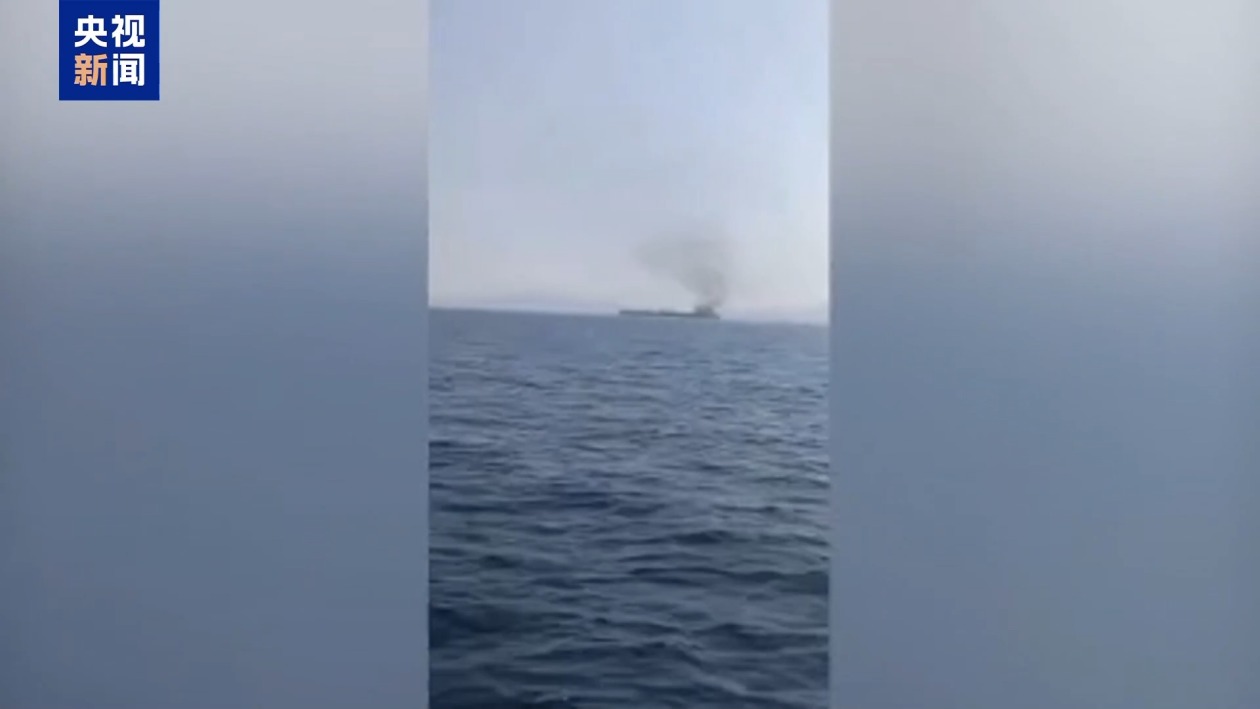
From the military point of view, mines paired with unattributed munitions are a more efficient denial instrument than a visible anti-ship-missile salvo. A missile announces its launch area, creates a rapid escalation test, and can be engaged by air and missile defences. A mine creates a continuing problem after the attacker has disappeared. It obliges every operator to ask whether a route is safe, whether an escort is actually mine-cleared, and whether a salvage tug can enter. An unidentified impact adds uncertainty without requiring a public claim of responsibility.
This does not establish that Iran laid any mine or fired any weapon. No authoritative public technical attribution has been released for the incidents described above. It does explain why the Iranian claim of enforcement and the available maritime warning can produce the same commercial effect even before attribution: a master, insurer, and charterer must price the hazard as real. A single suspected minefield converts a navigation question into an area-clearance problem. Carriers provide surveillance, air cover, command-and-control, and deterrent weight; they do not by themselves sweep a channel. That distinction is the weak point in the claim that the waterway is already open and safe.
The throughput arithmetic is uncomfortable
CENTCOM said on 25 October that its forces had assisted more than 3,000 commercial vessels through Hormuz in six months and helped Gulf partners export more than 1.5 billion barrels of crude. That is roughly 16 to 17 supported transits per day on a six-month average. If the 4 plus 3 reports are treated only as a provisional incident count, they imply 3.5 reported tanker incidents per day over 48 hours, or one reported event for about every 4.8 of that average daily throughput. It would be wrong to call that a probability of loss: the numerator is not independently reconciled and the denominator is not a same-day escorted-vessel count. But it is sufficient to refute any lazy inference that a high aggregate throughput proves a safe operating environment.
For a shipowner, the relevant calculation is not how many ships crossed six months ago; it is whether the next ship can obtain a named corridor, a current mine-clearance assessment, an escort window, rescue coverage, and war-risk insurance at an acceptable rate. The reported strike north of Qatar widens the perceived hazard from an Iranian-policed zone to a Gulf approach route. Expect operators to slow-load, wait outside the risk box, seek convoy slots, tighten AIS and routing procedures where legally safe, and demand higher additional premiums. The Treasury’s 4 November action against fraudulent flagging networks makes this worse: a vessel with doubtful registry or invalid protection-and-indemnity cover becomes commercially toxic precisely when insurers are most risk-sensitive.
Two carrier groups cannot erase a minefield
Officials say two carrier strike groups already in the region can execute assigned missions. That may be true for strikes, air defence, surveillance, and maritime presence. It is not a substitute for enough mine-countermeasure ships, helicopters, unmanned systems, explosive-ordnance teams, hydrographic intelligence, and protected clearance time. The USS Theodore Roosevelt’s 6 November port call in Singapore means its reported arrival is at least two weeks away. Its net effect on today’s mine problem is therefore zero, and even on arrival a carrier is not a mine-clearance force.
The practical constraint is escort density. Every convoy commitment consumes escorts, aircraft, communications bandwidth, rescue assets, and clearance confidence; every suspected new mine forces a route check that reduces the number of departures that can be scheduled safely. The attacking side need not sink a large proportion of traffic. It only has to make the available safe windows narrower than the demand for them.
Oman is negotiating with one Iran while another Iran sets the price
Oman’s foreign minister said on 5 November that Muscat and Tehran were pursuing a joint Hormuz control mechanism intended to end the state of war and restore unobstructed passage. On the same day, Iranian Foreign Minister Abbas Araghchi held calls with counterparts including Pakistan, Saudi Arabia, the UAE, and Türkiye. This is the diplomatic track. The IRGC’s public accounts of exclusion zones, interception, mines, and burning tankers are the coercive track.
The two tracks may be coordinated, but that is not demonstrated. The decisive question is whether Iranian negotiators can deliver operational restraint from the forces that control coastal waters, mines, and tactical messaging. A joint-control formula without a verifiable command link, published safe lanes, notice procedures, and independent incident investigation would risk formalising ambiguity rather than restoring navigation. From the Gulf perspective, that is not joint management; it is a toll paid in uncertainty.
Moscow’s energy offer is political insurance, not a maritime remedy
President Vladimir Putin’s meeting with Iranian Supreme National Security Council secretary Ali Akbar Rezaei on 5 November, reportedly including a Russia-Iran gas pipeline, should be read through Iran’s energy constraint. A gas link can offer energy complementarity and political backing while Iran faces pressure on oil exports and logistics. It may also create another structure through which sanctions exposure, transport services, and payments can be rearranged. No public agreement, route, financing mechanism, or sanctions-evasion arrangement was confirmed at publication, so those outcomes remain contingent.
It cannot clear mines or lower a war-risk premium tomorrow. Its near-term value to Tehran is bargaining resilience: the perception that isolation can be softened while pressure is imposed at sea. Washington’s sanctions campaign and Moscow’s energy diplomacy thus pull in opposite directions, while commercial crews remain exposed to the gap between diplomatic assurances and the water in front of them.
The structural contradiction is now plain. Washington can report impressive aggregate throughput and Tehran can discuss a future control mechanism, yet neither statement answers the captain’s immediate question: who has certified this next mile of water as clear? Until that question has a credible, independently verifiable answer, Hormuz is not reopened by rhetoric or by the number of carriers nearby.
Sources and verification status
- Reuters Middle East reporting, 5 November 2026 — reported three additional damaged tankers; vessel identities and attribution pending confirmation.
- UKMTO warnings — reported the Madinat ash Shamal incident; munition type and origin pending confirmation.
- CENTCOM, 25 October 2026 — 3,000-plus supported transits and 1.5 billion barrels; this is an aggregate historical measure, not a guarantee for the current 48-hour period.
- US Treasury, Operation Economic Outcast, 4 November 2026 — false-flagging and maritime-fraud network sanctions.
- IRGC Navy and IRNA statements, 4–5 November 2026 — Iranian unilateral claims regarding mines, fires, exclusion zones, and interceptions; all associated vessel, casualty, flag, cargo, and responsibility details remain pending confirmation.
- Omani and Iranian foreign-ministry statements, 5 November 2026 — reported diplomatic contacts and proposed control mechanism; operational command arrangements remain unverified.
On November 5, 2026, multiple tanker incidents occurred in the Strait of Hormuz, with reports of damage to at least seven vessels. The IRGC Navy claimed responsibility for several incidents, while UK Maritime Trade Operations warned of a tanker struck by unidentified munitions near Qatar. Diplomatic discussions between Oman and Iran are ongoing to establish a control mechanism for safe passage, but no verification of the incidents has been confirmed yet.
- Three additional tankers reported damaged near Hormuz.
- IRGC Navy claims four tankers destroyed or burning.
- UKMTO reported a tanker struck by unidentified munitions.
- Diplomatic efforts between Oman and Iran for joint control mechanism.
- No confirmed attribution for the incidents reported.