
Fujian at One Faces a Command Continuity Test as PLA Navy Purge Reaches Senior Ranks
 Li Minghui
Fujian at One Faces a Command Continuity Test as PLA Navy Purge Reaches Senior Ranks
On 5 November, official media presented a useful but demanding yardstick for Fujian: moving from basic carrier operations to high-intensity, all-weather, sustained, system-of-systems combat. On the same news cycle, reporting on the continuing PLA purge put senior naval personnel into the frame. The important question is not court intrigue. It is whether the people who turn a carrier, escort group, landing force and joint command post into a functioning wartime system remain in place long enough to finish that work.
This is not a claim that China’s fleet has stopped operating. It has not. Nor is it a forecast of an imminent Taiwan operation. It is an assessment of a more prosaic constraint: new hulls add capacity, but combat power also requires experienced staffs, rehearsed authorities and commanders trusted both politically and professionally.
Fujian’s readiness test is an organisational test

Global Times, citing CCTV reporting on 5 November, says the catapult-equipped carrier has completed cross-theatre trials and training in the South China, East China and Yellow seas. It describes the ship as having basic combat capability, while its next task is full combat capability: sustained full-deck sortie generation, night and complex-weather flying, and integrated command and information-sharing across ship and aircraft.
That distinction matters. Electromagnetic catapults, a deck and aircraft are necessary inputs; they are not an operationally mature carrier air wing. The J-15T, J-35 and KJ-600 combination must be managed by a stable chain linking pilots, maintenance, flight-deck control, escorts, logistics and theatre-level targeting. In Western terminology, much of that is operational test and evaluation, but the practical issue is simpler: can the same people repeatedly generate sorties under pressure, absorb failures and pass lessons into the next work-up?
Personnel turnover at senior level does not automatically delay that process. The PLAN has institutional depth and Fujian can draw on Liaoning and Shandong experience. Still, a purge that changes political-work, fleet or theatre posts raises transaction costs precisely when the carrier group is shifting from platform validation to integrated operations. A delayed or thinly staffed staff can slow the feedback loop even while the ship continues to sail.
What is known and what remains unconfirmed
The 4 November Maritime Executive report is the source for the following named naval claims. It should be read as a single-source reporting ledger, not an official finding. The report says the officers were dismissed amid allegations it characterises collectively as faction-building, disloyalty, abuse of office, illicit promotion assistance and defence-related corruption. It does not publish individual charge sheets. Each entry below is therefore pending independent confirmation.
NameRole reportedStatus and allegation sourceAdmiral Miao HuaHead of the Central Military Commission Political Work DepartmentReported dismissed; allegations not individualised — Maritime Executive, 4 Nov; pending confirmation.Admiral Yuan HuazhiHead of the PLA Navy Political Work DepartmentReported dismissed; allegations not individualised — Maritime Executive, 4 Nov; pending confirmation.Vice Admiral Li HanjunFormer PLA Navy commanderReported dismissed; allegations not individualised — Maritime Executive, 4 Nov; pending confirmation.Vice Admiral Wang ZhongcaiCommander, East Sea FleetReported dismissed; allegations not individualised — Maritime Executive, 4 Nov; pending confirmation.The operational significance lies below the headlines. North, East and South Sea Fleet commands feed forces and expertise into theatre joint operations. For a Taiwan contingency, the Eastern Theatre’s command staff must align blockade, air and missile support, amphibious movement and protection of follow-on shipping. Replacements can be highly capable, but their previous commands and risk preferences affect how quickly common procedures are rebuilt. The most consequential unknown is therefore not the size of the reported purge, but who is appointed to fleet, political-work and joint-staff posts, and whether commanders are moved across theatres.
The amphibious arithmetic has not disappeared
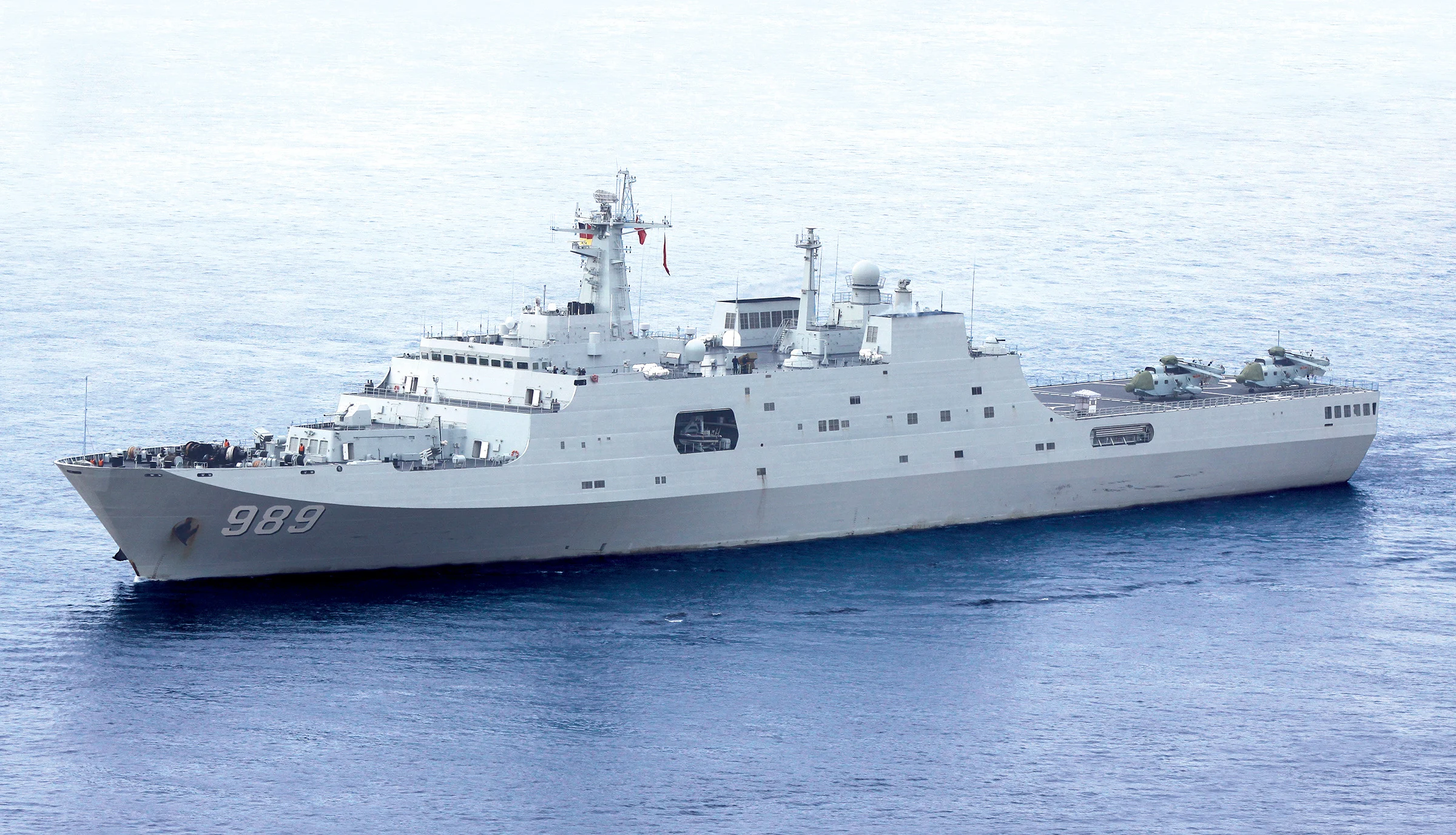
Asia Times, drawing on commercial imagery and published US naval analysis, reports six Type 071 landing-platform docks under construction or fitting out, in addition to eight already in service. Its estimate is that the resulting dedicated fleet could put roughly 23,000–29,800 troops ashore in a first lift, against a December 2024 China Maritime Studies Institute estimate of about one division, 20,000–25,000 personnel and roughly 1,000 vehicles, for the then-dedicated force. These are analytical ranges, not observed loading plans.
A Type 071 is commonly assessed to carry about 500–800 marines, four transport helicopters and either four Type 726 air-cushion craft or about 10 amphibious vehicles. China’s four Type 075 landing helicopter docks add aviation and command capacity. Type 076 is relevant to the future force mix but should not be counted as demonstrated lift today; its role and operating concept remain unproven in public evidence. Civilian roll-on/roll-off ships provide the much larger theoretical reserve. Asia Times cites Thomas Shugart’s estimate of more than 1.1 million displacement tons across large ferries and vehicle carriers and potential delivery of about 300,000 troops and vehicles in 10 days after tactical stability is achieved.
That conditional clause is the hard math. Sealift capacity is not beachhead capacity. Civilian ships need secure approaches, functioning ramps or ports, escorts, traffic control, damage control and a joint commander able to sequence waves under fire. A reliable command chain cannot create those conditions by itself, but an unsettled one makes it harder to exploit every additional hull. This is why counting 071s, 075s, a future 076 and merchant tonnage without counting command reliability gives a misleadingly generous answer.
Two readings and the indicators that can separate them
There are two credible interpretations. The first is that the purge reduces war risk: political reliability and anti-corruption enforcement may produce commanders less willing to take unauthorised risks and a leadership more confident in the chain it retains. The second is that repeated removals reduce readiness reliability: specialised expertise, informal coordination and candid staff reporting can be lost faster than they are recreated. Both can be true at different echelons.
- Fujian activity: watch for repeated full-deck launches, night qualifications, KJ-600 integration and long-range group deployments, rather than one-off demonstrations.
- Appointments: watch named, durable fleet and Eastern Theatre joint-staff appointments and the backgrounds of replacements.
- Joint integration: watch for cross-theatre transfers and exercises that combine landing forces, civilian shipping, escorts and logistics rather than simply counting hulls.
Congress is an external timing variable
From Beijing’s perspective, the US political picture complicates this calculation. A 5 November South China Morning Post analysis, “How Trump’s weakened grip on Congress complicates talks with China,” argues that Democratic control of Congress limits White House room for manoeuvre. For Taiwan policy, that does not mechanically mean slower arms deliveries. Congressional committees can press for stronger notifications, appropriations and oversight, and a Democratic Congress may make deterrence signals less dependent on presidential bargaining. But it can also attach conditions, widen scrutiny and make a negotiated US–China understanding harder to sell domestically.
For PLA planners, this increases the value of demonstrated readiness rather than announcements. The next revealing data point is not another claim about a carrier’s potential or another aggregate ship count. It is whether a newly constituted naval and theatre command can sustain realistic, joint activity long enough for Fujian’s promised combat capability and the amphibious fleet’s paper capacity to become mutually supporting operations.
Sources and methodology
Primary reporting used: Maritime Executive (4 Nov 2026); Global Times/CCTV reporting (5 Nov 2026); Asia Times (5 Nov 2026), which cites China Maritime Studies Institute, US Department of Defense and Thomas Shugart’s published analysis; and SCMP commentary (5 Nov 2026). Numerical lift figures are cited analytical estimates and are deliberately presented as ranges. The reported identities, roles and allegations in the personnel table have not been independently verified here and are marked accordingly.
The PLA Navy is undergoing a significant purge affecting senior ranks, which may impact operational readiness. On 5 November 2026, the Fujian carrier completed cross-theatre trials and is progressing towards full combat capability. The ongoing personnel changes raise concerns about command continuity and the effectiveness of joint operations in potential Taiwan contingencies.
- Fujian carrier has completed cross-theatre trials and training in multiple seas.
- Senior naval personnel have been reported dismissed amid allegations of disloyalty and corruption.
- The purge may affect the operational readiness of the PLA Navy.
- China is constructing additional Type 071 landing-platform docks.
- Political reliability may influence military command decisions.