
Russia's AGM-188 Claim Shows Ukraine's Deep Strike Problem Has Changed
 Alexandra Reeves
Russia's AGM-188 Claim Shows Ukraine's Deep Strike Problem Has Changed
Russia may be exaggerating, but it is not exaggerating at random. A Russian military-affiliated Telegram channel now claims Ukraine used the U.S.-designed AGM-188A Rusty Dagger to strike the Sborka semiconductor plant in Voronezh. Neither Kyiv nor Washington has confirmed that claim, and that matters. But the fact that Russian sources are reaching for this particular explanation tells us something useful: Moscow is beginning to treat Ukraine's long-range strike campaign as a munitions-volume problem, not just a drone nuisance.
That is the shift worth watching. For most of the war, Ukraine's deep strikes have been impressive but uneven: naval drones against the Black Sea Fleet, long-range UAVs against refineries, Storm Shadow and SCALP-EG against carefully selected military targets, and Ukrainian-built systems filling gaps as fast as industry can manage. The alleged Rusty Dagger appearance, if eventually verified, would point to a different phase. It would mean Ukraine is not merely improvising reach. It is moving toward a repeatable Western-supported strike architecture.
The Voronezh Target Was Not Symbolic
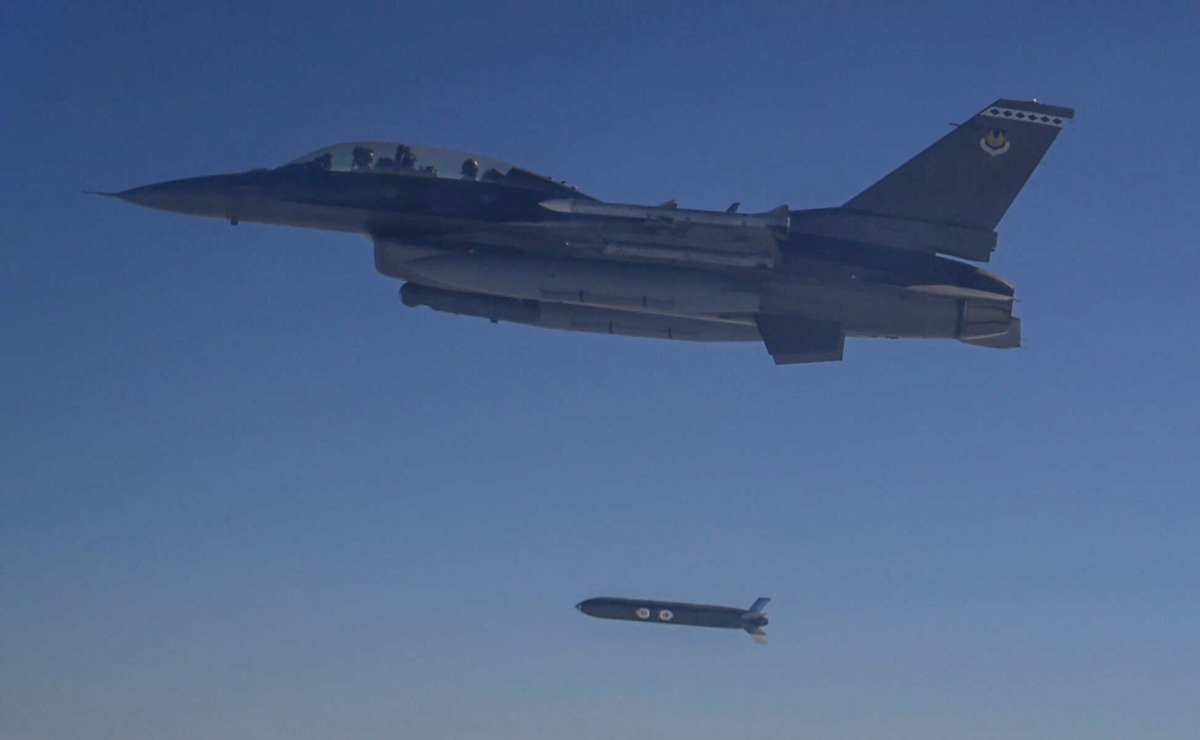
According to Defence Blog's reporting, the target was the Sborka plant in Voronezh, roughly 500 kilometers from Ukraine's border. Ukrainian military intelligence has identified the plant as part of Russia's weapons supply chain, including specialised semiconductor components for the Kh-101 cruise missile, the 9M727 Iskander-K cruise missile, and the Pantsir-S1 air defence system. That makes it a more interesting target than another fuel depot or rail yard.
The point of striking a plant like Sborka is not to create a dramatic fireball. It is to make Russian production managers solve a problem they were not supposed to have: replacing narrow, certified electronics components under sanctions while the front still demands finished missiles. A Kh-101 can fly thousands of kilometres, but it still depends on small pieces of industrial plumbing. Ukraine has learned to attack that plumbing.
This is why the AGM-188 claim is consequential even before it is proven. Voronezh was already within reach of several Ukrainian or Western-provided systems. But a purpose-built, affordable standoff weapon launched from F-16s would change the arithmetic. It would let Ukraine hit more nodes, more often, without treating every deep strike as a boutique operation.
What The Rusty Dagger Is Supposed To Solve
The AGM-188A Rusty Dagger is described in program reporting as the U.S. Air Force's Extended Range Attack Munition, developed to give Ukraine a lower-cost, mass-producible long-range precision weapon. Defence Blog cites Zone 5 Technologies as one of the ERAM developers and reports that the weapon fits broadly inside the size and weight logic of a 500-pound Mk 82-class weapon. The claimed range is over 930 kilometers, with a much smaller warhead than a traditional cruise missile.
That last detail is easy to misunderstand. A 45-kilogram class warhead is not a bunker-buster. It is not meant to flatten a hardened airbase. Its value is precision, range and numbers. If the target is a transformer hall, guidance unit workshop, semiconductor assembly area, fuel pump station or radar support building, the weapon does not need to be huge. It needs to arrive accurately and repeatedly.
That is exactly the kind of weapon Ukraine has been missing. Storm Shadow and SCALP-EG gave Kyiv reach, but not abundance. ATACMS gave punch, but with political and inventory constraints. Drones gave range and scale, but not always survivability or terminal precision against defended industrial targets. ERAM-style weapons sit in the middle: more expensive than a long-range drone, far cheaper than high-end cruise missiles, and potentially compatible with Ukraine's growing F-16 fleet.
Moscow's Narrative Cuts Both Ways
There is an obvious reason for caution. Russian sources have every incentive to attribute a Ukrainian strike to an American weapon. It supports Moscow's preferred escalation narrative: Russia is not merely fighting Ukraine, it is being attacked by NATO through Ukrainian hands. That line is politically useful at home and diplomatically useful abroad.
But propaganda can still reveal anxiety. If Russian military channels are pointing to AGM-188, they are implicitly acknowledging that Ukraine's strike portfolio is becoming harder to categorise. Was it a drone? A Storm Shadow? A Ukrainian cruise missile? A new U.S. munition quietly moved ahead of the published delivery schedule? The uncertainty itself imposes costs. Russian air defence planners have to defend against more flight profiles, more launch baskets and more target sets than they did a year ago.
For NATO, this is the part everyone in conference rooms likes to avoid. Ukraine is not just consuming Western arsenals. It is stress-testing Western procurement assumptions. The old model was to build exquisite weapons in limited numbers, save them for high-value targets, and assume escalation management would keep the magazine from emptying too fast. Ukraine's war says the opposite. The useful weapon is the one that can be built, integrated, taught, replaced and fired again.
The F-16 Factor Is Political As Much As Technical
Ukraine's F-16s matter here because they turn a munition into a campaign. A missile sitting in a warehouse is a signal. A missile that can be carried by an aircraft Ukraine already operates is an option. If ERAM weapons are entering Ukrainian service, even in small early batches, they give Kyiv a way to keep Russian industry at risk from launch points well behind the front.
That does not mean a sudden strategic breakthrough. Russia will adapt. It will disperse production, harden some facilities, push decoys, tighten air defence around industrial regions and try to identify Ukrainian launch cycles. The war has punished every claim of a single game-changer. The better question is whether Ukraine can make Russian adaptation expensive enough to matter.
On that test, the Voronezh strike already looks meaningful. It fits a wider Ukrainian pattern of hitting microelectronics and missile-supply facilities rather than simply chasing prestige targets. The alleged weapon is unconfirmed. The target logic is not.
What To Watch Next
The next indicator will not be a dramatic announcement from Washington. It will be repetition. If similar strikes begin landing against Russian electronics, guidance, fuel-system or air-defence component plants at distances beyond routine drone patterns, the AGM-188 question becomes less about one missile and more about a campaign design.
The second indicator is Russian behaviour. Watch for new air defence deployments around second-tier industrial cities, not just Moscow, Crimea and major airbases. Watch for procurement warnings inside Russian regional industry. Watch for complaints about component substitution. Those would tell us more than another round of official denials.
For now, the honest assessment is narrow but uncomfortable for Moscow: Ukraine has found the vulnerable layer between Russian battlefield systems and the factories that keep them alive. Whether the weapon over Voronezh was Rusty Dagger or something else, Russia's missile supply chain is no longer safely behind the war. That is the real story, and it is a bad one for the Kremlin.
Ukraine allegedly used the AGM-188A Rusty Dagger to strike the Sborka semiconductor plant in Voronezh, a key facility in Russia's missile supply chain. This action indicates a shift in Ukraine's deep strike capabilities towards a more structured and supported approach. The AGM-188A is designed for long-range precision strikes, potentially allowing Ukraine to target critical industrial nodes more effectively. Russian sources are reacting to this development, suggesting increased anxiety about Ukraine's evolving military capabilities.
- Russia claims Ukraine used AGM-188A Rusty Dagger against the Sborka plant in Voronezh.
- The Sborka plant is part of Russia's weapons supply chain for missiles.
- The AGM-188A is designed for long-range precision strikes and is mass-producible.
- Ukraine's deep strike capabilities are evolving beyond improvised methods.
- Russian sources are acknowledging the complexity of Ukraine's strike capabilities.