
Russia’s glide bomb use falls for the first time in months
Russian forces dropped 8,016 guided aerial bombs on Ukrainian positions in October, an 11% fall from September’s record, the monitoring project Oko Gora said in a post summarizing the month. The figure works out to an average of 259 bombs a day and is the first monthly decline after a long climb through the summer.
The count covers FAB-series bombs fitted with UMPK kits, a Russian add-on module, short for “unified gliding and correction module,” that bolts onto old unguided Soviet-era bombs and gives them pop-out wings and satellite guidance. With the kit, a bomb can glide tens of kilometers to its target, letting Russian aircraft release it from beyond the reach of most Ukrainian short-range air defenses. Based on the 11% drop, Russia used about 9,000 such bombs in September.
Glide bombs are one of the main weapons Russia uses against Ukrainian troops and fortified positions near the front. The kits are cheap compared with missiles and can be fitted to bombs Russia already holds in large stocks, from the FAB-500, which weighs about 500 kg (1,100 pounds), to the much heavier FAB-1500 and FAB-3000.
Before October, Ukrainian figures showed usage climbing month after month, with the Ukrainian Ministry of Defense counting 8,266 glide bombs in June and more than 8,300 in July. In August the total reached 8,766, the highest monthly total on record at the time, a jump The Defence Blog covered when Russia’s glide bomb strikes hit a new monthly record in August, and Oko Gora’s data puts September higher still.
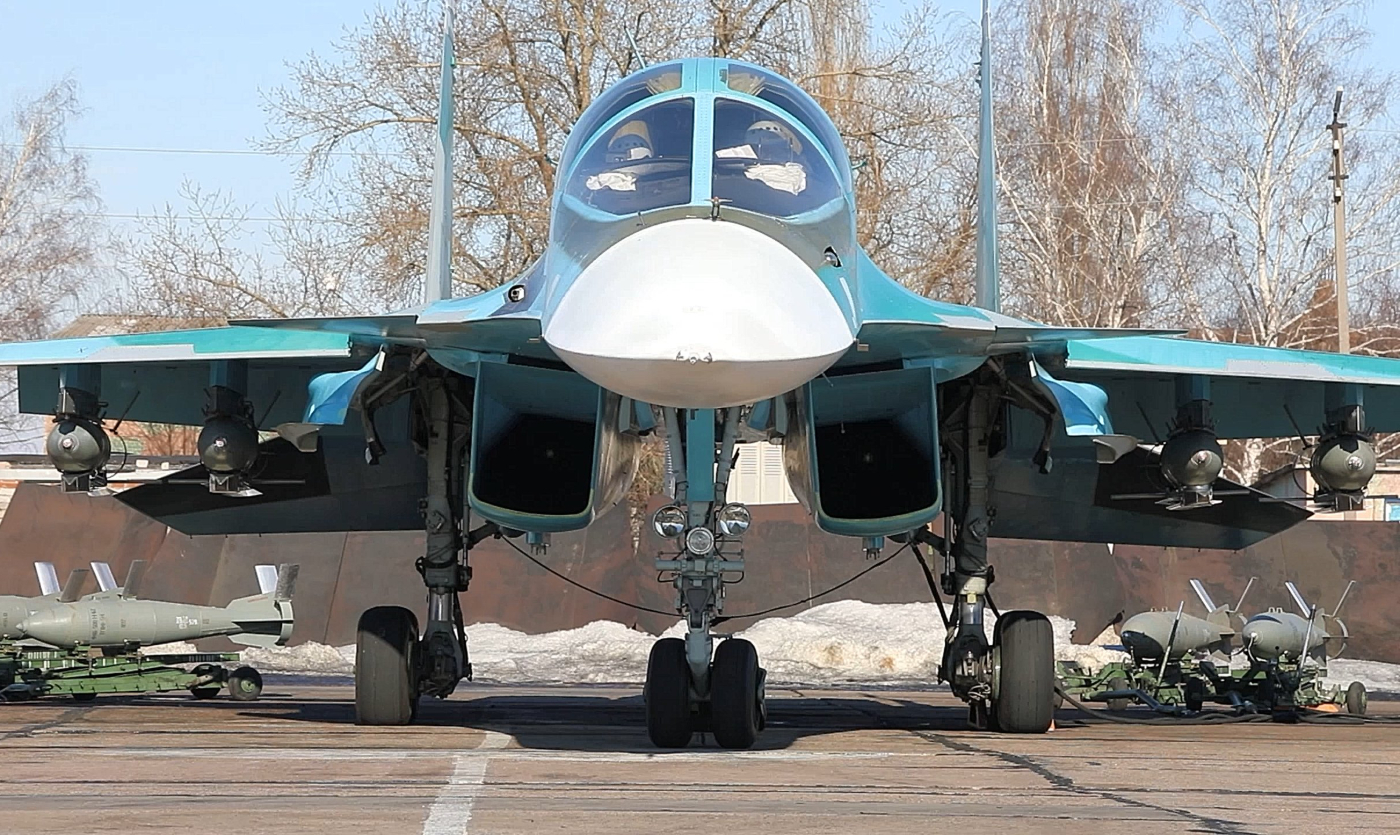
The decline came during a month of Ukrainian long-range strikes on the Su-34 fighter-bombers that carry much of Russia’s glide bomb load. Ukraine’s General Staff has described the Su-34 as an aircraft used in particular to drop guided bombs with gliding and correction modules.
On the night before Oct. 15, Ukrainian forces hit Borisoglebsk air base in Russia’s Voronezh region, about 370 km (230 miles) from the front line. President Volodymyr Zelensky said six Su-34M bombers were struck, four of them destroyed, and Ukraine’s naval forces said the attack used Neptune missiles. On Oct. 29, Ukraine’s Navy said it destroyed two more Su-34s with Neptune missiles at Marinovka air base in the Volgograd region.
The losses add to earlier attrition of the fleet, including aircraft Ukraine says it shot down in the air and Su-34s damaged in previous raids on Marinovka.
The October figures alone do not show whether the airfield strikes caused the drop, since monthly totals can also move with the tempo of ground fighting along different sectors, and Oko Gora’s summary does not break the numbers down by aircraft type or front.
Even after the decline, October’s total stayed close to the record levels of the summer, with more than 250 guided bombs a day, roughly the same pace Russian forces sustained in June and July.
Content preview only. Full article available at source. View Full Article
Russian forces dropped 8,016 guided aerial bombs on Ukrainian positions in October 2023, marking an 11% decrease from September. This decline occurred amid Ukrainian strikes on Russian Su-34 bombers, which are primarily used for delivering these glide bombs. Despite the drop, the average usage remained high, with over 250 bombs dropped daily.
- Russia dropped 8,016 guided aerial bombs in October 2023, an 11% decrease from September.
- The glide bombs are equipped with UMPK kits for enhanced targeting.
- Ukrainian forces targeted and destroyed several Su-34 bombers in response to the bombings.
- The decline in bomb usage coincided with increased Ukrainian strikes on Russian aircraft.
- October's usage remains high, averaging over 250 bombs per day.