
Russia's Nuclear Threat 2026 Exposes Europe's Deterrence Gap in the Baltics
 Dr. Klaus Weber
Russia's Nuclear Threat Exposes Europe's Deterrence Gap in the Baltics by 2026
On September 30, 2026, Reuters reported a new nuclear warning from Moscow to NATO as tensions in the Baltic Sea region continued to escalate. On the same day, NATO Secretary General Mark Rutte reaffirmed that the alliance would defend "every inch" of its territory. These two statements are interconnected. The first is strategic communication; the second is a political assurance. Between them lies Europe's actual problem: it has a credible mutual defense clause, but not yet a sufficiently dense military architecture to support it in the first month of a crisis.
The Nuclear Threat is No Substitute for Conventional Strength
Russia's nuclear rhetoric aims to change the political cost calculation for Western governments. It is directed not only at Washington or Brussels but also at the capitals along NATO's eastern flank. The message is clear: any conventional support for Ukraine and any reinforcement of the Baltics could trigger a dangerous escalation ladder. This is deterrence through uncertainty.
Militarily, however, this rhetoric does not resolve any of the practical problems that make a conflict more likely: unprotected logistics corridors, scarce air defense, limited stocks of precision munitions, and slow political decision-making processes. A nuclear hint does not replace an available air situation picture or a protected supply route. Responding to Moscow's threat with another statement already accepts its logic.
The Baltics Become a Test for Europe's Reaction Capability
Recent reports of Russian hybrid activities show why the situation cannot be reduced to strategic rhetoric. Politico reported on EU considerations for a NATO-like mechanism against hybrid attacks. At the same time, Deutsche Welle reported that Estonia blamed Russia for an arson attack on a defense company. Whether each individual incident can be legally attributed to a state order is another question. Politically, it is crucial that sabotage, disinformation, drone overflights, and military intimidation occur below the threshold of armed attack.
This is precisely where the European division of labor has so far failed. NATO has military jurisdiction, while the EU has instruments for sanctions, resilience, and internal market policy. However, there is often a lack of a procedure between the two levels that can produce a joint situational assessment and a graduated response within hours. The result is a dangerous gray area: Russia can test without Europe having to decide immediately whether it is war, terrorism, espionage, or an accident.
Eurofighter and Air Defense are Political Signals
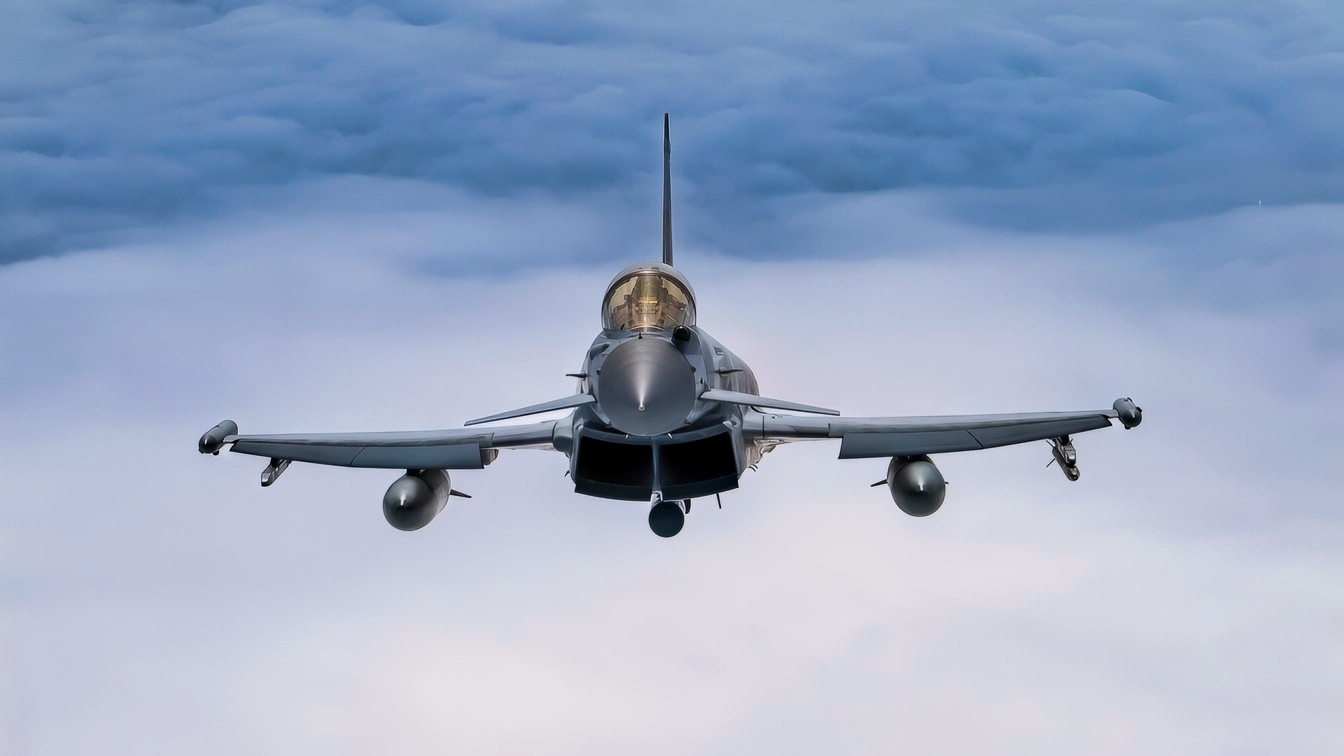
The deployment of Eurofighters and other NATO combat aircraft in the Baltics is therefore more than a routine air policing mission. It demonstrates presence, airspace control, and the readiness to respond to unknown aerial objects. A Eurofighter Typhoon has high speed, modern sensors, and a considerable payload. However, it is not a complete air defense system. Without ground-based sensors, data links, electronic warfare, tankers, spare parts, and sufficient flight hours, the individual aircraft remains an expensive symbol.
The crucial metric is therefore not the number of deployed jets but the duration for which Europe can maintain an integrated air defense and command structure. Rutte can promise "every inch." However, member states must finance common rules of engagement, munitions stocks, and a robust reinforcement planning. This is less spectacular than a summit communiqué but militarily relevant.
Institutional Separation Produces Strategic Dependency
A recent analysis by the Carnegie Endowment bears the telling title "Separable, not Separate" and describes European collective defense as a governance problem. This is precisely the lesson for the Baltics. Europe does not need to produce every capability completely autonomously from the United States. However, it must prevent a European operation from reaching its limits within a few days without American intelligence, satellite communication, air refueling, or strategic leadership.
This is the difference between strategic autonomy and strategic redundancy. Brussels continues to enjoy discussing European sovereignty while member states pursue national procurement projects side by side. Germany buys systems, France protects industrial decision-making authority, Poland accelerates rearmament, and the Baltic states increase their defense spending. These measures are individually understandable. Together, they do not yet form a military force as long as data standards, maintenance, munitions, and political control are not compatible.
What Europe's Response Must Achieve
- Joint Situational Assessment: The EU and NATO need a permanent mechanism that classifies hybrid incidents within hours and prepares a graduated response.
- Resilience: Investments in air defense, drone defense, spare parts, and munitions are more important than further symbolic announcements.
- European Reinforcement: The eastern flank needs pre-positioned stocks and clear transport corridors, not just rotating contingents.
- Political Clarity: Nuclear coercion must not paralyze conventional support for Ukraine and NATO's defense.
Europe's dilemma is thus precise: a nuclear threat can test political resolve, but it cannot create missing capabilities. Increased defense spending will only strengthen deterrence when it is translated into joint structures. Therefore, Europe does not need the illusion of being able to replace America in the short term. It needs the capability to survive the first weeks of a crisis independently. Otherwise, Rutte remains the credible voice of an alliance whose military grammar is still American.
Sources: Reuters, September 30, 2026; NATO Secretary General Mark Rutte, quoted by Anadolu Ajansı, September 30, 2026; Politico Europe, September 28, 2026; Deutsche Welle, September 29, 2026; Carnegie Endowment for International Peace, "Separable, not Separate," September 30, 2026.
On September 30, 2026, Russia issued a nuclear warning to NATO, emphasizing the deterrence gap in the Baltic amid escalating tensions. NATO Secretary General Mark Rutte reaffirmed the alliance's commitment to defend its territory. The report highlights Europe's military inadequacies in addressing hybrid threats and the need for improved defense mechanisms.
- Russia issued a nuclear warning to NATO on September 30, 2026.
- NATO Secretary General Mark Rutte affirmed the alliance's commitment to defend its territory.
- The report highlights Europe's military shortcomings in responding to hybrid threats from Russia.
- Estonia accused Russia of a firebombing incident at a defense contractor.
- The deployment of Eurofighters in the Baltic is more than routine air policing.