

Originating in the Soviet Union’s final, decisive decade, the Su-47 Berkut is one of the most legendary fighter designs the Soviet Union ever conceived. Looking less like a warplane and more like a starfighter, the Berkut still captures the imagination of aircraft enthusiasts worldwide. It was a deep black, with wings sweeping forward rather than backward (as in most other warplane designs worldwide).
The Soviets then put canards ahead of the wings on the Su-47 and conventional horizontal stabilizers behind them.
Su-47: Only One Was Ever Built
Ultimately, the Soviets built only one Su-47 Berkut.
It never entered service as an operational fighter, simply because the Soviet Union imploded and the post-Soviet government experienced an epic budget tightening.
Nevertheless, it is a curious “what might have been” to contemplate: what if the Russians had tried to build more of these unusual planes?
Let’s start with the forward-swept wings. They offer some unique advantages that conventionally designed warplanes lack.
With a conventionally designed warplane, airflow tends to migrate toward the wingtips.
At high angles of attack, airflow over the wingtips can cause the attacking plane to stall by reducing the effectiveness of the control surfaces at the tips.
But a forward-swept wing design, like the Su-47, allows air to move inward toward the wing root.
Thus, the outer portions of the wing (with the control surfaces) can remain aerodynamically effective at higher angles of attack.
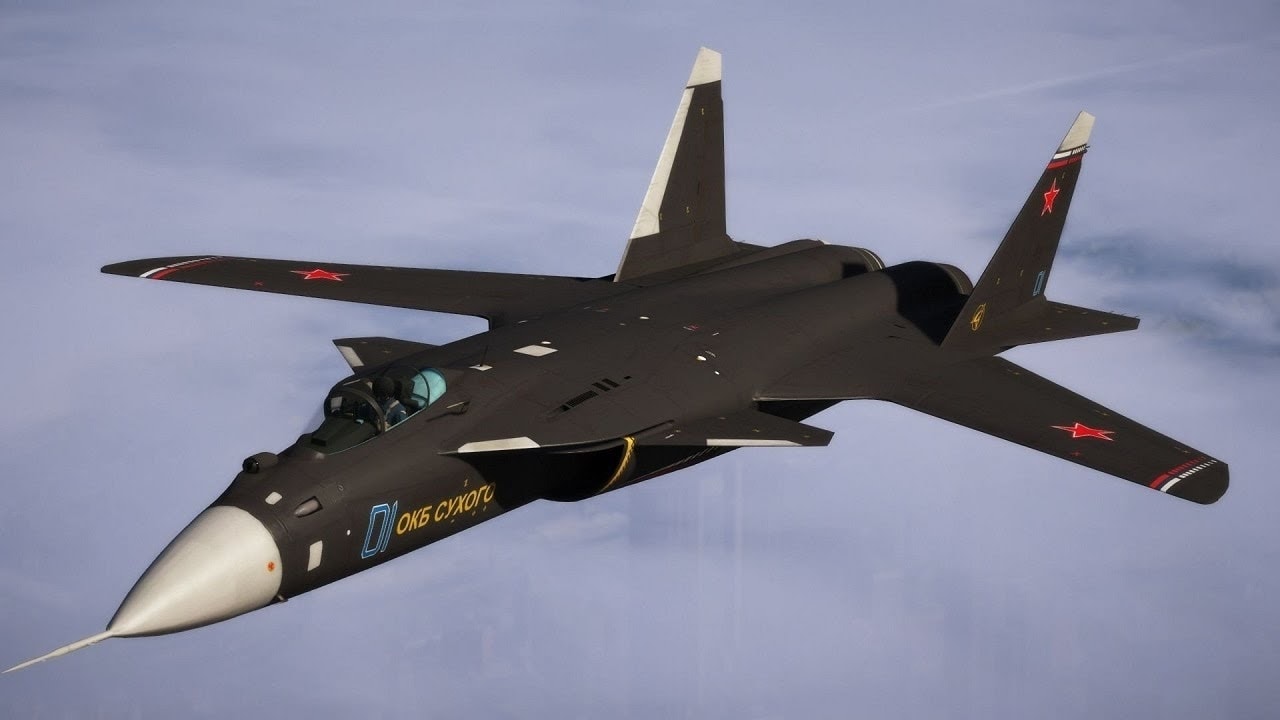
Su-47. Image Credit: Artist Rendering/Creative Commons.
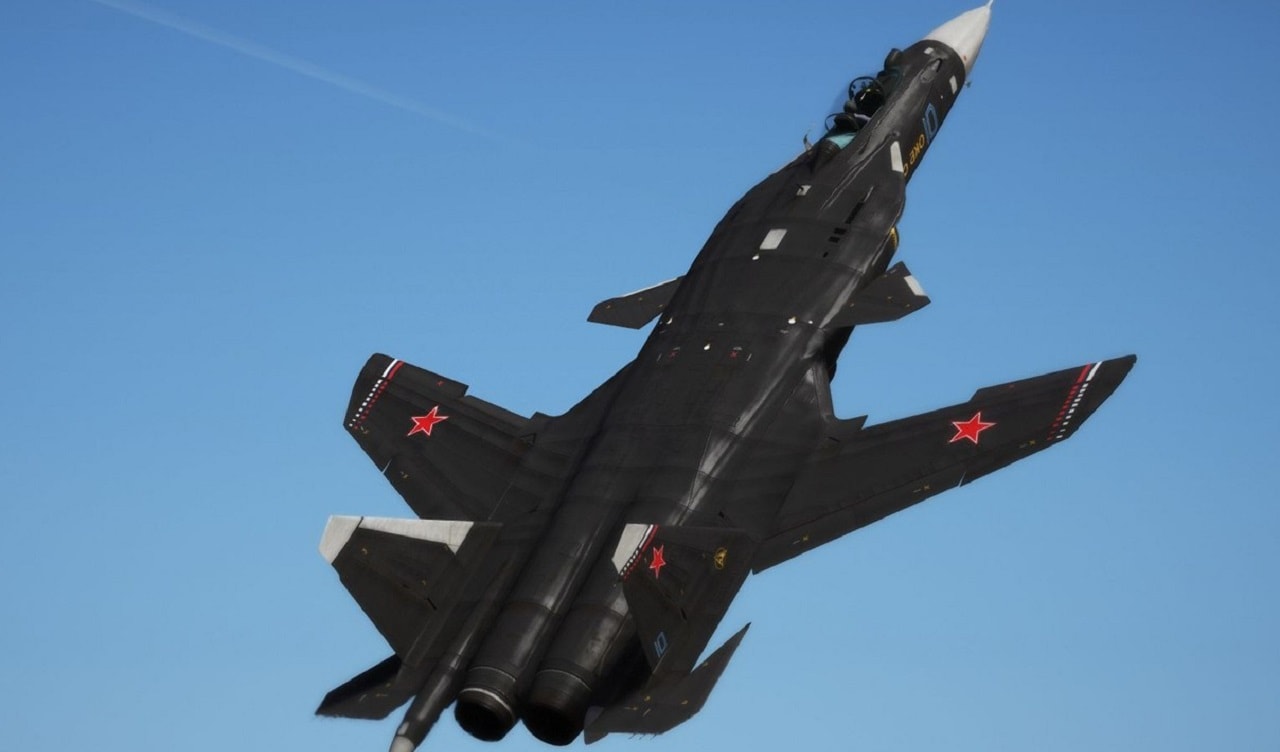
Su-47 fighter. Image Credit: Creative Commons.
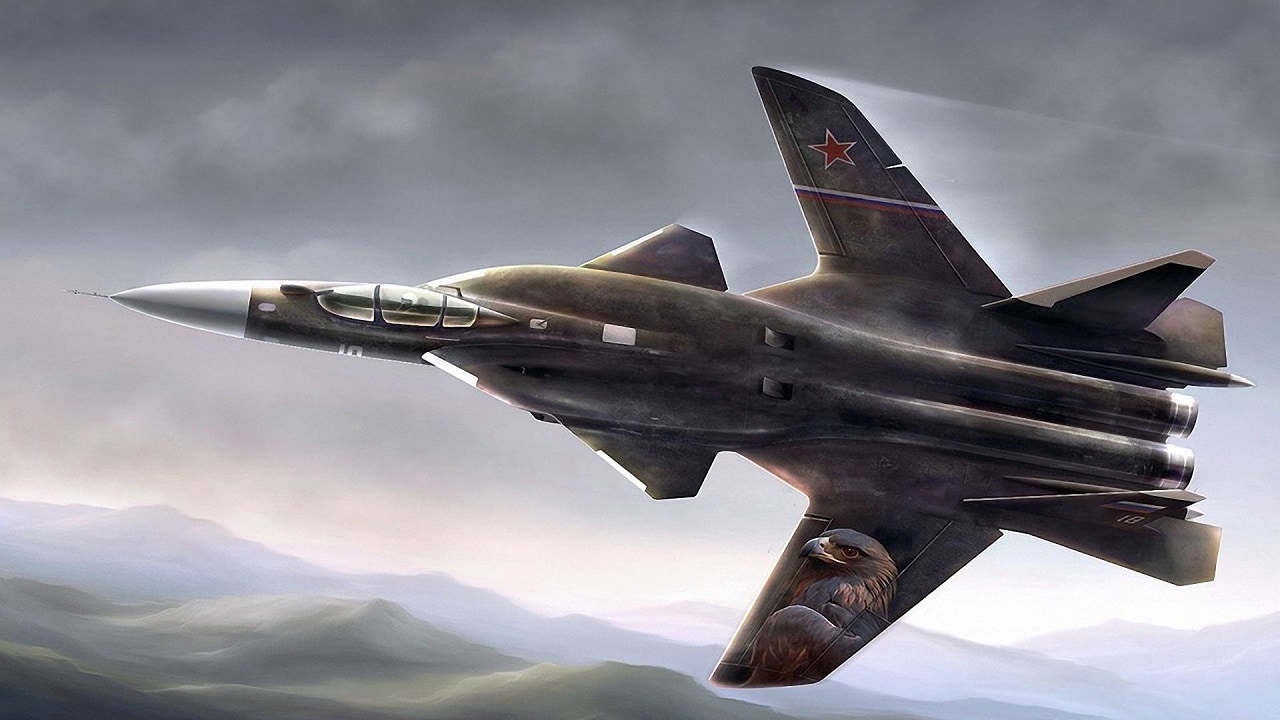
Su-47. Artist Rendition. Image Credit: Creative Commons.
This design contributed to better low-speed handling, longer life, greater stall resistance, and exceptional maneuverability.
Of course, the design had its flaws. Aerodynamic forces can twist that forward-swept wing upward.
In turn, that twisting increases what’s known as aerodynamic loading, which can produce further twisting in a potentially destructive process known as “aeroelastic divergence.”
Basically, an airplane’s wings are meant to stay in place. Yet the unwanted twisting associated with forward-swept wings can cause the wings to twist so severely that they ultimately break off and destroy the plane.
So, Soviet engineers turned to composite materials to overcome this unique aerodynamic quandary.
Carbon Composite Fibers Introduced
Engineers carefully overlaid carbon fibers onto the Su-47 wing design, ensuring the wing would resist twisting without adding the extra weight that often comes with conventional wing-strengthening techniques.
In fact, the United States had demonstrated a similar concept with the experimental Grumman X-29 design during the 1980s.
At the time, the Soviets were attempting that design on a much larger aircraft.
Long after the Soviet Union had imploded and Russia had been thrown into the chaos of the post-Soviet era, on September 25, 1997, the Su-47 Berkut flew for the first time.
Two D-30F6-type afterburning turbofan engines powered the Su-47, the same engines that powered the iconic MiG-31 interceptor. Originally, the Su-47 designers wanted more advanced engines.
But they didn’t install them because of cost. The Su-47 was massive.
It measured 74 feet long and had a wingspan of about 55 feet.
Its takeoff weight could reach 75,000 pounds. Berkut could exceed Mach 2, although its demonstrator was limited to Mach 1.6.
The forward-swept wing carried significant disadvantages, even though it could operate at extremely high angles of attack (especially with that composite material).
Plus, the Su-47 emerged just as the world began prioritizing stealth, advanced sensors, and internal weapons (for stealth purposes).
A Vital Testbed for Russian Warplanes
The systems were evolving toward beyond-visual-range (BVR) combat. So, a forward-swept wing was impressive for maneuverability.
Still, if BVR was becoming the primary mode of combat, along with stealth, extra dogfighting maneuverability was an interesting capability but not necessary.
Still, as a prototype, the Su-47 helped the Russians plan their next major series of combat aircraft. In that way, then, the Su-47 was invaluable.
And the fact that the Russians could still employ this wild plane design while they were in the throes of the post-Soviet doldrums shows how committed they were to maintaining their military competitiveness. The Su-47 never served.
But it was useful in other ways.
It was also an impressive-looking plane.
About the author: Brandon J. Weichert
Brandon J. Weichert is the Senior National Security Editor at 19FortyFive.com. He also manages The Weichert Brief on Substack. Weichert also hosts “National Security Talk” on Rumble. He is the author of four bestselling national security books, most recently A Disaster of Our Own Making: How the West Lost Ukraine (Encounter Books). Follow him via Twitter/X @WeTheBrandon.