
Saudi SKYWASP with a range of 1500 kilometers brings drone racing to Riyadh factories 2026
 Ahmed Al-Rashid
Saudi SkyWasp with a Range of 1500 Kilometers Moves the Drone Race to Riyadh Factories 2026
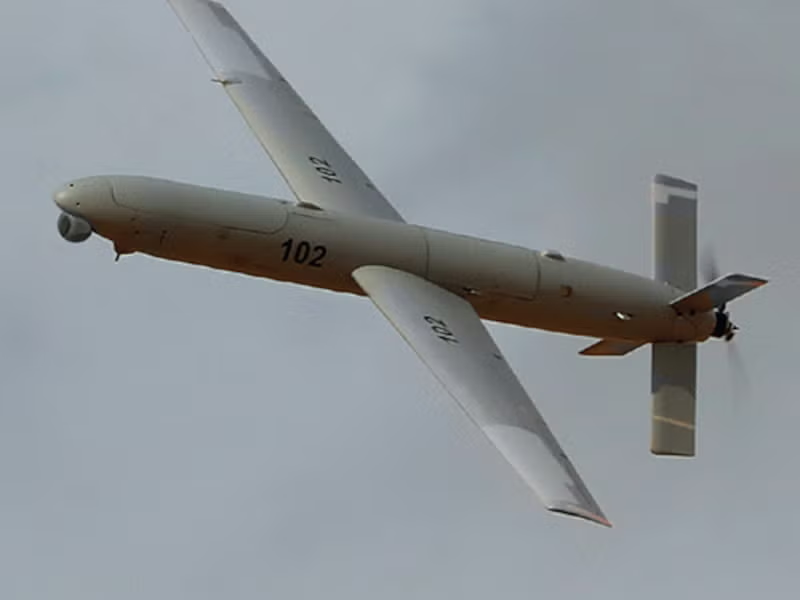
On May 25, 2026, American reports revealed that a Saudi-American startup is moving forward with a plan to manufacture single-use offensive drones in Riyadh, clearly inspired by the logic of the Iranian Shahed rather than the philosophy of expensive Western aircraft. The name in circulation is SkyWasp, and the announced range is around 1500 kilometers, a figure that alone is enough to make the news bigger than just a small industrial project in a crowded drone market.
The important thing here is not that Saudi Arabia wants a new drone. Every country in the region wants that now. The important thing is that Riyadh, after years of purchasing Patriot, THAAD, Eurofighter, and expensive surveillance systems, is looking at cheap long-range weapons as part of the deterrence equation. Militarily, this is a belated acknowledgment that the war in the Gulf is no longer just a game of ballistic missiles, but a game of thousands of small targets that consume air defense and reveal institutional weaknesses before radar weaknesses.
From Patriot to SkyWasp
In the morning, the discussion revolved around the U.S. military's attempt to produce an interceptor missile compatible with Patriot for less than a million dollars. Just hours later, the other side of the equation in the Gulf appears: if interception is expensive, then attack must become cheap, plentiful, and local. This is not an intellectual coincidence. It is the culmination of ten years of experience from the Houthis, Iran, Russia, and Ukraine in turning loitering munitions into a political pressure tool before being a tactical killing tool.
SkyWasp, according to published information, is neither a new MQ-9 Reaper nor an advanced reconnaissance aircraft. It is closer to a loitering munition or a suicide drone that uses a simple engine and a medium payload and flies far enough to change geographical calculations. A range of 1500 kilometers means that a platform launched from the center of the Arabian Peninsula can theoretically cover theaters in the Gulf, the Red Sea, and the northern Arabian Sea. But range does not automatically equal capability. Any military personnel who has served in the region knows that the real question is: who plans the strike, who programs the route, who secures communications, and who approves the target bank?
The Iranian Lesson That Gulf States Prefer Not to Mention
Iran did not create Shahed because it has a better aviation industry than the West. It created it because it understood that the adversary could lose politically while winning technically. A drone that costs tens of thousands of dollars can force its adversary to launch an interceptor missile worth hundreds of thousands or millions of dollars, or to keep air defense batteries in a state of constant depletion. This harsh lesson was received by Saudi Arabia in the Abqaiq and Khurais attacks in 2019, and by the UAE in the 2022 attacks, and then everyone saw it in Ukraine.
If the SkyWasp project is serious, it means that Riyadh does not just want a more expensive shield, but also wants a relatively cheap arrow in its quiver. This is an important shift in Saudi purchasing mentality. For years, the standard of prestige was owning the heaviest and shiniest Western system. Now another standard enters: can the Kingdom produce munitions in large quantities, store them, train Saudi units to use them, and quickly replace losses? In my opinion, this is the real test, not a model image in a defense exhibition.
Localization Does Not Create Capability Alone
Riyadh has been saying for years that its goal is to localize 50 percent of defense spending by 2030. This is a politically understandable goal, but militarily it needs precise translation. Manufacturing a drone body or assembling an engine does not equal possessing an independent strike system. True capability consists of three sides: equipment, training, and institution. Saudi Arabia is very good at the first side, improving in the second, and still testing itself in the third.
A local offensive drone project will face questions that do not appear in press releases. Will the electronic components be American, European, Chinese, or a complex mix? Will Washington allow the export of some sensitive technologies if the weapon turns into a long-range platform? Can the Saudi supply chain withstand a long war, not just a limited production showcase? And most importantly, will the use be subject to a clear Saudi operational doctrine, or will it remain tied to consultants, companies, and external political approvals?
Here lies the paradox. Saudi Arabia wants independence from complete reliance on American protection, but it often builds this independence through American partnerships. This is not necessarily a mistake, but it places a ceiling on operational freedom. Whoever holds the key to software and spare parts may not raise the flag on the weapon, but they remain present in the decision-making room.
A Message to Iran and a Message to Washington
To Iran, the message is clear: the monopoly on long-range loitering munitions in the region is no longer guaranteed. If Saudi Arabia possesses a wide production capability for cheap platforms, the balance of attrition changes. Tehran built its missile and drone influence on the idea that its adversaries buy defense and do not produce attack. Riyadh's entry into this field creates mutual deterrence, even if it remains limited in its early stages.
As for the message to Washington, it is more complex. Saudi Arabia is not saying it is abandoning the United States. It is saying that American protection alone is no longer sufficient. After years of discussions about the F-35, air defense, and interceptor missiles, Riyadh is choosing a less elegant path but one that is closer to today's wars: producing many munitions, relatively cheap, and usable for political and military purposes. This may ease Washington's concerns as it distributes the burden of deterrence, but it may also disturb it if it feels that Saudi strike tools will move out of traditional American control engineering.
The Red Sea and Yemen as an Unannounced Testing Ground
This project cannot be separated from the Red Sea and Yemen. The Houthis have proven that a non-state power can threaten international navigation with a mix of missiles, drones, and explosive boats. Saudi Arabia does not want to return to an open Yemeni war, but it cannot ignore that its southern adversary has real operational experience in using drones. The long-range Saudi drone, if it enters production, will be part of deterring this reality even if Riyadh does not explicitly announce it.
However, deterrence with drones in a crowded neighborhood like the Gulf and the Red Sea carries significant political risks. A navigational error, an ambiguous target, or a strike interpreted by the other side as escalation could open a crisis that no one wants. Here, the value of the military institution emerges, not just the value of the weapon. The cheap platform could become very expensive if used under a vague doctrine.
What to Watch for After the Announcement
- The first serious indicator is the existence of an actual production line in Saudi Arabia, not just a partnership office or a declaration of intent.
- The second indicator is the size of demand. Dozens of drones mean experimentation, while hundreds or thousands mean a doctrine of attrition.
- The third indicator is the type of guidance and communications. The more independence in navigation and programming, the greater the military value.
- The fourth indicator is the Saudi entity using it: the air force, air defense, the National Guard, or a new joint entity.
Open sources from Semafor, Enterprise AM, and defense industry reports have linked the project to Vector/SR2 and the idea of local manufacturing in the Kingdom, while CSIS studies on Shahed clarify that the value of this class of weapon comes not just from accuracy but from cost, quantity, and continuous pressure on defenses. Therefore, SkyWasp should be read as part of the war economy, not as a standalone piece of equipment.
Conclusion
The old Arab saying goes that a multitude of arrows sometimes overcomes the quality of armor. Saudi Arabia seems to have begun to understand this truth after paying a high price for purchasing armor. SkyWasp may not make the Saudi army independent tomorrow, nor give it immediate superiority over Iran, but it reveals a shift in the Saudi question itself: the question is no longer just what we buy from the West, but what we can produce when the sky over the Gulf becomes crowded, cheap, and dangerous.
The dilemma will remain as it is: Riyadh wants a weapon that grants it greater independence, but it needs a foreign partner to build this independence. Between reliance and the desire to free itself from it, most Gulf defense programs move like a drone in the wind; sometimes they reach their target, but they never fly outside the calculations of those who built their engine.
Saudi Arabia is developing the SkyWasp drone, capable of reaching 1500 kilometers, to enhance its military capabilities. This initiative, revealed on May 25, 2026, reflects a strategic shift towards local production and cost-effective military solutions, inspired by Iranian technology. The project aims to improve deterrence in the region and reduce dependence on U.S. defense systems.
- Saudi Arabia is developing the SkyWasp drone with a range of 1500 kilometers.
- The drone is intended to be a cost-effective alternative to expensive defense systems.
- The project reflects a shift in Saudi military procurement towards local production and self-sufficiency.
- The SkyWasp drone is inspired by Iranian technology and aims to enhance deterrence capabilities.
- The development is part of a broader strategy to reduce reliance on U.S. military support.