
Sentry Duty in the Dog Days: Visiting a Certain Red Army Regiment Stationed in Turpan, Observing the Soldiers on Watch
Reporters visit a certain Red Army regiment stationed in Turpan —
Under the Flame Mountain: Cadres on Duty and the Soldiers' Sentiments
■ Li Xiaolong, Reporter for the PLA Daily, Wang Yue
During the hottest days of summer, the reporter arrived at a certain Red Army regiment stationed in Turpan, under the Flame Mountain. As soon as I got out of the car, a wave of heat hit me.
It was the time for a midday break, and the sound of cicadas was louder than ever. The reporter noticed that the person standing at the camp gate was not a soldier, but a major officer. Zhang Zhiling, a staff officer accompanying the reporter, informed him that he was Instructor Lü, who was on duty at the camp.
Amidst the rising heat, Instructor Lü, fully equipped in duty gear, held a steel gun, his gaze vigilant, with sweat continuously dripping down his cheeks.
“Do instructors also have to stand guard?” the reporter asked, somewhat puzzled. “Turpan is surrounded by mountains, and it’s especially hot during the hottest days. They implement a system where all personnel take turns standing guard, with all cadres assigned to duty shifts alongside the soldiers,” Zhang Zhiling explained, showing the weather forecast on his phone, indicating that the outdoor temperature had exceeded 43 degrees Celsius.
Twenty minutes later, the guard shift ended, and Instructor Lü, after handing over to the incoming sentry, walked down from the post, drenched in sweat. The reporter handed him a bottle of water and struck up a conversation.
“The soldiers train in the scorching heat in the morning, and the midday break is a precious time for rest,” Instructor Lü explained. To allow everyone more time to rest, the party members and cadres voluntarily took on the duty of standing guard during the peak heat hours. The reporter checked the guard logbook and saw that most of the midday guard shifts were manned by cadres, with the instructor's name appearing multiple times.
After leaving the post, Instructor Lü did not return to the camp to rest but took a notebook to check attendance at various posts. This was his routine work after every guard shift. On the way, the reporter noticed that each post was equipped with supplies such as Huoxiang Zhengqi water and ice packs.
“We not only equipped each post with supplies to prevent heatstroke but also made appropriate adjustments to the duration of the midday guard shifts,” Instructor Lü said, recounting his experience of standing guard during the midday heat for the first time.
That day, the outdoor temperature was particularly high, and the old air conditioning system was almost ineffective. During the latter part of his guard shift, Instructor Lü clearly felt it difficult to concentrate, his mind becoming foggy.
“Sitting in the office, we look at data and listen to reports; standing at the post, we feel the heat and understand the difficulties,” Instructor Lü said. After implementing the all-personnel guard system, many cadres approached him to discuss their experiences standing guard during the midday heat and suggested specific measures such as “shortening the midday guard time,” “increasing heat prevention supplies,” “replacing cooling equipment,” and “building shade shelters.” Subsequently, they reported a plan for post improvements to the regiment's administrative department, which was quickly approved by the regiment's party committee. “Cadres taking turns standing guard during the midday heat allows everyone to truly experience the responsibilities of guarding and better understand the soldiers' expectations,” Instructor Lü said.
At the ammunition depot post, a certain company cadre, Wang Chenhao, was on duty. Instructor Lü told the reporter that Wang Chenhao had just finished his midday guard shift yesterday and was now replacing Sergeant Yaliku Yasen at the post. It turned out that Yaliku had sprained his ankle during training a few days ago but insisted on standing guard. Upon learning of the situation, Wang Chenhao found Yaliku: “Standing guard in this hot weather is not conducive to your ankle recovery. You should rest assured, I’ll take your shift!”
“Turpan not only has high temperatures but is also a spiritual highland,” Instructor Lü introduced. Ten kilometers outside the camp, there stands a statue themed on the spirit of military reclamation, inscribed with a segment of history worth remembering.
In early 1949, Comrade Wang Zhen volunteered: “I request to go to the most difficult places, to all the border areas that need help, to Xinjiang!” After the founding of the People's Republic of China, he led his troops into Xinjiang, with soldiers holding guns in one hand and picks in the other, reclaiming land and defending the border. In the first month of 1950, on a snow-covered road over 20 kilometers long, people were busy loading stones onto sleds, running along the snowy path. Leading the way was Wang Zhen.
To promote infrastructure in the border areas, he personally led commanders at all levels and soldiers to pull sleds and transport materials. In the cold winter, Wang Zhen's cotton coat became soaked with sweat, and when the wind blew, it froze stiff against his body, chilling him to the bone, yet he remained full of energy. Inspired by Wang Zhen's example, cadres, soldiers, and people of all ethnicities actively participated in reclamation and construction.
“Today, cadres taking turns standing guard during the midday heat and voluntarily replacing injured soldiers is a continuation and practice of the tradition of ‘leading by example and setting a model’,” Instructor Lü told the reporter. “Recently, we plan to organize all cadres in the regiment to use the story of Comrade Wang Zhen's reclamation and border defense as teaching material, to conduct in-depth ‘how cadres and key personnel lead by example’ on-site teaching, guiding party members and cadres to carry forward the fine traditions and shoulder their responsibilities.”
Returning to the camp entrance, the reporter saw that the intelligent license plate recognition system was operating efficiently, automatically verifying incoming vehicles, allowing sentries to supervise from the post. The newly replaced air conditioning system was continuously blowing cool air, and beside the post, a refrigerator marked “Convenient Service Point” contained a large bucket of saline water. The reporter took some water to taste and immediately felt a wave of coolness.
“This bucket of saline water not only ensures the sentries on duty but also serves passing pedestrians,” Instructor Lü explained. In previous years during the hottest days, sentries often encountered pedestrians suffering from heatstroke, and saline water could help them rehydrate and cool down in time. “This service initiative was also a suggestion made by a cadre based on their experience standing guard,” he said.
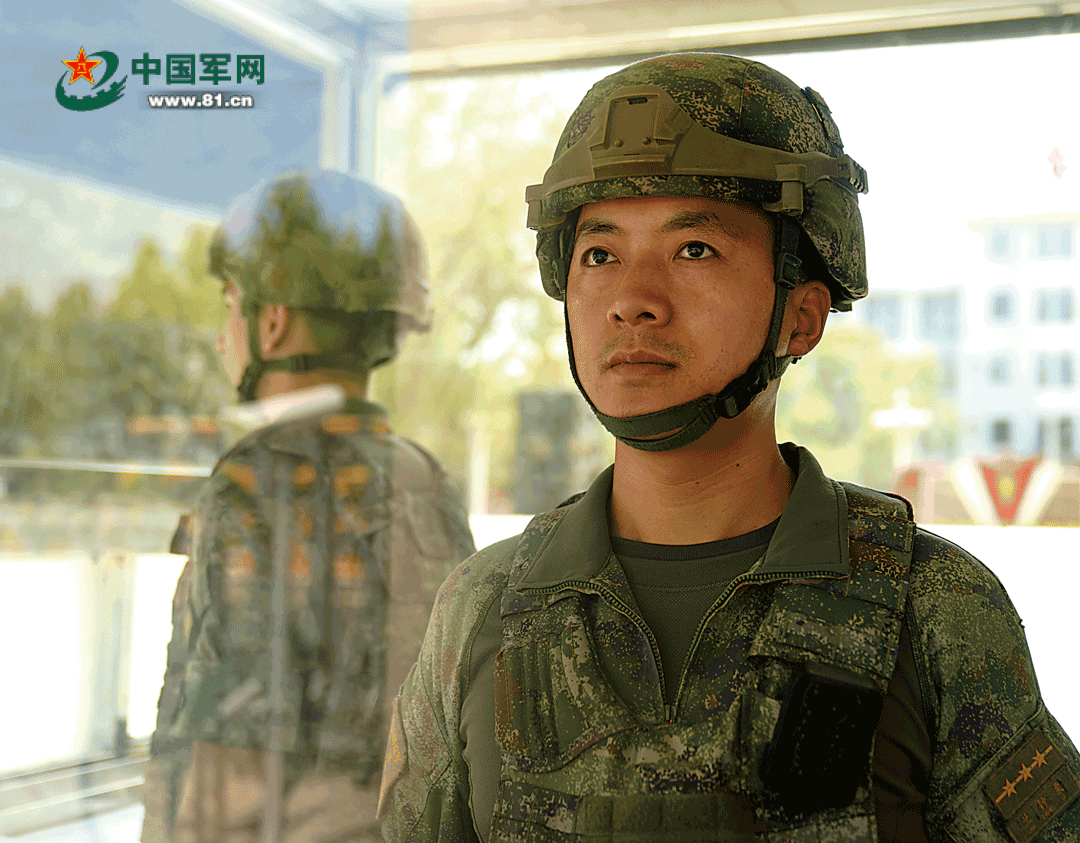
Lan Zhongli at the post. Photo by Yi Zhiming
As the interview concluded, the reporter was about to leave when he happened to encounter a company of soldiers returning from training. At this time, the soldiers' camouflage uniforms were soaked, and their faces were sunburned. When they reached the guard post, the leading cadre, Lan Zhongli, arranged for the key personnel to lead everyone back to the dormitory to rehydrate and rest, while he headed straight to the post. It turned out that the soldier who was supposed to take over the post had shown mild symptoms of heatstroke during training, and Lan Zhongli voluntarily offered to take his shift.
At the post, a sweating Lan Zhongli completed the handover with the sentry and deftly took over the steel gun. Not far away, at the battle flag square, the flags reading “Brave and Tenacious” and “Truly Tenacious” were fluttering in the wind.
Cool breezes at the high-temperature post
■ Wang Yue
Three feet of post reflect the original intention, and attention to detail reveals the style. Standing guard under the scorching summer sun in Turpan, in temperatures exceeding 40 degrees Celsius, is the daily reality for border defense soldiers. The party members and cadres on duty at the camp voluntarily take on the midday guard shifts, which may seem like just standing a post, but in reality, it is a vivid practice of changing work styles, warming soldiers' hearts, and boosting morale.
There are no small matters at the grassroots level; every detail matters. The true sentiments of soldiers are not found in office data reports but at the posts under the blazing sun, in the sweat of the soldiers. A real experience of role reversal surpasses a hundred paper surveys. By standing on the high-temperature post, the cadres of the regiment not only personally experienced the soldiers' feelings in the heat but also more accurately identified the pain points and difficulties existing at the grassroots level.
From replacing cooling equipment and building shade shelters to equipping heat prevention supplies and adjusting duty durations… a series of targeted and pragmatic measures not only solved problems but also solidified the fine style of “friendship among officers and soldiers, unity from top to bottom.” The story of the cadres taking turns standing guard during the midday heat reminds all levels that only by exchanging sincerity for soldiers' hearts and gathering morale through practical actions can a strong team be forged that is united and ready to win.
Military personnel from a certain Red Army regiment are actively standing guard in Turpan during extreme summer heat, with temperatures exceeding 43 degrees Celsius. Officers are taking turns to allow soldiers to rest, and cooling supplies are provided at guard posts to ensure their well-being. This initiative demonstrates a commitment to maintaining operational readiness and soldier welfare.
- Military officers are standing guard during extreme heat in Turpan.
- The temperature exceeds 43 degrees Celsius.
- Officers are taking turns to ensure soldiers can rest during the hottest part of the day.
- Cooling supplies are provided at guard posts to assist personnel.
- The initiative reflects a commitment to soldier welfare and operational effectiveness.