
Seventh 2026 US Philippine Maritime Drill Shows the Cutter Gap
 Marcus Chen
Seventh 2026 US Philippine Maritime Drill Shows the Cutter Gap
Seven Maritime Cooperative Activities in less than six months sounds like a tempo problem for Beijing. It is. But the June 14-19 U.S.-Philippine activity inside the Philippine Exclusive Economic Zone also exposed a harder problem for Washington and Manila: the ships doing the daily work are still mostly small, thinly armed, and dependent on aircraft that may not always be overhead.
Commander, U.S. 7th Fleet said the latest MCA included U.S. Navy, Army, Coast Guard, and Marine Corps participation, with training in littoral maneuver, amphibious assault exchanges, visit-board-search-and-seizure, maritime interdiction, search and rescue, and law enforcement. The unit list matters more than the press-release language. The Philippine side brought two FA-50 fighters, a Cessna C-208B, Sokol helicopters, the coast guard patrol vessels BRP Melchora Aquino and BRP Sindangan, the Jose Miguel Malvar-class frigate Diego Silang, and an AW159 helicopter. The U.S. side brought two Sentinel-class fast response cutters, USCGC Charles Moulthrope and USCGC Emlen Tunnell, the 3rd Marine Littoral Regiment, and a Navy P-8A Poseidon.
The Exercise Was Busy But Not Heavy
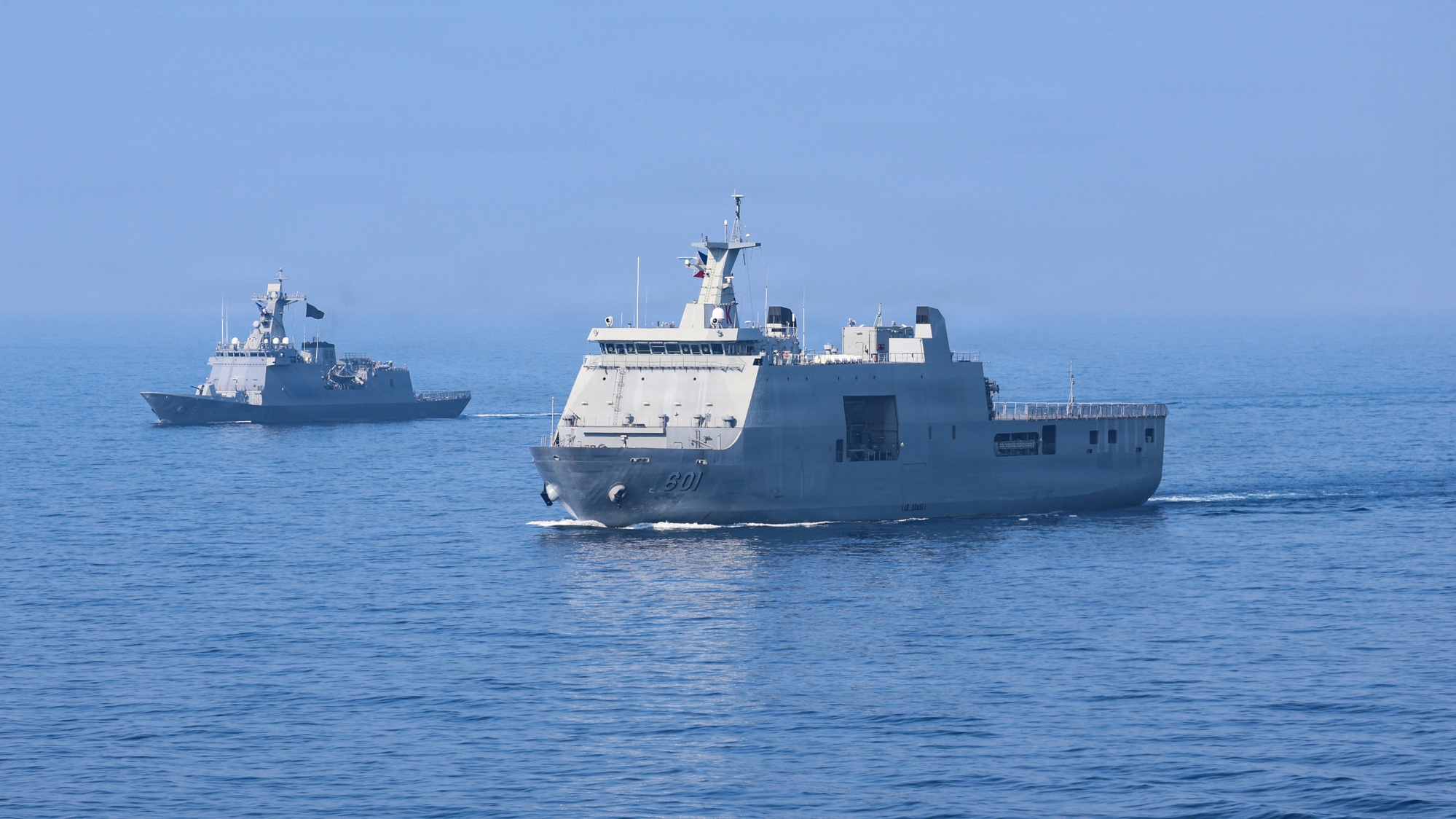
That is a useful package for presence, boarding practice, sensor sharing, and coast guard-to-coast guard signaling. It is not a sea-control force. A Sentinel-class cutter is a 154-foot patrol vessel built for law enforcement and security missions, not missile combat. The Philippine FA-50 is a capable light fighter for air policing and point defense, but it is not a long-range maritime strike aircraft. A P-8A can see a lot and cue a lot, but it cannot be everywhere over the Philippine EEZ for days without tanking, maintenance, crew cycles, and basing access.
The difference matters because China does not need to defeat the alliance in a set-piece naval battle to make trouble west of Luzon. It can use coast guard hulls, maritime militia, survey ships, and selective naval overwatch to stretch response times. The MCA package is designed for that grey-zone contest. But grey-zone forces still operate under the shadow of hard power. If a Chinese destroyer or land-based aircraft changes the risk calculation, two U.S. Coast Guard cutters do not provide the kind of magazine depth that anyone who has stood watch on a destroyer would call reassuring.
The Geography Is the Real Opponent
The Philippine EEZ is not a compact patrol box. Luzon faces the South China Sea, the Bashi Channel, and Taiwan's southern approaches. Palawan looks toward the Spratlys. The distances punish small ships. A cutter near one flashpoint is absent from another. An aircraft sortie can close the sensing gap for a few hours, then the map opens again.
7th Fleet's own fact sheet says its area of operations covers more than 124 million square kilometers and that the fleet normally has 50 to 70 ships and submarines, 150 aircraft, and more than 27,000 sailors and Marines. Those numbers are large until they are divided across Japan, Korea, Taiwan, the South China Sea, the Indian Ocean approaches, and crisis response elsewhere. The Philippines is becoming more important, but it is competing for the same finite hulls, crews, tankers, patrol aircraft, and maintenance windows.
That is why the seventh MCA is important. Frequency builds habits. Habit matters at sea. Boarding teams learn each other's signals. Aircrews learn who can pass what track data. A Philippine frigate and a U.S. cutter learn how quickly a boarding evolution becomes a communications problem. These are not ceremonial details. In a crisis, the first hour is mostly confusion, and rehearsed confusion is better than improvised confusion.
The 3rd Marine Littoral Regiment Is the Clue
The most interesting unit in the announcement was not a ship. It was the 3rd Marine Littoral Regiment. The Marine Corps built the littoral regiment concept for the same geography that makes the Philippines hard to defend: narrow seas, dispersed islands, long weapons ranges, and an opponent trying to deny access without necessarily crossing the threshold into open war.
Putting the 3rd MLR into an MCA alongside cutters and Philippine patrol vessels points toward a practical division of labor. Coast guard and navy units keep contact at sea. P-8A crews expand the sensing picture. Philippine aircraft provide visible national air presence. Marines ashore or moving through the littorals can complicate Chinese planning with sensors, communications nodes, unmanned systems, and potentially anti-ship weapons when politically authorized.
That is the theory. The hard part is keeping it supplied and connected. A littoral force that depends on fragile communications, exposed fuel points, and predictable boat movements becomes another target set. The U.S. can rotate Marines and cutters through exercises. Sustaining them under pressure is a different bill.
Manila Still Needs More Than Interoperability
For the Philippines, the MCA is a confidence-building tool and a deterrent signal. It shows that Manila can put coast guard cutters, a frigate, helicopters, light fighters, and U.S. partners into the same operating picture. That is real progress compared with a force that once had to rely on scattered patrols and diplomatic protests.
But interoperability is not a substitute for capacity. BRP Melchora Aquino is valuable because it can stay at sea and show the flag. BRP Sindangan adds law enforcement presence. Diego Silang gives the Philippine Navy a more credible combatant in the mix. Still, Manila needs more maritime patrol aircraft, more protected communications, better coastal sensors, and more ships that can remain on station without becoming isolated. The alliance can help, but it cannot lend Manila geography.
The U.S. also has to be honest about what its cutters are doing. They are excellent for maritime governance. They are politically useful because a white hull can meet Chinese coercion without immediately making the situation look like a navy-on-navy confrontation. But that political usefulness is also the operational limitation. A cutter can document, board, escort, and persist. It cannot absorb missile fire, defend a wide area, or replace a destroyer screen.
The Right Lesson
Beijing should not dismiss seven MCAs in 2026. Repetition changes behavior. It makes U.S.-Philippine cooperation normal, not exceptional. It also gives Manila a way to keep pressure on China without waiting for a large annual exercise.
Washington should not oversell it either. The latest MCA shows a better playbook for the Philippine EEZ, not a completed defense architecture. The alliance is learning how to operate small, mixed forces in contested water. That is necessary. It is not sufficient.
The math is simple. Seven exercises can build muscle memory. They cannot create hulls, magazines, fuel, shelters, and repair capacity by themselves. Until those material gaps close, the U.S.-Philippine maritime strategy west of Luzon will remain a smart operating concept carried by too few ships.
The U.S. and Philippine forces conducted Maritime Cooperative Activities from June 14-19, 2026, in the Philippine Exclusive Economic Zone, involving various military branches. The exercises included training in littoral maneuver and maritime law enforcement, showcasing the cooperation between the U.S. 7th Fleet and the Philippine Armed Forces. Despite the successful drills, the report emphasizes the limitations of the current naval capabilities in the region against potential threats from China.
- The U.S. and Philippine forces conducted seven Maritime Cooperative Activities in less than six months.
- The U.S. side included two Sentinel-class cutters and a P-8A Poseidon.
- The Philippine side included FA-50 fighters and a frigate.
- The exercises focused on maritime law enforcement and interoperability.
- The report highlights the challenges of operating small forces in a vast area.