
South Korean tank catches fire near North Korea border
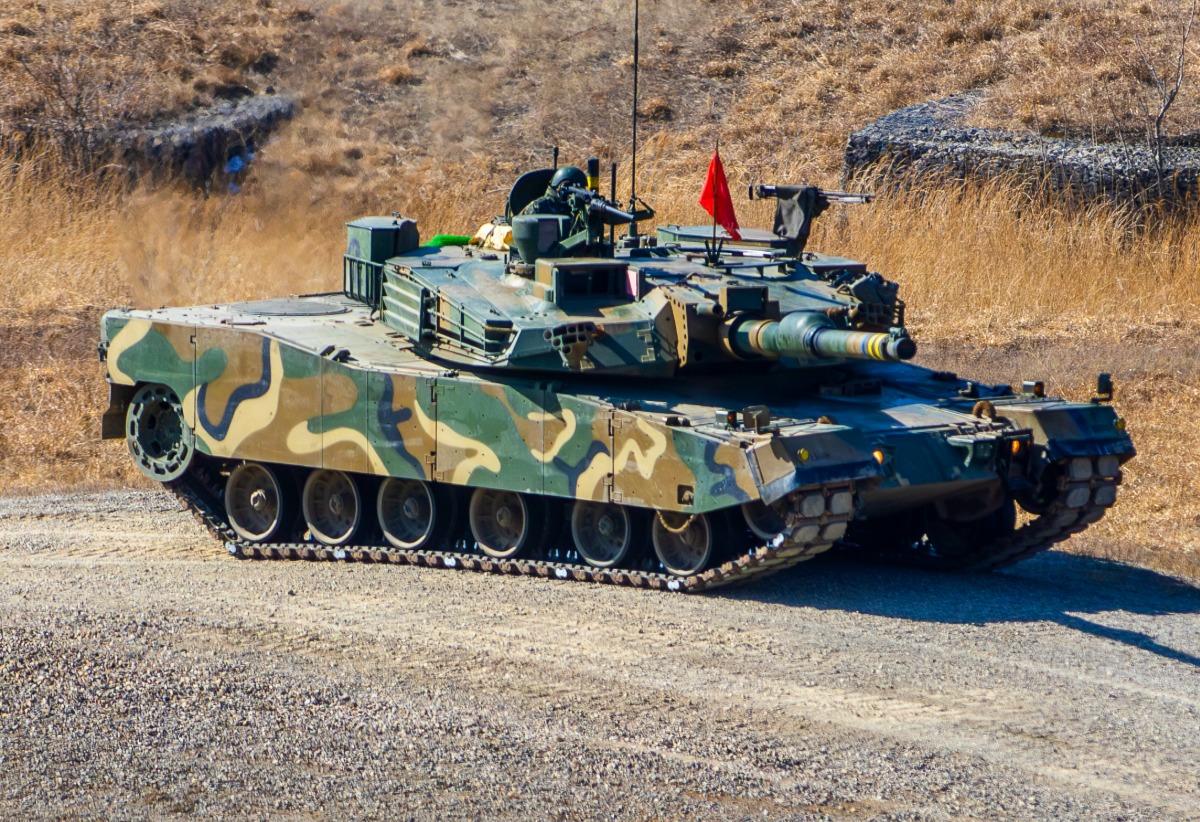
A South Korean tank crew scrambled out of their vehicle and ran for safety early Thursday after flames broke out inside one of the military’s frontline main battle tanks during a live-fire training exercise just a few miles from North Korea, though officials confirmed nobody was hurt.
A K1E1 tank operated by South Korea’s Army caught fire during live-fire drills in the border city of Pocheon, with the blaze starting in the engine compartment, the section at the rear of the vehicle housing the diesel powerplant that drives the tank, according to officials. The tank belonged to the 5th Armored Brigade of South Korea’s 5th Corps, and the fire broke out at the Seungjin Fire Training Field in Pocheon, a training area located roughly 25 kilometers (15.5 miles) south of the inter-Korean border, a stretch of the peninsula where South Korean and American forces routinely conduct combat training given its proximity to North Korean territory.
Troops aboard the tank immediately fled the vehicle once the fire started, and officials confirmed no casualties resulted from the incident, a fact that speaks to how quickly the crew recognized the danger and evacuated rather than attempting to fight the fire from inside. Military officials and firefighting authorities are now investigating the exact cause of the blaze and have said they plan to take appropriate follow-up measures once that investigation is complete, though officials have not yet indicated whether the fire points to a mechanical defect specific to this tank, a broader maintenance issue affecting the wider fleet, or simply an isolated equipment failure unrelated to any systemic problem.
The K1E1 sits within a tank family that traces its roots directly back to American armor technology, a lineage that explains why the vehicle has earned the nickname “baby Abrams” among military enthusiasts for its close visual and design similarity to the U.S. Army’s M1 Abrams. Chrysler Defense, the company later absorbed into General Dynamics Land Systems, originally designed the K1 in the early 1980s using technology developed during the American XM1 program that also produced the Abrams, and Hyundai manufactured the resulting tank in South Korea starting in 1985, making the K1 the first main battle tank ever domestically produced in the country. The original K1 entered service in 1987 and eventually saw more than 1,000 units built, forming the backbone of South Korea’s armored forces for decades even as the country later developed the more advanced K1A1, K1A2, and K2 Black Panther tank variants alongside it.
The K1E1 specifically represents a performance upgrade applied to existing K1 tanks rather than an entirely new vehicle, with deliveries to South Korea’s Army beginning in 2014 and continuing in phases since then. Unlike the K1A1 and K1A2 variants, which were upgraded to fire a larger 120-millimeter (4.7-inch) main gun, the K1E1 retains the original K1’s 105-millimeter (4.1-inch) KM68A1 cannon while adding digitalized and advanced key components, including digital battlefield management systems that let crews share targeting and positioning data electronically, identification friend-or-foe equipment designed to help distinguish allied vehicles from enemy ones in the chaos of combat, and surveillance cameras mounted at the front and rear of the vehicle to improve crew awareness of the surrounding terrain. The tank weighs roughly 51 metric tons (56 short tons), carries a crew of four, and runs on a 1,200-horsepower diesel engine that gives it a top road speed of 65 kilometers per hour (40 mph) and an operational range of about 500 kilometers (310 miles) on a single fuel load, specifications that have kept the aging K1 design militarily relevant even as newer tanks have entered South Korea’s arsenal.
Pocheon itself carries particular significance within South Korea’s defense posture, functioning as a regular training ground for both South Korean forces and their American allies specifically because of how close it sits to the North Korean border. The city is home to the Rodriguez Live Fire Complex, a range where U.S. and South Korean troops have conducted numerous joint exercises in recent years, including combined arms live-fire drills bringing together armor, infantry, and attack helicopters under exercise names like CALFEX, Freedom Shield, and Warrior Shield.
Notably, American Marines conducted their own first publicly disclosed live-fire exercise using first-person view attack drones at that same Pocheon range within the same window as the K1E1 fire, working directly with South Korea’s 5th Corps, the same command the burned tank belonged to, underscoring how concentrated allied training activity has become in this particular stretch of terrain along the border in recent days.
Content preview only. Full article available at source. View Full Article
A South Korean K1E1 tank caught fire during a live-fire training exercise in Pocheon early Thursday. The crew evacuated safely, and no injuries were reported. The incident is under investigation to determine the cause of the fire, which occurred in the engine compartment of the tank.
- A South Korean K1E1 tank caught fire during live-fire drills in Pocheon.
- The fire started in the engine compartment of the tank.
- No casualties were reported as the crew evacuated quickly.
- The tank belongs to the 5th Armored Brigade of South Korea's Army.
- Investigations are underway to determine the cause of the fire.