
Japan protests as North Korea fires new ballistic missile
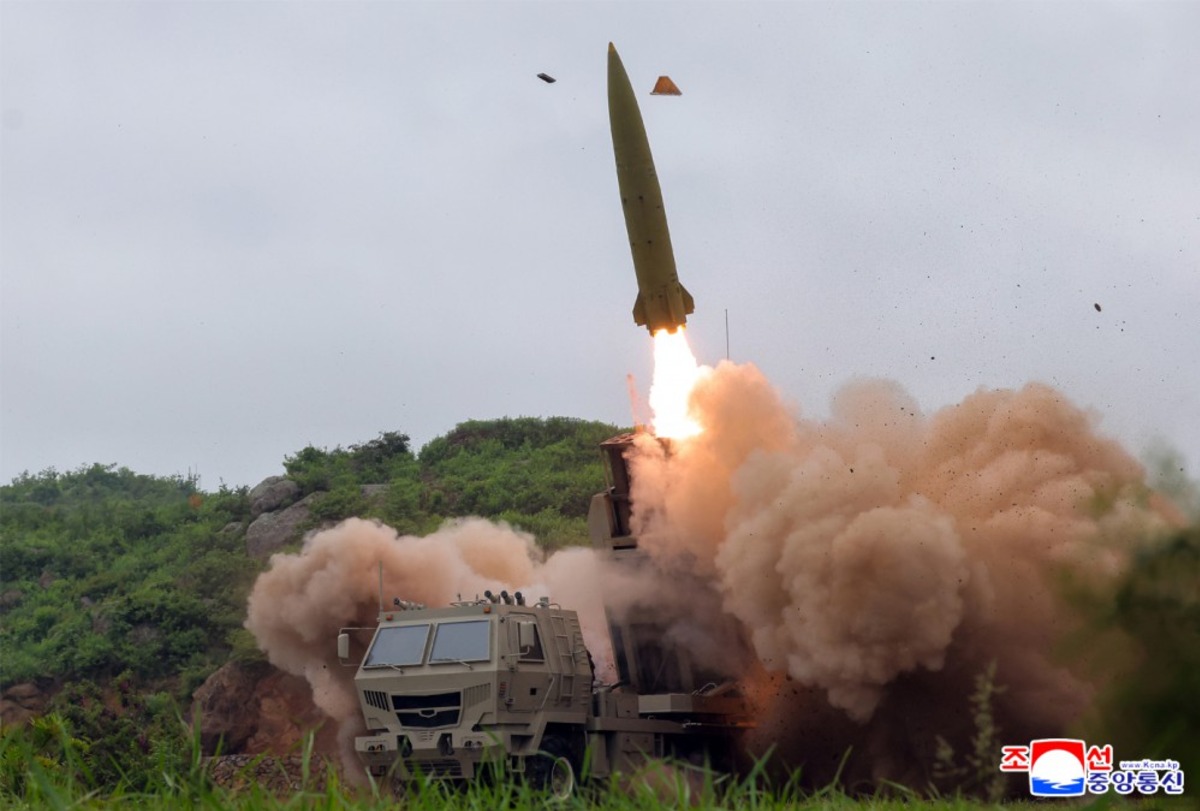
A ballistic missile alert sent Japan’s government scrambling into emergency mode on the evening of Aug. 6, triggering crisis meetings at the highest levels within minutes of the launch, even though the missile ultimately posed no direct threat to Japanese territory.
Japan’s Ministry of Defense and Cabinet Secretariat announced that North Korea launched at least one ballistic missile at approximately 5:02 p.m. local time on Aug. 6, 2026, with the projectile estimated to have fallen near the eastern coast of the Korean Peninsula rather than anywhere close to Japan, according to the government’s own timeline of the incident.
The ministry’s alert system moved fast: an initial warning at 5:07 p.m. flagged the possible launch, a follow-up just 15 minutes later confirmed no impact was expected on the area surrounding Japan, and a subsequent update at 5:29 p.m. specifically for press purposes stated the missile had not been confirmed to enter Japan’s exclusive economic zone, the stretch of ocean extending 200 nautical miles (370 kilometers) from the country’s coastline where Japan holds special rights over marine resources.
That rapid sequence of alerts reflects how seriously Japan treats any North Korean missile launch regardless of where the weapon ultimately lands, since a ballistic missile follows a high, arcing trajectory powered by rocket engines rather than the sustained, lower-altitude flight of a cruise missile, making its exact path harder to predict in the crucial first minutes after launch. Japan, the United States, and South Korea began closely coordinating their intelligence and analysis immediately, and by the time the government issued its fuller follow-up statement at 6:45 p.m., officials had confirmed no aircraft or vessels operating in the area had reported any damage from the launch.
Japan’s prime minister received an immediate briefing on the launch and issued three specific instructions to his government, according to the ministry’s statement: dedicate full effort to gathering and analyzing information while providing the public with swift and accurate updates, thoroughly confirm the safety of aircraft and vessels operating in the region, and maintain complete readiness in case the situation escalated unexpectedly. The government activated its North Korea Situation Response Office inside the Prime Minister’s Office Crisis Management Center, a body specifically designed to consolidate information from across multiple ministries during exactly this kind of fast-moving security incident, and convened an emergency response team to coordinate the government’s reaction in real time.
Japan’s defense minister, acting on the prime minister’s instructions, issued two additional directives to the Ministry of Defense specifically: maintain close coordination with the United States and South Korea while dedicating full effort to gathering and analyzing information, and continue maintaining complete vigilance and surveillance readiness in case of any unexpected developments. The government’s statement went further than simply describing the technical details of the launch, characterizing the broader pattern of North Korean missile testing, including this launch and the country’s repeated prior launches, as a threat to the peace and safety of Japan, the surrounding region, and the international community. The statement also noted that such ballistic missile launches violate relevant United Nations Security Council resolutions, which have prohibited North Korea from testing ballistic missile technology since the early 2000s given its potential connection to the country’s nuclear weapons program, and the Japanese government confirmed it had lodged a formal protest with North Korea and condemned the action in the strongest terms.
Thursday’s launch landed within a broader pattern of recent tension between Japan and North Korea that gives the timing added weight. The launch came roughly a day after North Korea reportedly warned it would pursue unspecified additional military options in response to Japan’s expanding defense capabilities, and it also followed by one day Japan’s commemoration of the 81st anniversary of the atomic bombing of Hiroshima, a coincidence of timing that inevitably drew attention even though North Korea’s state media did not explicitly link the launch to that anniversary. Separately, Japan’s Nippon reported that Defense Minister Shinjiro Koizumi confirmed Japan had lodged its protest through diplomatic channels in Beijing, a routing that reflects the reality that Japan and North Korea maintain no direct diplomatic relations, forcing Tokyo to route formal complaints through China, one of Pyongyang’s few remaining diplomatic partners with an active channel to both governments.
Content preview only. Full article available at source. View Full Article
North Korea launched a ballistic missile on August 6, 2026, which fell near the eastern coast of the Korean Peninsula. Japan's government activated emergency protocols, confirming no threat to its territory. Japan lodged a formal protest through diplomatic channels in Beijing, citing the launch as a violation of UN Security Council resolutions and a threat to regional peace.
- North Korea launched a ballistic missile on August 6, 2026.
- The missile fell near the eastern coast of the Korean Peninsula.
- Japan's government activated emergency protocols in response to the launch.
- Japan lodged a formal protest with North Korea through diplomatic channels in Beijing.
- The launch is part of a broader pattern of North Korean missile testing.