
Taiwan's First 32 Rocket HIMARS Drill Shows Why 111 Launchers Still May Not Be Enough
 Marcus Chen
Taiwan's First 32 Rocket HIMARS Drill Shows Why 111 Launchers Still May Not Be Enough
Thirty-two rockets actually left the rails. Taiwan planned to fire 36 from six M142 High Mobility Artillery Rocket System launchers near the mouth of the Dajia River on June 10, but four rounds failed to launch or misfired, according to Taiwan's own reporting. That is not a scandal. It is the useful part of the drill. Paper deterrence always looks cleaner than wet launch sites, tired crews, traffic control, ammunition handling, and a cross-strait target set that does not wait politely for a second salvo.
The Republic of China Army's first HIMARS live-fire exercise from Taiwan's west coast mattered because it moved the system from abstract procurement into the geography that would decide an invasion fight. Previous firings were easier to treat as weapons qualification. This one pointed into the Taiwan Strait, from the side of the island where Chinese amphibious forces would have to cross roughly 110 miles of water and then survive the landing zone.
The Drill Was Small But Operationally Honest
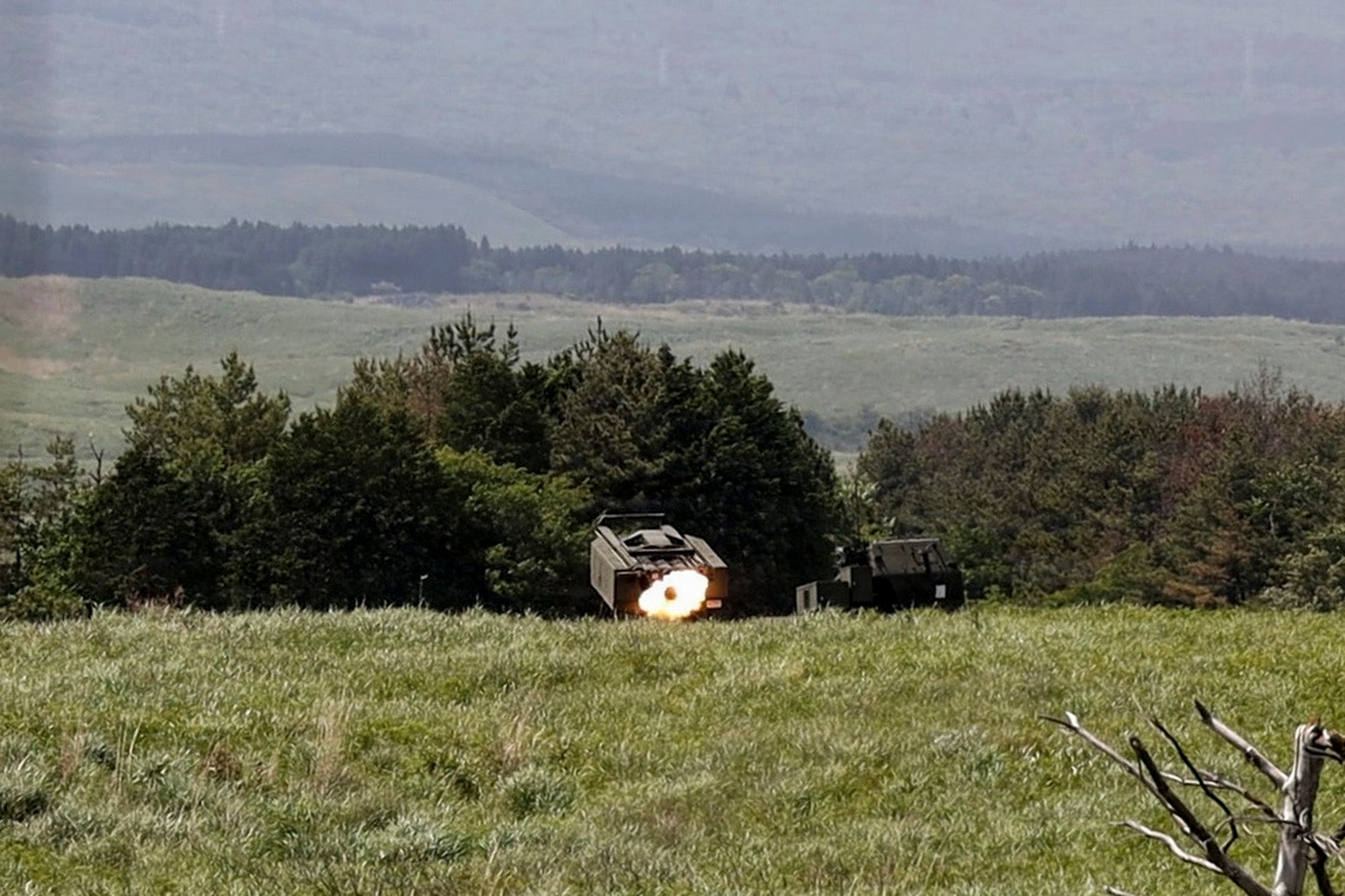
Taiwan's Ministry of National Defense said the HIMARS launchers rehearsed firing missions and rapid redeployment, with vehicles moving to new positions within three minutes of launch. USNI News reported that the exercise was designed to validate precision strike and mobile fires. Taipei Times added the useful tactical detail: the 58th Artillery Command placed three launchers on each side of the Dajia River, each carrying six M28 reduced-range practice rockets, and planned three firing waves.
That geometry is the point. HIMARS is not a coastal artillery piece. It is a road-mobile launcher that carries either six Guided Multiple Launch Rocket System rockets, two Precision Strike Missiles, or one ATACMS missile, according to Lockheed Martin. The launcher is valuable only if Taiwan can keep it moving, keep it supplied, and keep the fire-control network alive after Chinese missiles start hitting bridges, ports, depots, radars, and command posts.
Anyone who has served on a ship in the western Pacific understands the tyranny of short distances. The Taiwan Strait is narrow enough for Chinese aircraft, drones, rockets, and electronic warfare to compress warning time. It is also wide enough that an invasion fleet would be exposed for hours if Taiwan can locate it and mass fires. HIMARS sits exactly inside that problem. It gives Taiwan a way to hit ships, beachheads, staging areas, and command nodes without trying to match the People's Liberation Army platform for platform.
The Launcher Count Is Not the Real Count
Taiwan's HIMARS force is growing fast on paper. USNI reported that Taipei wants a force of 111 HIMARS after an additional 82-launcher request. The Defense Security Cooperation Agency's December 2025 notification described an estimated $4.05 billion package for 82 M142 launchers, 420 M57 ATACMS missiles, 756 M31A2 GMLRS unitary pods, and 447 M30A2 alternative warhead pods. Add that to earlier procurement and the headline number looks serious.
But the battlefield number is not 111. The battlefield number is how many launchers can be hidden, cued, fueled, reloaded, and moved after the first Chinese strike wave. A HIMARS launcher without fresh pods is an expensive truck. A pod without targeting is stored metal. A firing unit stuck in traffic near a known bridge is a target. The June 10 drill showed three-minute displacement, which is good. It did not prove reload throughput under missile attack, nor did it prove that Taiwan can sustain dozens of dispersed launchers during the first 72 hours of a blockade or landing attempt.
The four failed rounds matter in that context. Four failures out of 36 planned rockets is not enough to condemn the system, especially with practice ammunition. It is enough to remind planners that precision fires are not magic. If Taiwan needs to break up a landing force in several windows, it cannot assume every launcher fires, every rocket leaves, every data link works, and every road remains open.
Washington Is the Other Bottleneck
The drill also landed in a bad political moment. The Associated Press reported this week that Taiwan's representative in Washington, Alexander Yui, said the island still needs U.S. weapons as a $14 billion arms package remains in limbo. Al Jazeera, citing Reuters and AFP, reported President Lai Ching-te's appeal for approval of the package as soon as possible. That package is not just a diplomatic token. It is part of the munition depth problem.
This is where the usual Taiwan debate gets lazy. Washington likes to tell Taipei to buy asymmetric weapons. Taipei is now doing exactly that: mobile rockets, drones, coastal missiles, air defense, and hard-to-kill fires. But asymmetric defense still requires an industrial base. The United States cannot urge Taiwan to become a porcupine and then treat quills as a bargaining chip with Beijing or as a bill-payer for another theater.
There is also a munitions math problem. The DSCA package's 756 M31A2 pods and 447 M30A2 pods sound large. Each HIMARS pod contains six rockets. Spread across 111 launchers, that inventory gives depth, but not endless depth, especially if Taiwan uses rockets for suppression, counter-battery fire, landing-zone disruption, and follow-on strikes against assembly areas. ATACMS adds range, but 420 missiles are a finite magazine against a PLA target set that includes ports, airfields, missile brigades, logistics nodes, amphibious ships, and command infrastructure across a vast coastline.
China Will Adapt to the Lesson
Beijing will not ignore the Dajia River drill. The PLA will study firing positions, road networks, sensor signatures, and likely reload points. It will assume Taiwan wants to make the western coast too expensive to cross, then design countermeasures: drones to hunt launchers, electronic attack against command links, ballistic missile strikes on depots, and political warfare aimed at slowing future U.S. deliveries.
Taiwan's answer cannot be simply buying more launchers. It needs decoys, hardened storage, redundant communications, local repair capacity, and enough trained crews to keep launchers cycling after losses. It also needs civil-military coordination because the best firing positions on Taiwan's west coast sit among towns, farms, rivers, bridges, and ports. The June drill's use of local support was not a public relations detail. It was part of the military problem.
The right conclusion is narrow but important. Taiwan's first west-coast HIMARS firing was a real step toward a more credible denial defense. It was not proof that Taiwan can stop an invasion. The system gives Taipei a sharper knife; it does not solve targeting, survivability, reloads, or U.S. delivery politics.
If Washington wants Taiwan to deter China without immediate U.S. intervention, this is the bill: launchers, rockets, spare parts, training time, hardened logistics, and political consistency. Thirty-two rockets in the Strait are a start. They are not yet a war plan.
Sources
- USNI News on Taiwan's June 2026 HIMARS live-fire drills
- Taipei Times on Dajia River HIMARS firing positions and rocket counts
- DSCA December 2025 notification for Taiwan HIMARS and munitions package
- Lockheed Martin HIMARS munition configuration data
- Associated Press on Taiwan's $14 billion arms package concerns
Taiwan conducted a live-fire exercise with 32 HIMARS rockets near the Dajia River on June 10, 2026, validating its precision strike capabilities. Four rockets failed to launch, highlighting logistical challenges. The Republic of China Army aims to expand its HIMARS force to 111 launchers, but faces issues with supply and rapid redeployment under potential attack. U.S. military support remains crucial for Taiwan's defense strategy.
- Taiwan conducted a live-fire exercise with 32 HIMARS rockets on June 10, 2026.
- Four rockets failed to launch during the drill.
- Taiwan aims to acquire a total of 111 HIMARS launchers.
- The exercise validated rapid redeployment and precision strike capabilities.
- Taiwan's HIMARS force faces logistical challenges and needs U.S. support.