
Ten Chinese Navy Type 055 Destroyers Pass Through Three Waterways Around Japan, Intensifying Surveillance of the First Island Chain
 Tanaka Takashi
Ten Chinese Navy Ships Including Type 055 Pass Through Three Waterways Around Japan, Pressuring First Island Chain Surveillance
In the days leading up to the end of June, among the ship silhouettes successively announced by Japan's Joint Staff Office, what caught my attention was not the 106th ship "Yen'an," but the width of the group of vessels that passed through multiple waterways in the southwestern islands almost simultaneously. According to Stars and Stripes, from June 26 to July 1, ten ships of the Chinese Navy passed through straits around Japan, with several reportedly heading towards the Pacific Ocean.
Simply counting the number of ships, it would be prudent not to immediately label this a crisis. However, this movement specifically indicated the surveillance burden on the first island chain that Japan has long anticipated, including three southwestern routes: the Miyako Strait, the Osumi Strait, and the waters between Amami Oshima and Yokodate Island.
Dispersed Passage Through Three Waterways
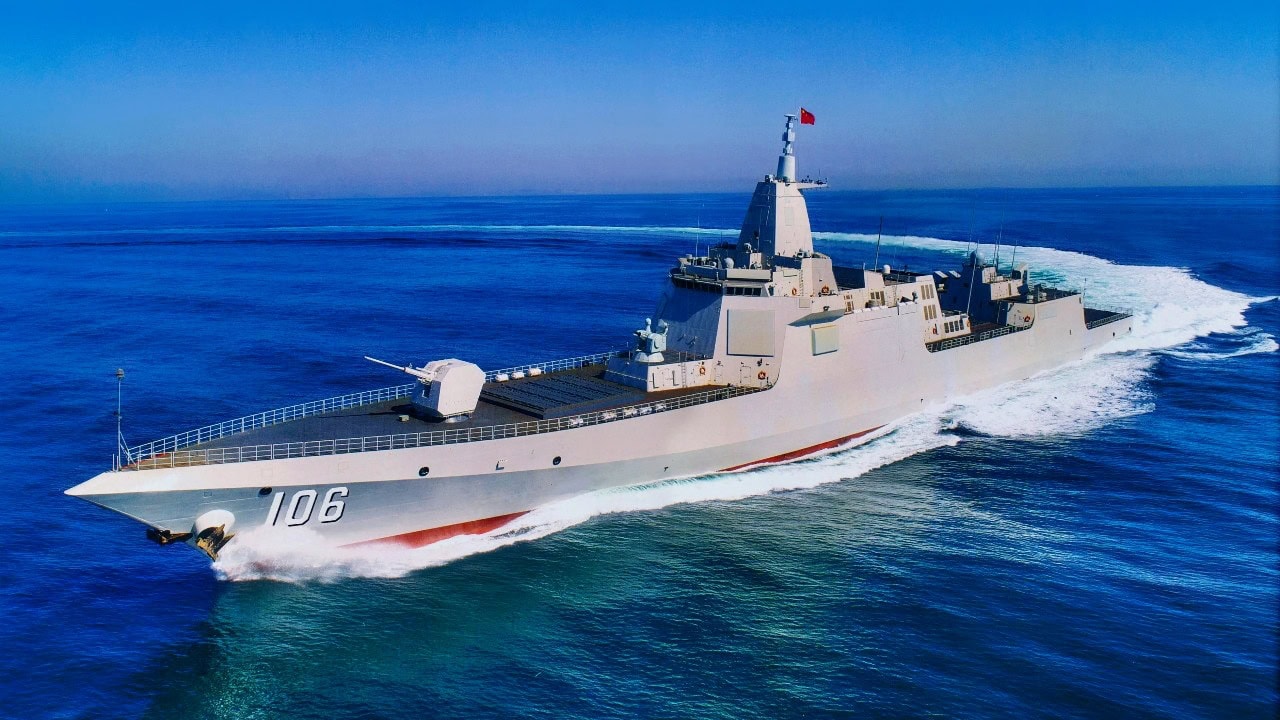
Reports indicate that the 054A-class "Anyang" and the 052D-class destroyer "Dongguan" passed through the Miyako Strait, while the 052D-class "Suzhou" and the intelligence-gathering ship "Tianshuxing" passed between Amami Oshima and Yokodate Island. Additionally, the 054A-class "Yancheng" and the supply ship "Dongpinghu" passed through the Osumi Strait, followed by the 055-class "Nanchang" and the 052C-class "Xi'an." Movements of the 052D-class "Guiyang" and "Xining" were also confirmed around Tsushima.
What is important is that this was not a flashy display of a single fleet action, but rather a form that flowed multiple types of ships through separate corridors. If the 055-class large destroyers, 052D-class destroyers, 054A-class frigates, supply ships, and intelligence-gathering ships are mixed, Japan's P-1 patrol aircraft, escort ships, coastal radar, and communication systems will be forced to make priority judgments rather than just tracking.
Chinese Explanation and Japanese Awareness of Issues
Global Times reported that, according to Chinese experts, these passages are legitimate and normal high-seas training in international straits, arguing that Japan is overreacting. The paper further noted that the newly constructed 055-class "Dongguan" was quickly deployed for high-seas training, reflecting the speed of the Chinese Navy's equipment transition.
This explanation needs to be read with a discount on the political expressions from the Chinese side. Nevertheless, the facts regarding capabilities cannot be overlooked. The 055-class is a large surface combatant of around 10,000 tons, capable of wide-area air defense, anti-ship, land attack, and command and control. When combined with the 052D-class, the fleet's air defense and sensor network possess a quality different from that of the Soviet Pacific Fleet during the Cold War.
The issue is not only what the Chinese Navy intends. It is also about how many days and with what accuracy Japan can continue to track simultaneous passages.
Temporal Overlap with Valiant Shield 26
The U.S. Navy announced that it conducted Valiant Shield 26 from June 22 to July 1 in the waters around Guam, the Northern Mariana Islands, Japan, and the Mariana Islands. From 2024 onwards, this exercise is expected to strengthen its multilateral and multi-domain nature, and it is said that Japan's Self-Defense Forces were deeply integrated into the planning and execution.
There is no definitive evidence that this schedule was completely linked to the passage of Chinese vessels. Rather, as officials from the Joint Staff Office explained regarding the movements of Russian vessels, stating that "it is not a joint exercise," there may be incidental overlaps. However, from the perspective of the Japan Maritime Self-Defense Force, alliance exercises and surrounding surveillance do not fall into separate categories. This is because the units participating in training, those assigned to continuous monitoring, vessels under maintenance, and crew rest are all allocated from the same limited pool.
Implications for SLOC Defense
The waterways around the southwestern islands are not just routes for a Taiwan contingency. For Japan, they are nodes of SLOC (Sea Lines of Communication) connecting energy transport from the Middle East, commercial shipping routes with Southeast Asia, and the rear deployment of U.S. forces. If the Chinese Navy combines not only the Miyako Strait but also the Osumi, Amami areas, and Tsushima, Japan will be forced to return to the old question of "where to prioritize surveillance."
In my view, the passage of these ten ships is more a training exercise that undermines peacetime surveillance capabilities than a precursor to war. The passage of vessels itself is not immediately illegal under international law. That is precisely what makes it troublesome. While Japan finds it difficult to take strong action, neglecting surveillance could lead to losing track of activity patterns.
Overlooked Vulnerabilities
Discussions in Japan often focus on the range of the Type 12 surface-to-ship guided missile and the possession of counterattack capabilities. However, in response to simultaneous use of multiple waterways like this, the speed of identification, tracking, sharing, and political judgment is more critical than missile range. Even if P-1 patrol aircraft and escort ships confirm the silhouettes of vessels, if that information is reflected late in the integrated operational picture of Japan and the U.S., tactical advantages could be lost in a short time.
The real challenge is not that Chinese vessels passed through the waters around Japan. The issue lies in the fact that actions that appear legal in peacetime can become almost indistinguishable from operational preparations just 48 hours before a crisis.
Sources: Stars and Stripes, Global Times, U.S. Navy public release on Valiant Shield 26.
Ten Chinese Navy vessels, including Type 055 destroyers, passed through the Miyako Strait, Osumi Strait, and between Amami Oshima and Yokoto Island from June 26 to July 1, 2023. This movement increased surveillance pressure on Japan's first island chain. The vessels included various classes, indicating a coordinated naval operation. Chinese experts described the passage as a routine training exercise.
- 10 Chinese Navy vessels, including Type 055 destroyers, passed through three straits near Japan.
- The vessels included Type 052D destroyers and Type 054A frigates.
- The movement occurred from June 26 to July 1, 2023.
- The passage through these straits increases surveillance pressure on Japan's first island chain.
- The operation is described as a legitimate and routine high-seas training by Chinese experts.