

Summary and Key Points: The Raptor lost its planned IRST to post-1991 budget cuts, leaving it unable to find ground targets through the War on Terror while the Su-57 and J-20 got IRST from the start. A clean F-22 reaches about 590 nautical miles; Lockheed Martin says the new tanks push combat range to 850, bridging to the F-47.
The F-22 Raptor Range Flaw?
In March of this year, California-based aviation photographer Jarod Hamilton got some good photos of the F-22 Raptor in its latest configuration.
The photos show the F-22 with new stealthy external fuel tanks and external pods reportedly housing infrared search-and-track (IRST) sensors or other optical targeting systems.
While this isn’t the first time the F-22 has flown with these systems, Hamilton’s photos offer observers the best view yet of the aircraft’s new layout.
These new systems address several long-standing deficiencies in the F-22 that have historically limited its versatility.
However, with the F-47 not expected until the 2030s, the F-22 is receiving these upgrades as a stopgap between the fifth and sixth generations.
Addressing the F-22’s Current Deficiencies
Early in the F-22’s development, the aircraft was originally supposed to receive IRST systems similar to the F-35’s Electro-Optical Targeting System (EOTS).
However, when the USSR collapsed in 1991, subsequent budget cuts made IRST systems too expensive to integrate into the already costly F-22 Raptor.
The lack of IRST or similar optical systems became a major Achilles’ heel for the aircraft, as it had no way to optically scan for and designate its own ground targets.
Consequently, in the subsequent War on Terror (GWOT), the F-22 had fairly limited strike capabilities, rendering it virtually useless against enemies without an air force.
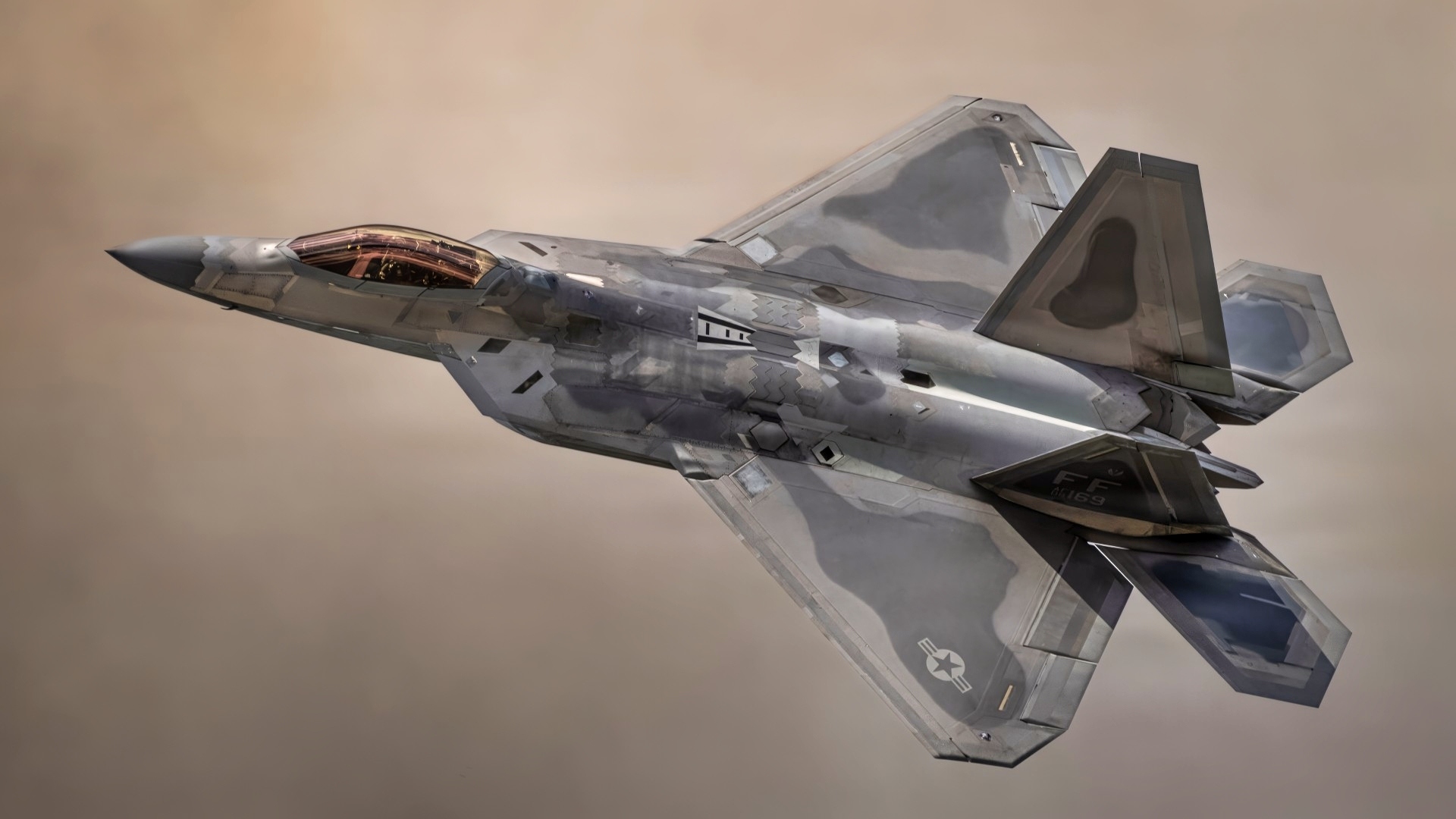
U.S. Air Force Capt. Nick “Laz” Le Tourneau, pilot and commander of the F-22 Raptor Aerial Demonstration Team, performs for the Naval Air Station (NAS) Oceana Air Show, Virginia Beach, Va., Sept. 20, 2026. For more than 70 years, the NAS Oceana Air Show has been a cornerstone of the Virginia Beach community, strengthening the bond between our warfighters and the community we proudly serve. This year’s theme, “Celebrating 250 Years of America,” honors our nation’s founding, its enduring legacy and the generations of men and women who have answered the call to serve and defend it.(U.S. Navy Photo by Mass Communication Specialist Seaman Cierra Middleton)
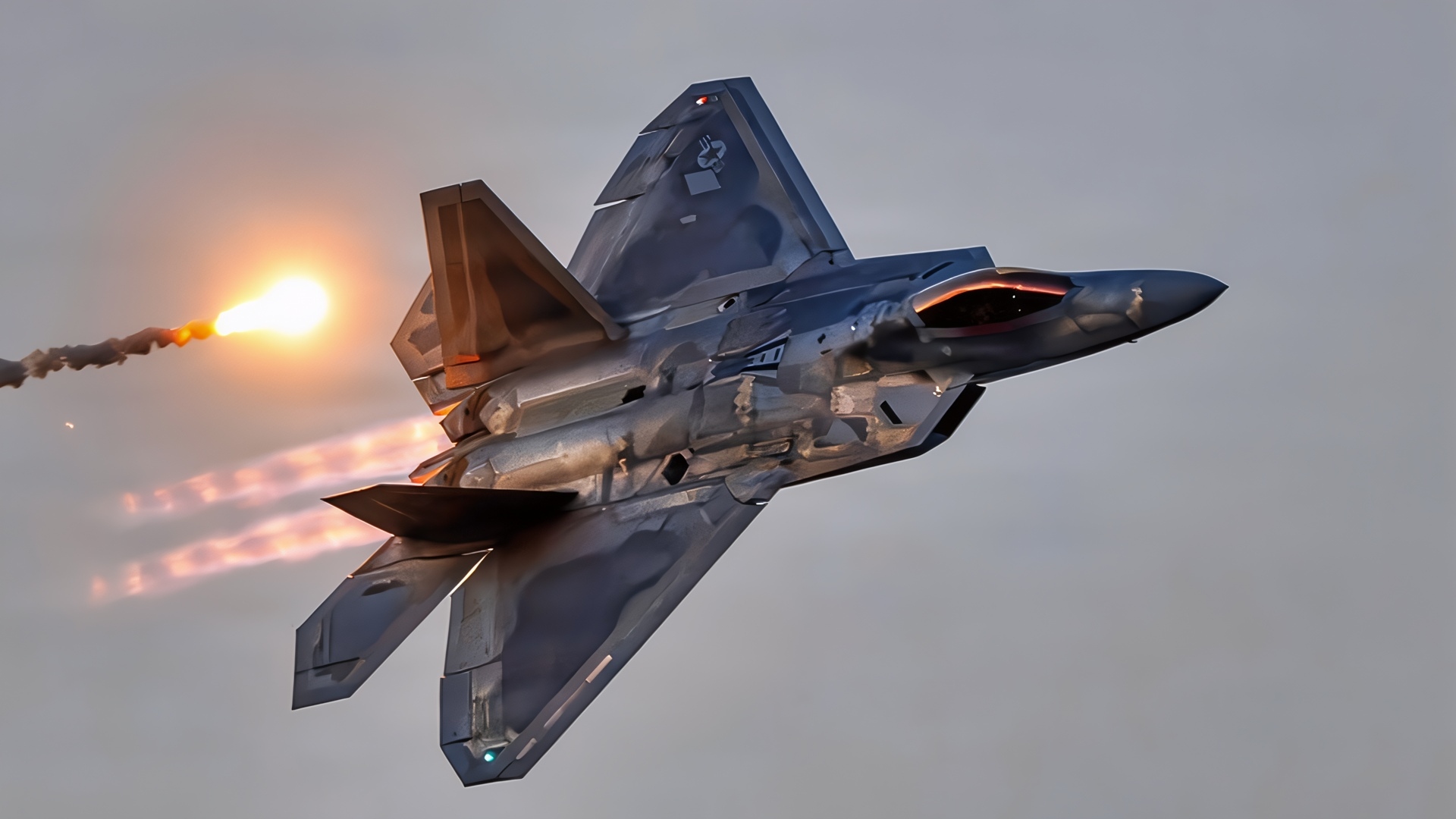
U.S. Air Force Capt. Nick “Laz” Le Tourneau, pilot and commander of the F-22 Raptor Aerial Demonstration Team, flies over Virginia Beach, Virginia, Sept. 19, 2026. The flyover occurred as part of the Naval Air Station Oceana Air Show “Beach Blast”. The event included a free concert with the U.S. Fleet Forces Band, a parachute jump from Skydive Suffolk and flyovers from VFA-106 Rhino Demonstration Team and the F-22 Demo team. (U.S. Air Force photo by Staff Sgt. Mary Bowers)
Later upgrades integrated GPS- or laser-guided munitions, but compared to most other aircraft, the Raptor was seen as a one-trick pony, whose one trick was not particularly useful.
Integrating IRST pods became one of the most pressing needs for the F-22, especially as enemy stealth fighters like the Su-57 and the J-20 received IRST capabilities from the get-go.
The new equipment pods appear to have a similar shape, although one seems to have a transparent section at the front, likely for IRST or similar optical systems.
The other likely provides electronic warfare (EW) capabilities, or houses electronic equipment to enable networking with collaborative combat aircraft (CCAs), another goal of upcoming Raptor upgrades.
Both pods feature a carefully shaped design, allowing the F-22 to retain its low observability while carrying them.
However, adding IRST is likely to affect the Raptor’s stealth characteristics, though probably not significantly.
Increasing the Raptor’s Range
Range has historically been another limitation on the F-22.
Currently, a clean Raptor has a combat range of around 590 nautical miles, which is considerably low for a fifth-generation aircraft.
For comparison’s sake, the Su-57 has a combat range of 670 nautical miles, while the J-20 has an estimated combat radius of 1,100 nautical miles.
With non-stealthy fuel tanks, the F-22 increases its range to 750 nmi, though these are typically used for ferry flights rather than combat missions.
According to Lockheed Martin, the new stealth drop tanks increase the aircraft’s combat range up to 850 nmi and can be used in combat.
The fuel tanks can also be jettisoned if necessary, although the plan is to retain them throughout the mission for reuse.
The new drop tanks are designed to fit the F-22 without compromising its stealth profile. The tanks feature specialized stealth shaping to reduce their radar cross-section.
At the same time, the pylons they are fitted to are meticulously blended into the aircraft to avoid gaps and radar spikes.
The tanks, along with the sensor pods, are also likely coated with radar-absorbent materials (RAM) to further improve their stealth profile.
Overall, the new stealth pods are a much-needed improvement for the F-22, especially when operating over the vast Pacific Ocean.
They allow the aircraft to cover greater distances without compromising its stealth, which is especially handy in a confrontation with China.
The Past, Present, and Future King of the Skies
Recently, the F-22 has become the USAF’s center of attention, partly because of China’s rise as a near-peer competitor.
Originally, the Air Force planned to retire the Raptor slowly, but with the return of great-power competition and delays in the Next-Generation Air Dominance (NGAD) program, the F-22 has found a second life as a stopgap ahead of the eventual F-47.
Although designed in the 80s/90s, the F-22 remains one of the world’s most advanced fighter jets.
Its stealth and sensor-fusion capabilities are second only to the F-35, and its air-superiority capabilities remain unmatched.
The latest upgrades ensure the F-22 remains in service into the 2030s while remaining the dominant force in the skies. Although the Raptor was arguably one of the most advanced fighters in the world, the aircraft still left some room for improvement.
The exclusion of IRST capabilities and its shorter range, for example, straight up hindered its performance and versatility across the board.
Now, however, these deficiencies are being addressed.
The USAF currently has further plans to expand the F-22’s capabilities by making it compatible with loyal wingmen CCAs.
The service plans to integrate new systems that will enable the F-22 to control unmanned aircraft such as General Atomics’ YFQ-42A and Anduril’s YFQ-44A, both of which are currently under development.
About the Author: Isaac Seitz
Isaac Seitz, a Defense Columnist, graduated from Patrick Henry College’s Strategic Intelligence and National Security program. He has also studied Russian at Middlebury Language Schools and has worked as an intelligence Analyst in the private sector.